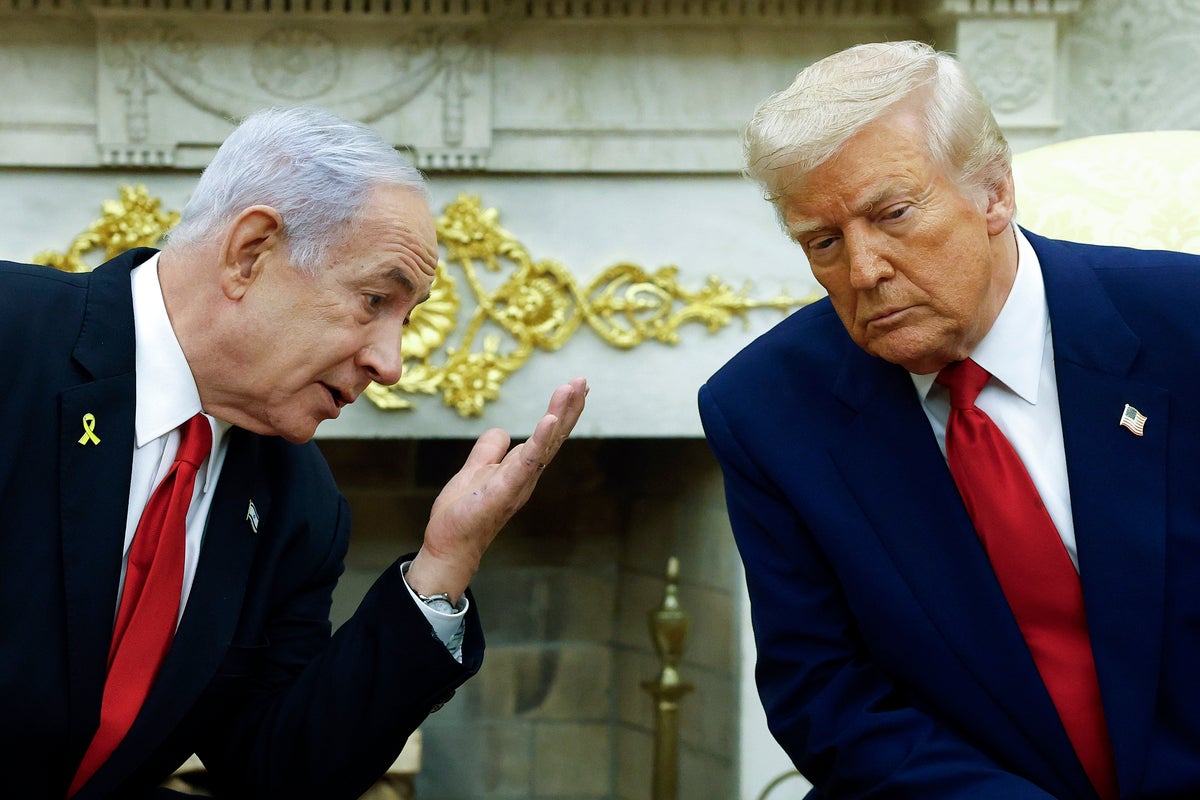
Diplomatic initiatives fail when the sequencing of security guarantees contradicts the domestic survival incentives of the participating actors. The breakdown of the United States-backed Board of Peace roadmap for Gaza, catalyzed by Israeli Prime Minister Benjamin Netanyahu’s public rejection of the draft disarmament terms, offers a textbook illustration of strategic misalignment. To understand why this initiative stalled immediately after its public announcement, one must deconstruct the structural mechanics, cost functions, and sequencing failures inherent in the design of the agreement.
The Sequencing Dilemma and Commitment Problems
The core architectural flaw of the current peace framework lies in an intractable commitment problem. In game theory, when two hostile entities lack a central enforcement mechanism, neither party can move first without incurring existential vulnerability.
The transaction costs and risks are distributed unevenly across the operational phases of the plan:
- The Disarmament Phase: The United States and its international mediators demand that Hamas surrender light weapons, heavy weapons, and underground tunnel infrastructure to an independent administrative body.
- The Withdrawal Phase: Hamas conditions its disarmament on the complete cessation of Israeli military operations and the full withdrawal of Israel Defense Forces from the Gaza Strip.
- The Retention Phase: Israel refuses any force redeployment or territorial withdrawal from its current lines, occupying over sixty percent of the enclave, until total disarmament is fully executed.
This creates a closed loop of mutual non-compliance. Hamas calculates that surrendering its physical deterrent before an Israeli withdrawal strips away its only leverage, exposing its remaining leadership to targeted destruction. Conversely, Israel calculates that withdrawing its forces before complete demilitarization leaves its civilian population vulnerable to a reconstituted insurgency, violating the primary risk-mitigation threshold established after the events of October 7, 2023. Because both actors prioritize worst-case survival over cooperative gains, the negotiation equilibrium collapses into status-quo hostility.
The Domestic Political Cost Function
External mediators frequently underestimate how domestic political survival functions dictate foreign policy posture. Netanyahu operates within a hyper-constrained coalition dynamic where any perceived softness on security parameters invites immediate government collapse.
The political cost function can be modeled through two competing variables: international diplomatic pressure versus domestic electoral survival. With a critical domestic election cycle underway, the cost of defying Washington's diplomatic pressure is mathematically lower than the cost of alienating hardline coalition partners who view any premature military pullback as an existential capitulation.
When the Board of Peace drafted terms directly with external intermediaries and Hamas without prior structural buy-in from Jerusalem, it violated basic negotiation hygiene. Netanyahu’s public rejection—declaring that the text was "not our draft"—was a necessary signal to his domestic constituency that Israel retains unilateral veto power over its national security boundaries.
Information Asymmetry and Signaling Failures
A profound divergence in operational optics plagues the multilateral approach. The White House and the international Board of Peace operated under the assumption that a preliminary agreement with select intermediaries constituted a structural breakthrough. This reflects a fundamental failure of information processing.
International mediators treat peace negotiations as linear linear events where public momentum forces compliance. In practice, regional actors treat public announcements as tactical pressure campaigns. When Washington publicized a completed disarmament milestone prematurely, it triggered an immediate defensive response from Jerusalem to correct the information asymmetry. Israeli security officials had already submitted formal reservations through institutional channels prior to the public rollout, making the public friction an inevitable consequence of uncoordinated signaling.
Structural Variables of the Impasse
Resolving the structural gridlock requires analyzing the immutable variables governing the theater:
- Asymmetric Enforcement: International monitoring bodies lack the kinetic capacity to enforce compliance on an entrenched insurgent network or compel a sovereign military to surrender tactical high ground.
- Territorial Control Costs: Maintaining a permanent military footprint across sixty percent of Gaza strains logistical supply lines and exposes troops to asymmetric attrition, yet abandoning that footprint removes the coercive pressure required to force political concessions.
- Governance Vacuum: The proposed transition to a technocratic administrative committee remains theoretical while armed factions retain local enforcement dominance.
External actors attempting to broker a durable resolution must abandon top-down declarations that ignore these operational realities. Force projections and security architectures cannot be engineered in diplomatic isolation from the tactical incentives on the ground.
To break the current equilibrium, mediators must shift away from demanding simultaneous concessions of core survival assets. The strategic imperative moving forward requires establishing an incremental, verifiable verification protocol where microscopic, time-bound withdrawals are directly tethered to verifiable, itemized decommissioning milestones, bypassing broad political declarations in favor of strictly enforced, low-trust operational metrics.