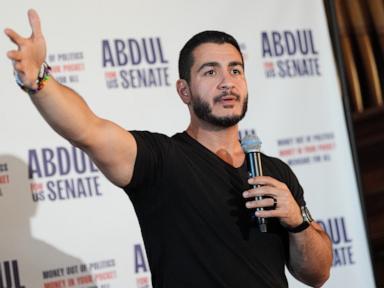
Modern political campaigns operate as competitive attention markets where signal extraction relies on strategic polarization. When conservative strategists and national Republican figures elevated Abdul El-Sayed to national prominence during the 2026 midterms, they were not merely engaging in standard partisan opposition. They were attempting to execute a classic out-group framing strategy: using an ideological outlier to define the boundaries of the opposing party's electoral coalition.
This dynamic reveals a predictable formula governing high-stakes legislative contests in electorally volatile states. Understanding how this operational model functions requires deconstructing the mechanics of target selection, narrative centralization, and the asymmetric returns of amplified opposition.
The Calculus of Out-Group Centralization
In electoral systems characterized by hyper-partisanship, political architects face a resource allocation problem. They must maximize turnout among their base while peeling away marginal voters in suburban or exurban swing districts. When a campaign chooses to make an opposing candidate the central antagonist of a cycle, it triggers a specific set of psychological and media mechanisms.
The opposition's objective rests on a simple premise: aggregate disparate policy disagreements into a single, highly personalized threat vector. By focusing media expenditure and surrogate rhetoric on an individual candidate, opponents seek to impose high information costs on the target. The strategy assumes that voters prioritize perceived cultural or ideological distance over granular economic policy.
Yet, this approach contains an inherent structural vulnerability. Centralizing attention on a single candidate transfers agency to that candidate. Instead of acting as a passive recipient of attacks, an agile campaign can convert the imposed spotlight into a megaphone for unmediated direct-to-voter communication.
The Cost Function of Amplified Opposition
When political opponents invest heavily in defining a candidate through negative framing, they inadvertently subsidize that candidate's reach. Paid media and earned media operate on different cost curves. When national surrogates and allied political action committees saturate airwaves with warnings about an opponent's ideological alignment, they eliminate the target's primary barrier to entry: name recognition.
For a progressive candidate running in a complex, diverse electorate, traditional media penetration requires substantial capital expenditure. By making the candidate the focal point of the political debate, the opposition absorbs the introductory marketing costs.
The strategic trade-off for the opposition involves diminishing marginal returns. Initial attacks solidify base opposition, but prolonged, hyper-personalized focus shifts the burden of proof. Voters begin examining the veracity of the claims, creating an opening for the targeted candidate to reframe the narrative around accessibility, retail politics, and community engagement. Rather than defending against abstract labels, the campaign pivots to physical ground games, holding hundreds of localized events across regional sub-markets.
Narrative Control and the Local-National Disconnect
A primary tension in contemporary Senate races is the divergence between nationalized media narratives and local voter priorities. National party apparatuses attempt to map uniform ideological templates onto localized contests. Conversely, successful state-level candidates deploy a decentralized operational model designed to bypass national filter bubbles.
The mechanism relies on structural redundancy: maintaining a high volume of direct physical touchpoints with constituents while simultaneously weaponizing the national attacks for fundraising and volunteer mobilization. When national figures target a candidate with severe rhetoric, the local campaign converts that hostility into social proof of political independence from establishment moneyed interests.
This creates a divergence in voter perception. While high-information partisans view the race through a nationalized ideological lens, low-information or independent voters in competitive counties evaluate candidates based on perceived authenticity and local responsiveness. If the opposition's attacks are perceived as detached from daily economic pressures, the narrative collapses under the weight of localized retail campaigning.
Strategic Execution and Downstream System Effects
The long-term consequence of elevating a polarizing figure extends beyond a single electoral cycle. When an insurgent campaign successfully absorbs aggressive opposition and converts it into a legislative victory, it alters the internal bargaining power dynamics of the governing party.
A candidate who builds a national fundraising apparatus and a localized grassroots infrastructure independent of traditional party gatekeepers enters legislative office with structural autonomy. They are less susceptible to conventional whip counts and institutional pressures.
For strategic planners observing these dynamics, the takeaway is clear. Attempting to disqualify an opponent by making them the primary character of a midterm cycle requires absolute narrative discipline. If the target possesses the organizational capacity to redistribute that attention into direct voter contact, the strategy backfires, transforming a calculated wedge issue into a vehicle for institutional disruption.


