Urban resilience under tropical cyclone stress requires an analytical evaluation of precipitation input rates versus subterranean and infrastructural drainage capacity. When a high-intensity typhoon traverses the Pacific coast toward the Kanto plain, the meteorological threat profile shifts from a generalized wind hazard to a localized hydraulic and geomechanical crisis. Deconstructing this threat demands a rigorous examination of rainfall-runoff dynamics, slope stability thresholds, and the cascading failure modes inherent in mega-city logistics.
The Hydraulic Load Function and Urban Drainage Saturation
The primary driver of urban flooding during a typhoon event is the mismatch between precipitation volume and discharge capacity. Surface water accumulation operates on a simple mass-balance equation where the rate of water entry from convective and stratiform precipitation bands exceeds the volumetric export capacity of subterranean stormwater networks.
In heavily urbanized environments like Greater Tokyo, the baseline impervious surface ratio is exceptionally high. Concrete and asphalt infrastructure eliminates natural soil infiltration, forcing 100 percent of precipitation into surface runoff channels. During peak typhoon precipitation rates—often exceeding threshold parameters of 20 to 50 millimeters per hour—regional river systems, canal networks, and underground retention basins experience severe hydraulic pressure.
The failure cascade unfolds sequentially:
- Primary drainage conduits reach 100 percent capacity, halting gravity-fed runoff from minor street-level inlets.
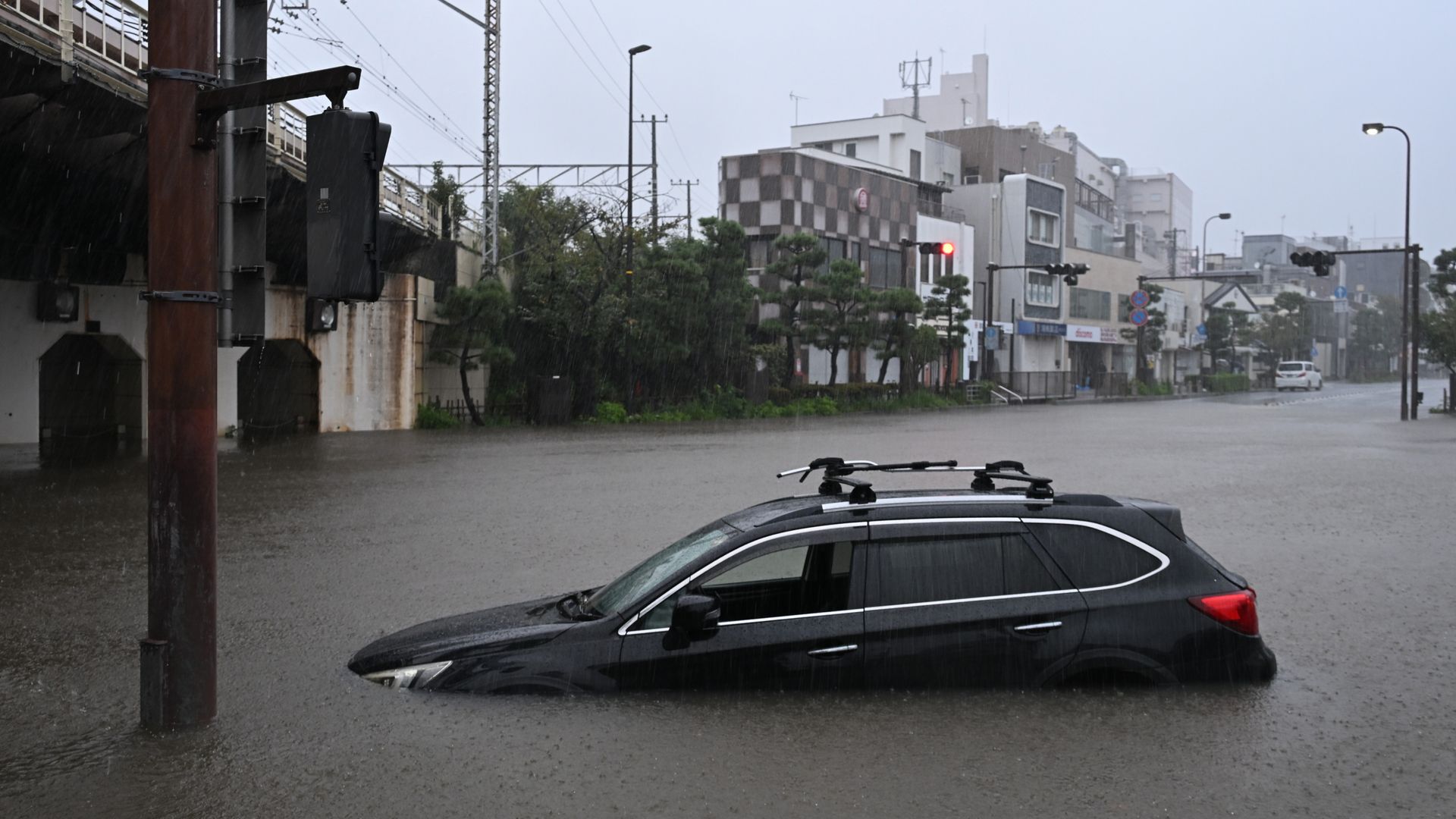
- Backpressure forces water upward through manholes and storm drains, creating localized urban pooling independent of river proximity.
- Secondary river channels reach critical warning stages, forcing municipal authorities to trigger automated diversion gates into subterranean subterranean flood-storage facilities, such as outer discharge channels.
- When storage capacity reaches saturation, uncontrolled overtopping or emergency releases threaten low-lying residential and commercial sectors.
This hydraulic bottleneck transforms arterial roadways into open-channel watercourses, rendering standard vehicular transit mechanically impossible and initiating structural transit suspensions well before wind speeds reach structural damage thresholds.
Geomechanical Failure and Slope Stability Mechanics
While urban flatlands contend with surface water accumulation, the surrounding topography—characterized by steep residential hillsides and retaining walls in prefectures such as Kanagawa and western Tokyo—faces acute geomechanical destabilization. Landslide initiation during typhoon events is governed by changes in pore water pressure within unsaturated soil matrices.
Under normal conditions, matric suction (negative pore water pressure) acts as an invisible cohesive force that maintains the shear strength of granular slopes and weathered rock formations. As continuous heavy rainfall infiltrates the upper soil mantle, the wetting front advances downward, reducing matric suction and increasing the unit weight of the soil via positive pore water pressure generation.
A slope fails when the shear stress induced by gravity acting on the saturated soil mass exceeds the available shear strength defined by the Mohr-Coulomb failure criterion:
$$\tau_f = c' + (\sigma - u) \tan \phi'$$
In this mechanical relationship, pore water pressure ($u$) increases rapidly during prolonged rainfall, directly reducing the effective normal stress $(\sigma - u)$ and driving the shear strength ($\tau_f$) toward zero. Once the safety factor drops below 1.0, translational or rotational landslides occur instantaneously. Because residential expansion in the Kanto region frequently utilizes cut-and-fill construction methods on steep hillsides, artificial earth structures and retaining walls frequently serve as the primary failure points, endangering adjacent residential foundations.
Systemic Vulnerability and Cascading Infrastructural Interdependencies
The economic and operational disruption of a metropolitan area during a severe meteorological event is rarely the result of a single physical failure. Instead, it stems from systemic interdependencies across critical infrastructure networks.
| Infrastructure Sector | Primary Failure Mechanism | Cascading Systemic Consequence |
|---|---|---|
| Mass Transit | Planned preventive suspension (Keikaku-unkyu) and track flooding | Complete immobilization of workforce mobility; stranded commuter populations |
| Power Grid | Wind-induced conductor clashing, tree contact, and substation water ingress | Loss of pumping stations, communication nodes, and traffic signaling systems |
| Logistics & Port Operations | High wave action, storm surge warnings, and crane wind-lock protocols | Disruption of maritime supply chains and inbound freight distribution |
The propagation of these failures follows a strict network-dependency hierarchy. Power grid disruptions directly disable localized pumping stations responsible for clearing subterranean water accumulation from transit underpasses, thereby compounding the spatial extent of surface flooding. Similarly, pre-emptive transit suspensions, while necessary to prevent catastrophic derailments or strandings, paralyze economic output and complicate the execution of municipal evacuation orders.
Operational Risk Mitigation and Evacuation Thresholds
Managing catastrophic risk in high-density environments relies on structured early-warning compliance rather than reactive emergency response. Japan's multi-tiered disaster alert system establishes quantitative boundaries for civic action:
- Alert Level 3: Directs the evacuation of elderly and vulnerable demographics from high-risk flood and landslide zones before mobility becomes constrained.
- Alert Level 4: Mandates total evacuation for all residents within hazard-designated footprints prior to the onset of peak meteorological forcing.
- Alert Level 5: Signifies that a disaster is actively occurring, shifting the operational priority from mass evacuation to immediate vertical survival within reinforced structures.
The efficacy of these tiers depends entirely on public adherence and the lead time of meteorological forecasting models. Because typhoon tracks exhibit velocity variance and intensity fluctuations upon interacting with coastal topography, municipal strategy must account for forecast uncertainty by maintaining high-readiness posture across emergency response assets before landfall confirmation.
Execute systematic structural audits of hillside residential retaining walls, enforce real-time hydrological telemetry monitoring at subterranean diversion bottlenecks, and align municipal transport shutdown protocols with predictive rainfall accumulation models rather than reactive wind-speed observations.