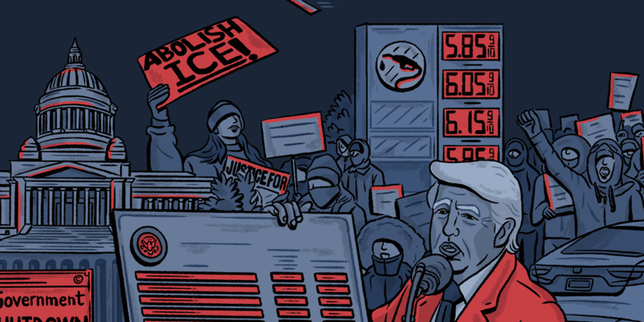
Since the end of World War II, the political party holding the White House has lost seats in the House of Representatives in 18 out of 20 midterm elections. Defying this historical gravity requires overcoming a structural defect built directly into the American electoral system, rather than merely executing a superior campaign. Conventional political journalism frames midterm cycles as a series of isolated personality clashes, localized scandals, and unpredictable swings in public mood. That framing obscures the underlying mechanics. To evaluate whether a sitting president—specifically Donald Trump in a second-term scenario—can break the midterm curse, analysts must isolate the structural variables that govern off-year turnout, economic attribution, and district-level elasticity.
The Structural Deficit of the Midterm Electorate
Midterm elections are fundamentally low-turnout events compared to presidential years, and the composition of the electorate shifts predictably. In a presidential cycle, high-salience national media coverage pulls low-propensity, peripheral voters into the booths. In a midterm cycle, those peripheral voters stay home. What remains is a smaller, older, wealthier, and more ideologically rigid electorate.
This compositional shift creates an immediate mathematical problem for a governing party whose coalition relies heavily on irregular voters. When a political movement is built around the singular charisma of a top-of-the-ticket figure, that movement suffers from a severe Turnout Transfer Deficit when the leader's name is absent from the ballot. The voters who mobilize specifically for a populist executive do not automatically transfer their enthusiasm to down-ballot congressional candidates.
This dynamic interacts with Thermostatic Public Opinion, a well-established political science model developed by Christopher Wlezien. The public treats policy like a thermostat. When the government moves policy to the right, the public’s relative preference shifts to the left, and vice versa. Voters who supported a president to correct perceived excesses of the prior administration quickly grow alienated once the new administration begins implementing its own agenda. Because the executive branch is the primary driver of national policy—and the primary target of media scrutiny—the president's party absorbs 100% of the thermostatic backlash, regardless of which party actually controls the legislative chambers.
Differential Mobilization and the Asymmetric Anger Gap
Elections are rarely won by persuading undecided voters to switch sides; modern polarization has reduced the true swing electorate to a statistical rounding error. Instead, midterm outcomes are decided by Differential Mobilization—the gap in turnout enthusiasm between the out-party and the in-party.
In political psychology, loss aversion dictates that the threat of losing something produces a stronger behavioral response than the prospect of gaining something of equal value. Once a coalition wins the White House, its voters experience a psychological state of satisfaction or complacency. The immediate threat has been neutralized. Conversely, the opposition party experiences acute loss aversion. Every executive order, judicial appointment, and cabinet confirmation acts as an ongoing stimulus that sustains opposition anger for twenty-four months.
To overcome this Asymmetric Anger Gap, a sitting president must manufacture an external threat potent enough to keep their own base in a state of defensive mobilization while simultaneously fractured enough to prevent the opposition from coalescing around a unified counter-narrative. Historically, this is nearly impossible to sustain over two years without a major national security crisis—such as the post-9/11 environment in 2002, one of the rare exceptions to the midterm rule. Absent an external shock, the governing party spends the midterm cycle playing defense across dozens of disparate local battlegrounds, while the opposition runs a single, nationalized campaign centered on checking executive power.
The Economic Attribution Fallacy
Conventional wisdom holds that "it's the economy, stupid," suggesting that strong macroeconomic indicators will insulate a president's party from midterm losses. Operational data proves this assumption is flawed. The relationship between macroeconomic performance and midterm seat retention is asymmetrical: a bad economy guarantees severe losses, while a good economy merely caps the damage rather than producing gains.
Voters evaluate economic conditions through two distinct lenses: Sociotropic (how the overall national economy is doing) and Pocketbook (how their personal household finances are faring). During midterm cycles, pocketbook realities override sociotropic data. Even if gross domestic product grows, unemployment remains low, and equity markets reach highs, persistent inflation in non-discretionary categories—housing, groceries, healthcare, and energy—creates a permanent drag on incumbent approval.
Voters do not reward the executive branch for stabilizing inflation; they punish the executive branch because price levels remain higher than they were four years prior. Because modern presidents aggressively claim credit for every positive economic data point, they inadvertently train the electorate to assign them total blame for every negative price shock. When a president campaigns on economic nationalism, tariffs, or deregulation, any resulting supply-chain friction or consumer price increases are immediately mapped back to the Oval Office. The opposition does not need to offer a coherent alternative economic plan; they only need to point to the gap between executive promises and household balance sheets.
Geographic Sorting and the Diminishing Battleground
The physical map of American congressional districts acts as a hard constraint on how far any political wave can travel. Over the past three decades, aggressive partisan redistricting and voluntary Geographic Sorting—where Americans increasingly live near people who share their political worldview—have systematically eliminated competitive House seats.
In the 1990s, over 100 House districts were genuinely competitive. Today, the number of true toss-up districts hovers between 30 and 45 out of 435. This structural rigidity alters the strategic calculus of midterm campaigns in three distinct ways:
- The Floor Effect: Because roughly 390 seats are safely locked into one party or the other via structural partisan lean, a sitting president is protected from a total legislative wipeout. Even a historic unpopular wave cannot easily flip a district with a 15-point partisan advantage.
- The Ceiling Effect: The same geographic sorting prevents the president's party from expanding its majority. When the House majority is razor-thin—often separated by fewer than ten seats—the margin for error disappears. Losing just a handful of suburban districts in states like New York, California, or Pennsylvania is sufficient to flip control of the entire chamber.
- The Suburban Elasticity Bottleneck: The remaining competitive seats are heavily concentrated in educated, affluent suburban rings surrounding major metropolitan areas. These districts exhibit high Electoral Elasticity, meaning their voters swing sharply in response to candidate quality and rhetorical tone. Populist messaging that maximizes turnout in rural, exurban districts often alienates these exact suburban swing voters, creating an intractable strategic dilemma for the governing party.
The Senate Map Asymmetry
While the House of Representatives acts as a sensitive barometer of immediate national sentiment, the United States Senate functions as a lagged, structurally biased institution. Only one-third of the Senate faces election in any given cycle, meaning the battleground is dictated entirely by which class of seats happens to be up for renewal.
This creates a sharp divergence between House and Senate outcomes. A president's party can lose 25 seats in the House while simultaneously gaining seats in the Senate if the six-year cycle exposes opposition incumbents in states that lean toward the president's party. Conversely, if the map forces the governing party to defend seats in states won by the opposition in the previous presidential race, the structural drag of the midterm environment becomes fatal.
In Senate races, candidate quality exerts far greater influence than in House races. Because statewide elections cannot be gerrymandered, candidates must appeal to a broader median voter. When a president intervenes in party primaries to elevate ideological loyalists over candidates tailored to the specific state's electorate, they introduce self-inflicted variance into the map. In a neutral or slightly favorable environment, a strong candidate can overcome a five-point partisan deficit. In a midterm environment where the president's party already faces a structural headwind, an unvetted or extreme nominee turns a winnable seat into a guaranteed loss.
Execution Risk and the Legislative Bottleneck
A president's first two years in office are defined by a race against the legislative clock. Recognizing that they will likely lose unified control of Congress in the midterms, administrations attempt to front-load their most ambitious policy priorities into the first 18 months. This operational urgency creates severe execution risks.
Passing major legislation through narrow congressional majorities requires forcing vulnerable members from swing districts to cast difficult, high-profile votes on partisan bills—whether on tax restructuring, healthcare overhauls, or immigration enforcement. Once those votes are cast, the opposition spends the next twelve months weaponizing them in targeted district-level advertising. The governing party trades future electoral viability for immediate legislative output.
If the governing party fails to pass its signature legislation due to internal factionalism, the outcome is even worse. The base becomes demoralized because promises went unfulfilled, depressing in-party turnout, while swing voters remain alienated by the chaotic governance on display in Washington. Internal party discipline thus becomes a prerequisite for midterm survival, yet narrow majorities inherently empower small factions of ideological purists to hold the legislative agenda hostage, magnifying the perception of dysfunction.
Tactical Constraints on Defying the Cycle
For a sitting president to break the historical pattern and either hold the House or minimize losses to single digits, four specific conditions must align simultaneously:
- Macroeconomic Disinflation: Real wages must outpace inflation visibly for at least three consecutive quarters prior to Election Day, shifting voter focus from price levels to purchasing power.
- Opposition Fragmentation: The out-party must fail to unify around a single message, ideally bogged down by internal ideological warfare between its moderate and radical wings, which dilutes their ability to present a credible governing alternative.
- Candidate Discipline: The president's party must nominate pragmatic, locally tailored candidates in the 35 competitive House districts and key Senate battlegrounds, avoiding primary battles that drain financial resources and alienate median voters.
- Turnout Engineering: The governing party must build a ground-game infrastructure capable of identifying and physically moving low-propensity, presidential-only voters to the polls without relying on the president's name being on the ballot.
Even if an administration executes all four tactics flawlessly, historical precedent demonstrates that structural forces usually overpower campaign mechanics. Midterms are not referendums on a candidate's future vision; they are retrospective audits of executive performance conducted by an electorate skewed toward grievance.
The Strategic Reality for the Governing Coalition
Campaign strategists routinely overestimate their ability to message their way out of structural deficits. No amount of digital ad spending, rally attendance, or earned media dominance can alter the fundamental math of off-year electorate composition or thermostatic public opinion.
The optimal strategic play for a second-term administration facing a midterm cycle is not to attempt a miraculous expansion of its congressional map, which wastes capital on unwinnable territory. Instead, the governing coalition must execute a Defensive Triage Strategy. Capital, executive visits, and organizational infrastructure must be ruthlessly concentrated on the roughly 30 suburban House districts that represent the true tipping point of legislative control, while writing off offensive targets that require double-digit swings. Simultaneously, the administration must shift its executive posture from disruptive ideological restructuring to visible administrative competence at least nine months prior to November, starving the opposition of the daily controversies required to sustain their asymmetric anger gap.