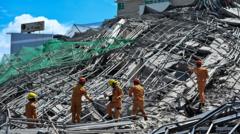
The headlines are predictable. They lead with "Tragedy," "Act of God," or "Nature’s Fury." They focus on the frantic scratching at the rubble and the desperate prayers of the families. This is the lazy consensus of disaster reporting in the Philippines. It frames the collapse of a building as an unfortunate collision between human life and an unstoppable geological force.
It’s a lie.
When a building pancaked in the Philippines—whether it’s the Chuzon Supermarket in Porac or the next inevitable mid-rise in a secondary city—it isn't a natural disaster. It is a calculated failure of the private sector and a systemic collapse of local governance. We need to stop calling these events "accidents." They are the logical, mathematical outcome of a culture that treats the National Building Code of the Philippines as a polite suggestion rather than a rigid law of physics.
The Myth of the "Unprecedented" Quake
The most common defense from developers and local officials is that the earthquake was "too strong" or "unexpected." This is engineering gaslighting. The Philippines sits on the Ring of Fire. The West Valley Fault, the Philippine Fault Zone, and the Cotabato Trench are not secrets. They are well-mapped, high-activity zones.
In engineering terms, we design for the Maximum Credible Earthquake (MCE). If a building collapses under a $6.1$ or $6.5$ magnitude tremor, it didn't fail because the earth moved too much. It failed because the builders gambled that a massive quake wouldn't happen during their investment lifecycle. They lost the bet, but the tenants paid the stake with their lives.
I have stood on site after site where "Class A" concrete crumbled into dust between my fingers. That isn't just a lack of oversight; that is the intentional thinning of aggregate and the "optimization" of rebar spacing to pad a margin.
The Cost of the "Palakasan" System
In the Philippines, the structural integrity of a building is often decided in a windowless office long before the first bag of cement is poured. We call it Palakasan—the system of leverage and patronage.
- Permit Laundering: Local Government Units (LGUs) are often understaffed or under-qualified to vet complex structural calculations. They rely on the "prestige" of the developer.
- The Inspector Blindfold: Site inspectors are frequently offered "facilitation fees" to look the other way when a contractor swaps out high-grade steel for cheaper, substandard imports.
- The Professional Seal for Hire: There is a thriving, dark market for licensed engineers who sign off on blueprints they haven't vetted for a few thousand pesos.
The "lazy consensus" says we need more rescuers. The truth is we need more handcuffs. We treat structural failure like a logistical hurdle for the Red Cross. It should be treated as a homicide investigation.
Why Retrofitting is a Financial Taboo
We know which buildings are going to fall. Anyone with a structural mapping tool and a history of the building's permits can point to the "soft-story" deathtraps lining the streets of Manila, Cebu, and Davao. But nobody wants to talk about retrofitting.
Why? Because retrofitting has a zero-percent ROI (Return on Investment) for a landlord. It’s expensive, it’s invasive, and it doesn't increase the rent. In a market obsessed with "condo-flipping" and rapid urban expansion, the suggestion that a 20-year-old building needs structural reinforcement is treated as an attack on the economy.
Imagine a scenario where the government mandated a "Structural Health Rating" prominently displayed at the entrance of every commercial building, similar to a sanitary permit. The market would crash. People would realize that the "luxury" high-rise they are paying 40,000 pesos a month for is actually a vertical tomb waiting for a trigger.
The Concrete Quality Crisis
Let's get technical. The strength of a structure is largely dependent on the Compressive Strength of its concrete, measured in $psi$ (pounds per square inch). For most multi-story buildings, the standard is $3,000$ to $4,000$ $psi$.
However, the "hand-mixed" culture on many mid-tier Philippine construction sites creates massive variability. When you mix concrete on a sidewalk or in a substandard drum, you introduce "honeycombing"—pockets of air and unbonded aggregate. During a seismic event, these pockets become the failure points.
The competitor articles focus on the "rescue dog" finding a survivor. They should be focusing on the Water-Cement Ratio. Too much water makes the concrete easy to pour but turns the final product into brittle chalk. Contractors do this to save time. Time is money. Speed is the enemy of safety.
Stop Asking "How Many Survived?"
When we focus exclusively on the rescue efforts, we give the perpetrators a pass. The media cycle follows the heartbeat of the person trapped in the basement. Once the body is recovered or the survivor is pulled out, the cameras leave. The developer pays a fine that represents 0.01% of their annual revenue, rebrands the subsidiary, and starts a new project three blocks away.
The "People Also Ask" sections on search engines are filled with: Is it safe to live in a condo in Manila?
The honest, brutal answer? Only if you have the original structural stamps, the results of the core-drilling tests, and proof that the LGU inspector wasn't a cousin of the contractor. Since 99% of tenants will never see those documents, you are living on a prayer, not a foundation.
The Actionable Reality
If we actually wanted to stop people from being trapped under buildings, we would stop focusing on disaster response and start focusing on Seismic Retrofitting and Criminal Liability.
- Abolish Self-Regulation: Developers should not be allowed to hire their own third-party inspectors. Inspections must be randomized and funded by a blind pool.
- The "Structural Blacklist": Any firm involved in a building collapse should be permanently barred from public and private bidding. No rebrands. No shell companies.
- Digital Twins: Every building over three stories should be required to maintain a digital structural twin that records every modification made to the building’s load-bearing elements.
We have the technology to make buildings that don't fall. We simply lack the spine to tell the construction giants that their margins aren't worth our lives.
The next time the ground shakes and a roof gives way, don't look at the sky and blame nature. Look at the ledger. Look at the permit. Look at the man who signed the paper and knew the steel was too thin.
He didn't make a mistake. He made a profit.