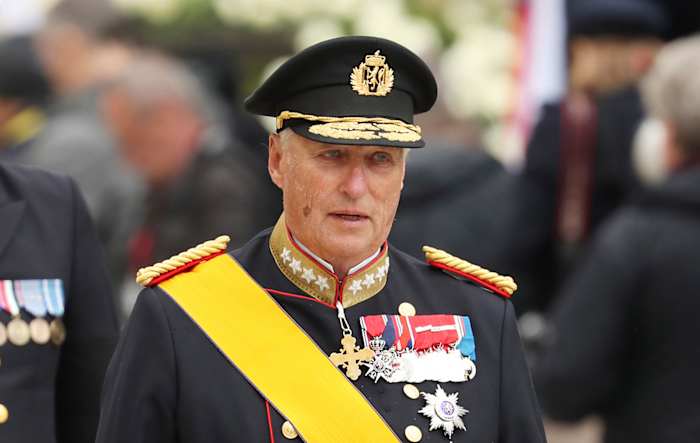
The transition of sovereign power following the death of King Harald V at age 89 exposes the structural vulnerability and institutional resilience of constitutional monarchies. When King Haakon VIII assumed the throne, the mechanics of state succession triggered an immediate operational stress test for the royal house. Beyond the public display of grief, the transition forces an evaluation of how modern hereditary institutions manage legitimacy deficits, operational continuity, and public trust under acute scrutiny.
The Structural Mechanics of the Transition
State transitions in constitutional frameworks rely on rigid procedural compliance to maintain institutional stability. The immediate movement of King Harald V's bier from the National Hospital through the Royal Palace to the Red Salon, followed by the formal procession to the Palace Chapel, functions as a visual manifestation of continuity.
This operational sequence follows a strict hierarchy of state protocol:
- The Chief of Staff and high-ranking secretariat officials manage the physical transfer of sovereign symbols, including the royal crown, national sword, and historical decorations.
- Immediate family members and designated heirs form the core procession, anchoring the visual transition of bloodlines and constitutional duty.
- The institutional apparatus provides an unbroken chain of custody, ensuring that executive continuity remains uninterrupted even as the physical head of state changes.
Constitutional monarchies operate on symbolic capital. The speed with which King Haakon VIII takes the constitutional oath minimizes the window of perceived instability, neutralizing market and civic uncertainty.
The Legitimacy Deficit and Reputation Management
The ascension of King Haakon VIII occurs against a backdrop of compounding reputational friction. Modern monarchies derive their license to operate from public consensus rather than divine right. Consequently, reputational damage directly affects institutional survival.
The incoming monarch faces distinct operational hurdles that threaten public trust:
- Historical associations and familial controversies involving close household members create ongoing public relations liabilities that require active containment.
- Public scrutiny regarding royal accountability demands higher standards of transparency than previous generations encountered.
- Queen Mette-Marit's re-emergence into public view during the procession, despite severe health constraints stemming from pulmonary fibrosis, serves a dual purpose. It projects familial unity while testing public reception ahead of broader institutional duties.
The cost function of these controversies is measurable in public opinion volatility and parliamentary skepticism. To secure long-term viability, the crown must execute an effective rehabilitation strategy that decouples the institution's functional utility from individual missteps.
Health Infrastructure and Succession Timelines
The physiological vulnerability of the monarchy became a central operational variable during King Harald's final years. Managing an aging head of state requires strategic delegation. King Haakon operated as regent during multiple medical leaves, creating a soft transition phase that mitigated the shock of the eventual vacancy.
Pulmonary fibrosis and chronic systemic infections created predictable institutional friction. The royal household addressed this by institutionalizing regency protocols well in advance. This administrative foresight prevented a sudden leadership vacuum, contrasting sharply with systems that lack structured interim mechanisms.
The logistical planning for the state funeral set for September 9 further illustrates the scale of organizational output required. Coordinating international heads of state, including foreign monarchs and high-security delegations, demands high-level diplomatic coordination and security resource allocation from state agencies.
Institutional Resilience Under Scrutiny
The survival of the Norwegian crown depends on its capacity to adapt to shifting social values without losing its core symbolic utility. King Harald V maintained high approval ratings by cultivating an egalitarian persona, often styled as the people's king. King Haakon VIII inherits a stabilized brand but lacks the specific generational goodwill accumulated by his predecessor over a decades-long reign.
The strategic imperative for the new monarch is clear. He must consolidate institutional support by demonstrating active stewardship over state affairs while systematically insulating the crown from external controversies. The success of this transition will be measured by the stability of public consensus and the seamless execution of parliamentary duties in the immediate post-funeral period.
Execute the constitutional oath without delay, prioritize transparent stakeholder communication, and isolate core state functions from peripheral familial liabilities to stabilize public trust during the initial hundred days of the new reign.