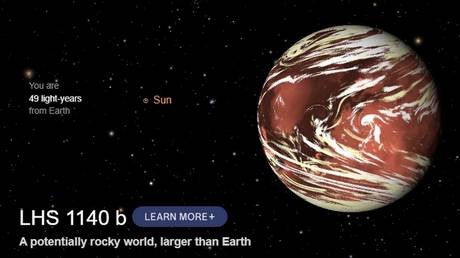
The recent identification of a nearby super-Earth has triggered the usual frenzy of headlines, promising another habitable oasis drifting just beyond our solar reach. Scientists have confirmed the planet orbits within a stable zone, yet the data buried beneath the sensational claims reveals a far more uncomfortable truth. We are not finding homes; we are finding geologic puzzles that defy our current models of planetary evolution.
This discovery relies on the radial velocity method, a technique that tracks the slight gravitational tug a planet exerts on its host star. It is a precise measure of mass, but a poor measure of identity. By focusing on the mass of this world, which sits roughly five times that of our own, researchers have confirmed its existence. They have failed, however, to confirm if it possesses a solid surface, a magnetic field, or even a stable atmosphere.
The Mass Problem
We categorize these worlds as super-Earths based on a loose definition. If it is larger than Earth but smaller than Neptune, it enters the club. This creates a dangerous assumption that these planets share the rocky composition of our own world. Nothing could be further from reality.
A planet with five times the mass of Earth has a significantly stronger gravitational pull. This force determines how the planet holds onto its gases. In a hypothetical example, a planet of this size might possess a thick, crushing envelope of hydrogen and helium rather than the thin nitrogen-oxygen mix we breathe. If this atmosphere is too dense, the pressure at the surface would be extreme. We would be looking at a world that functions less like a rocky globe and more like a scaled-down version of a gas giant.
The excitement surrounding this planet stems from its location. It sits at a distance from its sun where liquid water could theoretically persist. Yet, water requires a surface to pool upon. If the planet is a mini-Neptune, that water is trapped under hundreds of miles of pressurized gas, unreachable and useless for the biological processes we understand.
The Bias Of Detection
Current observation technology favors the big and the loud. Large planets near their stars are easy to spot because they disrupt their suns with significant force. Smaller, rocky worlds like ours, which orbit at greater distances, remain invisible to current equipment. We are effectively looking for keys only under the brightest streetlights, even if we suspect the lock is located in the dark alleyway next door.
The reliance on transit photometry—watching for the dimming of a star as a planet passes in front of it—further skews our understanding. This method tells us how big the planet is by the amount of light it blocks. Combining this with mass data allows us to calculate density. Density is our only real clue to composition.
If the calculated density is high, we assume rock. If low, we assume gas. The problem occurs when the data falls into the middle range. A planet might be composed of a mix of rock, water ice, and volatile gases. We have no way to distinguish between a water-heavy world and a rocky world with a massive, puffy atmosphere using current spectroscopic capabilities.
Atmospheric Mystery
The next frontier involves analyzing the light that filters through these planetary atmospheres during transit. This is where the limitations of modern hardware become apparent. Detecting the chemical signature of oxygen, methane, or carbon dioxide requires a level of clarity we are only beginning to achieve.
Even with high-end observatories, the signal-to-noise ratio remains a stubborn enemy. Small, rocky planets do not block enough light to yield clean, readable data. A super-Earth is a better target, but even then, the atmosphere might be shrouded in high-altitude haze. This haze acts like a curtain, preventing our instruments from seeing the chemical composition of the lower atmosphere. We see the tops of the clouds and nothing more.
We are forced to rely on computer modeling to fill the gaps. These models are only as good as the physics we input into them. If we assume a planet acts like a scaled-up Earth, the model will produce a result that mirrors that bias. We are essentially projecting our own planet's history onto distant, alien spheres that may have followed an entirely different formation path.
The Search For True Analogs
True Earth analogs will not be found in the current catalog of super-Earths. They will be smaller, less massive, and much harder to detect. They will likely be found orbiting stars that are quieter than our own sun, as stellar activity—flares, radiation, and magnetic noise—often strips away the atmospheres of smaller planets.
The ongoing obsession with super-Earths serves a specific purpose in the funding cycle of space exploration. It provides the public with a narrative of discovery, which secures the budgets needed for the next generation of telescopes. This is not inherently dishonest, but it is an incomplete picture.
We must accept that many of these worlds are fundamentally hostile. They are not waiting to be colonized; they are not even waiting to be understood by our current paradigms. They represent a class of planet that simply does not exist in our solar system. By trying to fit them into the mold of a terrestrial world, we are ignoring the unique geological and atmospheric mechanics that likely govern their development.
The industry must shift its focus toward high-resolution spectroscopy that can pierce through the haze of these larger planets. We need to distinguish between a world covered in a deep, global ocean and a world dominated by a runaway greenhouse effect. One is a potential cradle for chemistry; the other is a pressure cooker that destroys the very building blocks of life.
We are at the threshold of being able to classify these planets by their actual surface conditions rather than just their mass. The leap from measuring gravity to measuring chemistry is the most significant hurdle remaining in planetary science. Until we clear that bar, every headline about a new super-Earth should be read with extreme skepticism. We are cataloging points of light, not finding new frontiers. The real breakthrough will happen when we stop counting planets and start identifying the signatures of a world that actually functions like our own.
The data will eventually force us to abandon the hope for a nearby twin. We will have to reconcile with the probability that the conditions allowing for human life are a rare outlier in a galaxy defined by extreme, alien environments. The sooner we integrate this reality into our search, the more efficient our investigation will become.
Science demands the rejection of the comfortable narrative. When the telescope turns away from the current target, the real work of defining the boundaries of our isolation will finally begin.