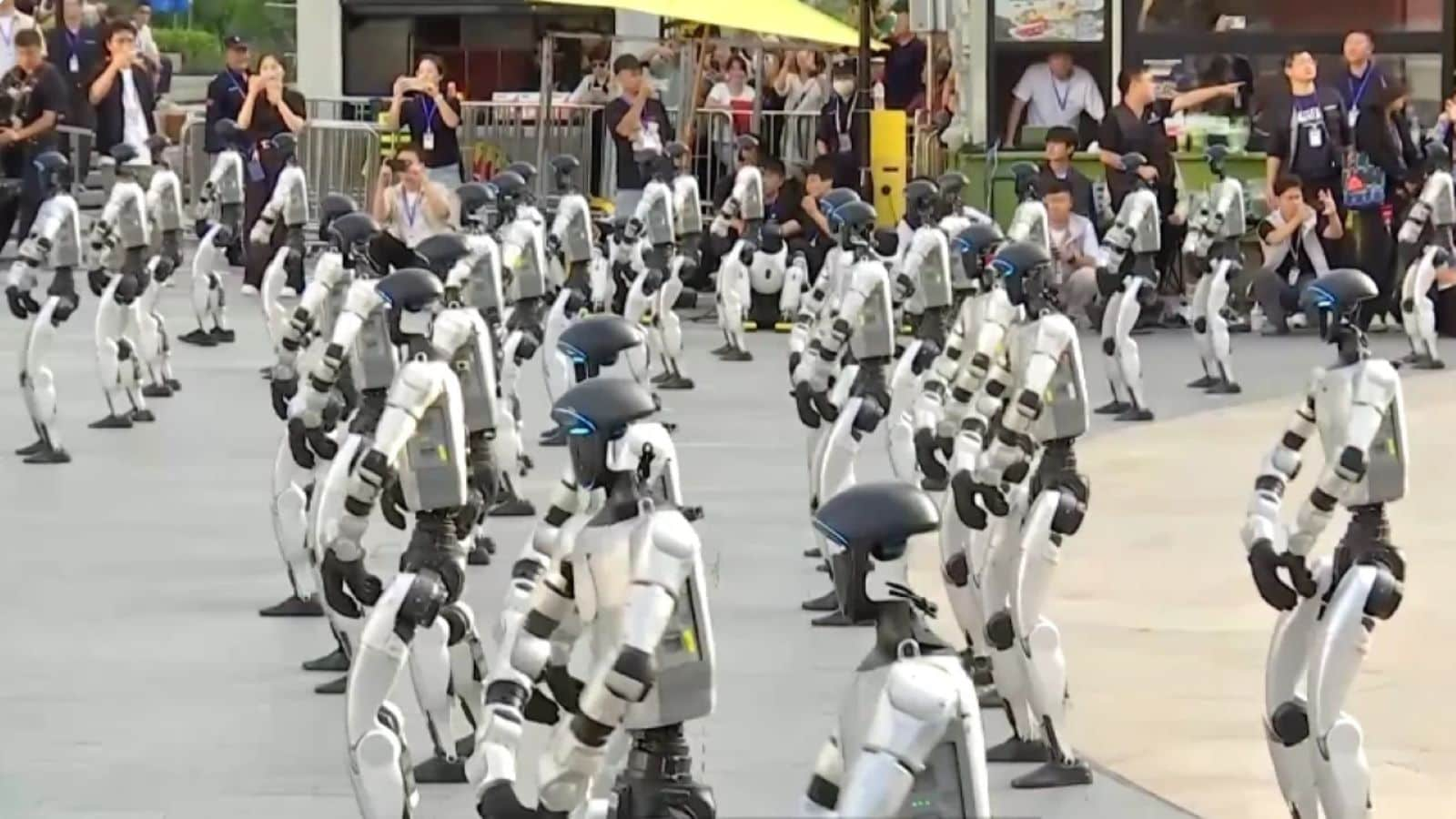
When dancing humanoid robots greeted world leaders arriving in China for the 2026 Asia-Pacific Economic Cooperation summit, the viral clips played out like pure sci-fi spectacle. Beneath the polished choreography, however, lies a calculated geopolitical and industrial play. Beijing deployed its domestic robotics fleet on a global diplomatic stage to signal manufacturing dominance, attract foreign capital, and mask the steep engineering hurdles that still keep bipedal machines out of everyday factories.
The choreography was tight. Dozens of bipedal units executed synchronized arm waves, weight shifts, and rhythmic steps along the arrival corridors without a single visible tether or stumble. For the international press corps and visiting delegations, the visual message was unmistakable: China wants the world to view its embodied artificial intelligence sector as ready for prime time.
The Geopolitics of Stagecraft
Diplomatic summits have always served as showcases for host nations to project soft power and technological muscle. During the 2008 Beijing Olympics, it was mass human choreography and high-speed rail. In 2026, with China hosting APEC in Shenzhen—the beating heart of its hardware supply chain—the state turned to embodied AI as its flagship calling card.
Placing humanoid robots in front of heads of state from Pacific Rim economies accomplishes three immediate goals for Beijing:
- Supply chain deterrence: It reminds trading partners like the United States, Japan, and South Korea that China controls the localized component ecosystem required to build physical machines at scale.
- Domestic morale and capital signaling: State-backed broadcasts of the APEC welcome ceremony feed directly into domestic equity markets, propping up valuations for local robotics startups facing a tightening venture capital environment.
- Standard-setting posturing: By normalizing humanoids in high-security diplomatic zones, Chinese regulators push the narrative that their safety and operational frameworks are mature enough for public deployment.
Yet anyone who has spent years tracking industrial automation knows the gap between a rehearsed stage routine and unscripted utility. A greeting ceremony is a closed-loop environment. The floor is flat, the lighting is controlled, the obstacles are mapped in advance, and the motion trajectories are pre-programmed or tightly constrained by motion-capture data.
Deconstructing the Choreography
To understand what happened on the APEC red carpet, you have to separate pre-planned trajectory execution from real-time autonomous reasoning. Watching a robot dance looks complex because human brains associate dancing with balance, musicality, and improvisation. In robotics engineering, dancing is often easier than folding a crumpled shirt.
Modern Chinese humanoid platforms—built by firms clustered in Shenzhen, Hangzhou, and Beijing—rely heavily on reinforcement learning conducted inside physics simulators. Engineers train digital twins of the robot across millions of virtual iterations, teaching the control policy how to maintain its center of mass while swinging limbs at specific frequencies. Once that policy transfers to the physical hardware, the machine is essentially running a high-speed stabilization loop over a fixed sequence of joint angles.
The hardware doing the heavy lifting beneath the sleek composite shells comes down to three core subsystems:
- Quasi-direct drive actuators: High-torque electric motors paired with low-ratio planetary gearboxes allow the joints to absorb impact and react quickly without stripping gears.
- Inertial measurement units: Micro-sensors tucked inside the torso measure tilt and acceleration hundreds of times per second, feeding data to onboard compute modules that adjust ankle and hip torque to prevent a fall.
- High-discharge battery packs: Delivering burst power to thirty or forty motors simultaneously requires custom lithium cells capable of dumping current rapidly without thermal throttling.
None of this requires the robot to understand who it is greeting, why the summit is happening, or how to react if a diplomat drops a briefcase in its path. When a human stumbles on a stage, they improvise. When a choreographed humanoid encounters an unexpected push outside its trained recovery envelope, it hits the floor hard.
The Shenzhen Supply Chain Advantage
While Western critics frequently dismiss these appearances as mere theater, writing off China's robotics push would be a severe analytical mistake. The real story is not the dance. The real story is the unit economics of the machines performing it.
Over the past decade, China built an unmatched industrial base for electric vehicles and consumer drones. It turns out that the supply chain for an EV—permanent magnet motors, precision bearings, battery management systems, and lidar sensors—overlaps heavily with the bill of materials for a humanoid robot. Because Shenzhen manufacturers can source custom actuators and harmonic drives within a fifty-mile radius, Chinese robotics companies iterate on hardware prototypes in weeks rather than years.
This component density drives prices down aggressively. While legacy Western bipedal platforms historically carried six-figure price tags aimed at defense contractors and university labs, Chinese manufacturers have pushed entry-level commercial units down toward the cost of a compact economy car. At the APEC summit, organizers did not just deploy one multi-million-dollar prototype; they deployed an entire squad. That fleet-level availability is the direct result of localized mass production.
Where the Illusion Breaks Down
Step away from the cameras and walk onto an actual automotive assembly line or logistics warehouse, and the limitations of current humanoid hardware become glaringly obvious. Industry insiders call it the moravec paradox in action: high-level cognitive tasks like writing code or summarizing diplomatic treaties require relatively little compute, while basic sensorimotor tasks—reaching into a cluttered bin, gripping a slippery part, walking across an oily floor—remain brutal engineering problems.
Battery Life and Thermal Limits
Most untethered bipedal robots operate for roughly two to four hours on a single charge under moderate loads. Continuous dynamic movement, like dancing or carrying heavy payloads, drains packs even faster and generates intense heat inside tightly packed actuator housings. A factory shift runs eight to twelve hours. Swapping batteries every ninety minutes destroys return-on-investment calculations for plant managers.
The Generalization Bottleneck
Factories already use automation everywhere it makes sense. Robotic arms weld car frames with sub-millimeter precision at speeds no human can match, and wheeled autonomous mobile robots haul pallets across warehouses reliably for twenty hours a day. The only reason to build a machine shaped like a human is to navigate environments built for humans—stairs, narrow doorways, ladders—and perform varied tasks using human tools.
Right now, generalist vision-language-action models struggle with edge cases. If lighting shifts, a conveyor belt jams, or a cable hangs at an unfamiliar angle, the robot's manipulation success rate plummets. Teleoperation—having a human worker wear a VR headset in a back room to pilot the robot remotely—often fills the gap during public demos, creating an illusion of autonomy that evaporates once the exhibition closes.
Maintenance and Mean Time Between Failures
A humanoid robot packs dozens of moving joints, wiring harnesses, and delicate sensors into a frame that constantly vibrates and absorbs ground-reaction forces. Every actuator is a potential point of failure. In high-volume manufacturing, downtime costs thousands of dollars per minute. Plant directors do not want an impressive machine; they want a boring machine that runs for ten thousand hours without needing a technician to recalibrate its knee joint.
The Capital Race Behind the Curtain
The timing of the APEC showcase aligns with a critical inflection point in global robotics funding. Between 2023 and 2025, billions of dollars poured into humanoid startups across both Silicon Valley and China, fueled by breakthroughs in large language models and the assumption that physical AI would follow the exact same scaling laws.
By late 2026, investors started demanding commercial receipts. Demos of robots folding laundry or walking across gravel no longer guarantee a Series B term sheet. Venture firms and state-guided industrial funds are pressing founders for signed deployment contracts, recurring software revenue, and hard metrics on throughput per hour.
By putting humanoid fleets in front of APEC delegates, Beijing effectively acted as a state-level marketing agency for its domestic champions. For visiting trade ministers and sovereign wealth fund managers from Southeast Asia and the Middle East, the visual proof of concept carries weight. If a foreign government decides to subsidize smart-city infrastructure or automated port logistics, Chinese vendors just secured prime placement in the procurement pipeline.
What Actually Matters Next in Embodied AI
If you want to track whether China's robotics push translates into genuine economic dominance over the next twenty-four months, ignore the viral summit clips and watch three unglamorous indicators instead.
First, look at unattended operational hours in pilot factories. When an automaker like BYD or NIO publishes verified data showing humanoid units working full shifts alongside human technicians without safety cages or remote teleoperators, the technology has crossed a real threshold.
Second, track the standardization of hands and tactile sensors. Legs get the headlines, but hands make the money. Until dexterous robotic grippers can match the force feedback and durability of human skin and tendons at an affordable replacement cost, humanoids will remain limited to basic box-lifting and scripted appearances.
Third, watch export controls on high-end compute and precision machine tools. While China dominates mid-tier actuators and assembly, high-end AI training chips and ultra-precision grinding equipment for specialized gearboxes remain geopolitical choke points. How fast domestic suppliers close those specific gaps will determine whether China builds an insurmountable lead or hits a ceiling on intelligence and mechanical longevity.
The world leaders walking past those dancing robots in Shenzhen saw a glimpse of where industrial policy and hardware manufacturing are colliding. They did not see a finished workforce. They saw a multi-billion-dollar bet that whoever masters mass production first will eventually solve the software, leaving everyone else buying their machines from Shenzhen.