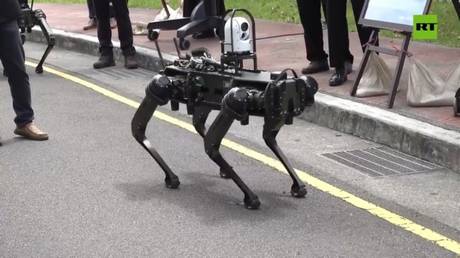
The deployment of armed quadrupedal Unmanned Ground Vehicles (UGVs) on remote island outposts solves a severe asymmetric bottleneck: the inability to maintain continuous tactical presence on isolated, high-risk coastlines without overextending human personnel. The National Chung-Shan Institute of Science and Technology (NCSIST), Taiwan's primary defense technology developer, demonstrated three custom variants of an uncrewed quadruped built on a platform from US-based Ghost Robotics. Rather than serving as standalone offensive assets, these systems function as persistent force multipliers designed specifically to optimize the defensive posture of isolated maritime features like Itu Aba (Taiping Island) in the Spratlys and the Pratas Islands (Dongsha).
To understand why a military organization pivots toward quadrupedal platforms over traditional wheeled or tracked options, the physical constraints of littoral terrain must be quantified. The operational environments in question consist primarily of sandy coastlines, uneven coral reefs, and variable coastal topography. Traditional drivetrains face high failure rates in these environments due to low traction, sinking risks, and an inability to navigate vertical obstacles. Also making news recently: The Structural Reality of the United States and China Artificial Intelligence Competition.
The Operational Mechanics of Legged Locomotion
The selection of a quadrupedal chassis is dictated by the requirement to maximize terrain trafficability. Wheeled systems rely on continuous surface contact and suffer from high rolling resistance in loose sand. Tracked systems offer better weight distribution but introduce significant mechanical complexity, high power consumption when turning, and vulnerability to sand grit degradation within the drive sprockets.
Quadrupedal platforms overcome these barriers via discrete ground contact. By calculating precise foot-placement vectors, the system can traverse non-contiguous surfaces, such as jagged coral structures or debris-strewn beaches, where a continuous path does not exist. More information into this topic are covered by CNET.
NCSIST has divided its prototyping into three distinct functional configurations to separate payload weights and preserve battery efficiency:
- The Reconnaissance Variant: Configured with lightweight optical and thermal imaging packages designed for rapid movement and forward scouting.
- The Surveillance Variant: Equipped with longer-range sensor suites, including signal-intelligence collectors or small radar units, optimized for stationary or low-velocity perimeter monitoring.
- The Firepower Variant: Integrated with a kinetic weapon system mounted dorsally, creating an active defensive or suppressive capability on a mobile platform.
The core engineering challenge of the firepower variant rests on recoil absorption and stabilization. When a kinetic weapon discharges, the force vector acts directly against the robot's center of mass. Without active counter-force calculation, the recoil destabilizes the platform, degrading follow-up shot accuracy and potentially causing a rollover. To counter this, the underlying software must execute real-time torque adjustments across all twelve joints simultaneously, transforming the robot's legs into an active suspension system that dampens kinetic energy before it alters the chassis orientation.
The Strategic Geography of Asymmetric Denial
The geography of the South China Sea creates an acute force-allocation problem for Taipei. The Pratas Islands and Itu Aba are small, flat, completely isolated features situated hundreds of kilometers from the main island of Taiwan. They possess no indigenous civilian populations and are garrisoned by small detachments of Coast Guard and Marine personnel.
[Mainland Taiwan] --- (High Logistic Tail / Long Distance) ---> [Isolated Outposts: Pratas / Itu Aba]
                                                                        |
                                                   +--------------------+--------------------+
                                                   |                                         |
                                        [Human Personnel Limits]                  [Gray-Zone Incursions]
                                        - Extreme exposure to strike              - Constant Coast Guard patrols
                                        - High caloric/water demands              - Persistent drone monitoring
                                        - Limited perimeter capacity              - Attrition via constant presence
The primary security challenge here is not an outright amphibious invasion, but rather "gray-zone" harassment. The Pratas Islands have faced a measurable uptick in Chinese coast guard patrols and uncrewed aerial vehicle flights. Countering these incursions with human troops creates an unfavorable cost-exchange ratio. Human personnel require food, water, climate-controlled shelter, and rotation cycles, all of which depend on vulnerable maritime supply lines.
Deploying UGVs alters this calculation through three core operational advantages.
Attrition Resistance
An uncrewed system can maintain a fixed perimeter watch in high-humidity, high-salinity, and extreme heat environments indefinitely, requiring only a localized electrical charging station rather than a complex life-support infrastructure.
Perimeter Density
Because these islands feature expansive coastlines relative to their small garrisons, human sentries can only monitor fixed choke points. A network of quadrupeds extends the sensory perimeter across the entire coastline, converting a passive defensive posture into an active, high-fidelity monitoring grid.
Escala-Response Mitigation
In gray-zone confrontations, the capture or destruction of an uncrewed platform does not yield the same political or escalatory consequences as the casualty or capture of a human marine. This gives local commanders a flexible option to contest low-level territorial encroachments aggressively.
Architectural Vulnerabilities and Technical Limitations
While the operational profile of an armed robot dog is highly compelling on paper, the system is bound by distinct physical and electronic limitations that prevent it from being a definitive tactical solution.
The first bottleneck is energy density. Unlike wheeled vehicles that can coast or idle efficiently, a quadrupedal robot must expend energy constantly just to maintain a standing posture against gravity. The battery life of modern military quadrupeds typically ranges from 90 minutes to four hours depending on the payload weight and the aggressiveness of the terrain. The integration of a kinetic weapon system, along with its associated targeting optics and ammunition, drastically reduces this operational window. This restricts their usage to short, scheduled patrol routes or static ambush positions where they remain powered down until triggered by remote sensors.
The second, more critical vulnerability lies in the command-and-control architecture. NCSIST's integration of proprietary technology onto a foreign-sourced chassis highlights a dependency on external hardware suppliers, though it deliberately minimizes reliance on parts manufactured within adversarial supply chains.
More broadly, these systems rely heavily on data links for remote operation. This introduces two failure vectors:
- Electronic Warfare (EW): An adversary equipped with localized radio-frequency jamming can sever the link between the robot and its human operator. If the connection drops, the platform must either rely on predictable autonomous return-to-base protocols or become immobilized, rendering it vulnerable to capture.
- Kinetic Sensor Blinding: The autonomy and targeting capabilities of the robot depend entirely on its sensor array, which typically includes LiDAR, optical cameras, and infrared sensors. Standard battlefield countermeasures, such as smoke screens, aerosolized particulate obscurants, or low-cost laser dazzling pointers, can effectively blind the system, stripping away its tactical awareness.
Tactical Synthesis
The introduction of these prototype systems by NCSIST signals an explicit shift toward autonomous and semi-autonomous systems to offset Taiwan's demographic and geographic vulnerabilities. The military utility of these quadrupeds will not be realized by treating them as mechanized infantry replacements, but rather by embedding them into a broader, multi-domain defense network.
The optimal deployment model requires integrating these quadrupeds with fixed ground sensors and overhead aerial drones. An aerial asset detects an inbound coastal anomaly; it passes the coordinate data down to a stationed quadruped, which moves autonomously through complex terrain to verify the contact. If hostility is confirmed, the firepower variant provides immediate suppression while human operators remain protected within fortified command bunkers.
The next phase of evaluation depends on converting these public demonstrations into a formalized procurement program. The true metric of success for Taiwan's defense apparatus will be its capacity to mass-produce these hardened, EW-resistant systems at a cost structure low enough to make their deployment economically viable across dozens of contested maritime features.