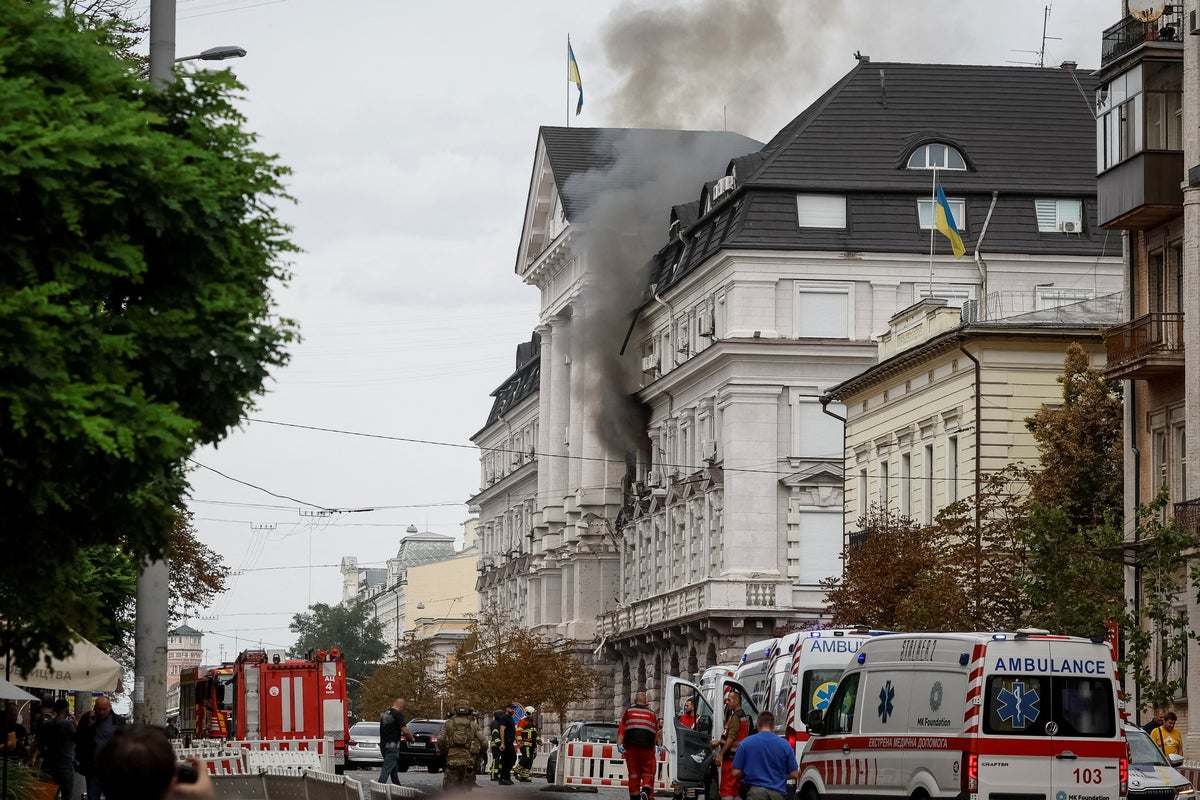
Every desk pundit with an internet connection is losing their mind over headlines claiming a Russian drone strike hit a Ukrainian security service building right before scheduled peace talks. The lazy consensus from the commentariat is predictable: it is painted as a deliberate provocation, a symbolic middle finger thrown at diplomacy, an escalation designed to sabotage negotiations before diplomats even unpack their briefcases.
It is a comforting narrative for people who prefer their geopolitics packaged like a Marvel movie, where every action is a theatrical gesture loaded with emotional significance.
It is also completely wrong.
When you spend years watching state actors handle logistics, signals intelligence, and kinetic targeting from command bunkers, you learn a hard truth about modern warfare. Generals do not waste million-dollar hardware on symbolic real estate just to send a message. Messages are for Twitter. Missiles are for node destruction.
Let us look at the mechanics of modern targeting protocols. A modern intelligence headquarters—whether you call it MI5, the SBU, or a regional directorate—is rarely a single fortress where James Bond villains stroke white cats. It is a distributed network of secure comms nodes, server racks, encrypted switchboards, and administrative hubs. When a strike hits one of these facilities, the attacker is not trying to ruin someone's day at the office. They are trying to blind a specific vector of tactical coordination.
The timing of these strikes relative to peace talks is almost always coincidental, driven by weather windows, satellite overpass schedules, and battery life, rather than some grand theatrical calendar orchestrated by central command. Yet, media outlets feed you the drama because drama drives ad revenue. They want you to believe that every explosion is a personal insult traded between presidents across a mahogany table.
This brings us to the core misconception dominating international relations commentary right now: the belief that peace talks are derailed by kinetic events on the ground.
History tells us the exact opposite. Wars do not pause because negotiators sit down in Geneva or Istanbul. In fact, the intensification of kinetic operations during pre-negotiation phases is a standard operational feature. Both sides fight harder in the field precisely because they are trying to improve their leverage at the table. If you want a favorable ceasefire line, you take ground or break enemy infrastructure up until the literal second the ink dries. Expecting a lull in drone activity because diplomats are shaking hands is like expecting opposing football teams to stop tackling each other during a referee timeout.
The Myth of the Symbolic Target
Let us dissect the obsession with the target itself. Much of the commentary surrounding these high-profile strikes focuses on the prestige of hitting an intelligence or security headquarters. Commentators hyperventilate about the violation of institutional spaces, as if a concrete office building holds some magical diplomatic immunity.
Military planners do not operate on etiquette. They operate on target value analysis.
If a building houses active fiber-optic trunk lines, secure terminal equipment, or liaison officers coordinating drone swarms across the front line, it is a legitimate military target under the laws of armed conflict, regardless of what sign is hanging outside the door. Calling it a security service headquarters makes for good copy, but structurally, it is just a node in a command-and-control network.
I have watched analysts spend weeks debating the psychological impact of hitting a high-profile administrative hub, completely missing the tactical reality. The people actually running operations inside those buildings do not sleep at their desks under portraits of national heroes. They are rotated out, decentralized, and backed up by redundant cloud servers or mobile command units. Hitting the physical brick-and-mortar structure is often the least damaging thing you can do to an intelligence agency; it forces them to upgrade their facilities and scatter into more resilient, harder-to-find civilian basements.
In many cases, striking a prominent downtown headquarters is an inefficient use of scarce precision-guided munitions. The air defense density around major urban centers makes the cost-per-target ratio terrible. If a command structure is truly vital, it is buried deep underground or hidden in plain sight inside industrial parks. When a strike lands on a prominent downtown facility, it often points to a target of opportunity rather than a masterstroke of strategic decapitation.
The Leverage Trap in Peace Negotiations
The broader conversation around upcoming peace talks suffers from a fundamental misunderstanding of how leverage works in attritional conflicts.
The mainstream narrative assumes that diplomacy is about finding common ground through sweet reason and mutual concessions. This is naive. Diplomacy during an active war is simply the continuation of combat by other means. Every missile strike, every drone swarm, and every artillery barrage is a data point fed into the enemy's calculation of continued resistance versus settlement.
When commentators scream that a strike "jeopardizes peace," they are misdiagnosing the root cause of the conflict. Peace talks do not fail because someone bombed a building; peace talks fail because the gap between the war aims of the belligerents is wider than the cost of continuing the fight.
Imagine a scenario where two opposing sides are deadlocked over territorial sovereignty. No amount of polite dialogue or diplomatic theater will bridge that gap until one side experiences a systemic collapse in its capacity to resist, or internal political exhaustion reaches a breaking point. Kinetic strikes on security infrastructure are attempts to accelerate that exhaustion. They are brutal, mechanical, and entirely divorced from the diplomatic posturing happening thousands of miles away in neutral European capitals.
By treating these strikes as insults rather than tactical attrition, we misinform the public about what it will actually take to end the bloodshed. We foster the illusion that if everyone just behaved politely and stopped hitting high-value targets, peace would magically break out. That is not how empires or sovereign states operate when their vital interests are on the line.
Dismantling the Intelligence Industrial Complex
The media coverage of these events also exposes a deep rot in how security analysis is conducted. Too many commentators rely on anonymous intelligence leaks that serve immediate political narratives rather than objective reality.
When an official tells a reporter that a strike was timed specifically to disrupt peace talks, ask yourself a simple question: who benefits from that framing?
The side receiving the strike benefits by painting their opponent as irrational and untrustworthy, thereby securing more military aid and tighter sanctions. The defense contractors benefit by validating the need for more air defense systems. The media outlets benefit by driving clicks with apocalyptic prose.
Real analysis requires ignoring the talking points and looking at the telemetry. What was actually destroyed? Was it a power substation feeding a communications hub, or was it an empty floor of a bureaucratic office block? What was the density of air defense in the sector? What was the operational tempo of the surrounding units before and after the impact?
When you strip away the emotional language and look at the raw logistics, the picture changes entirely. You stop seeing a soap opera of diplomatic betrayals and start seeing a cold, grinding war of attrition where every square meter of infrastructure and every ounce of processing power is contested until exhaustion sets in.
Stop looking for hidden messages in the rubble. There is no message. There is only the math of destruction.