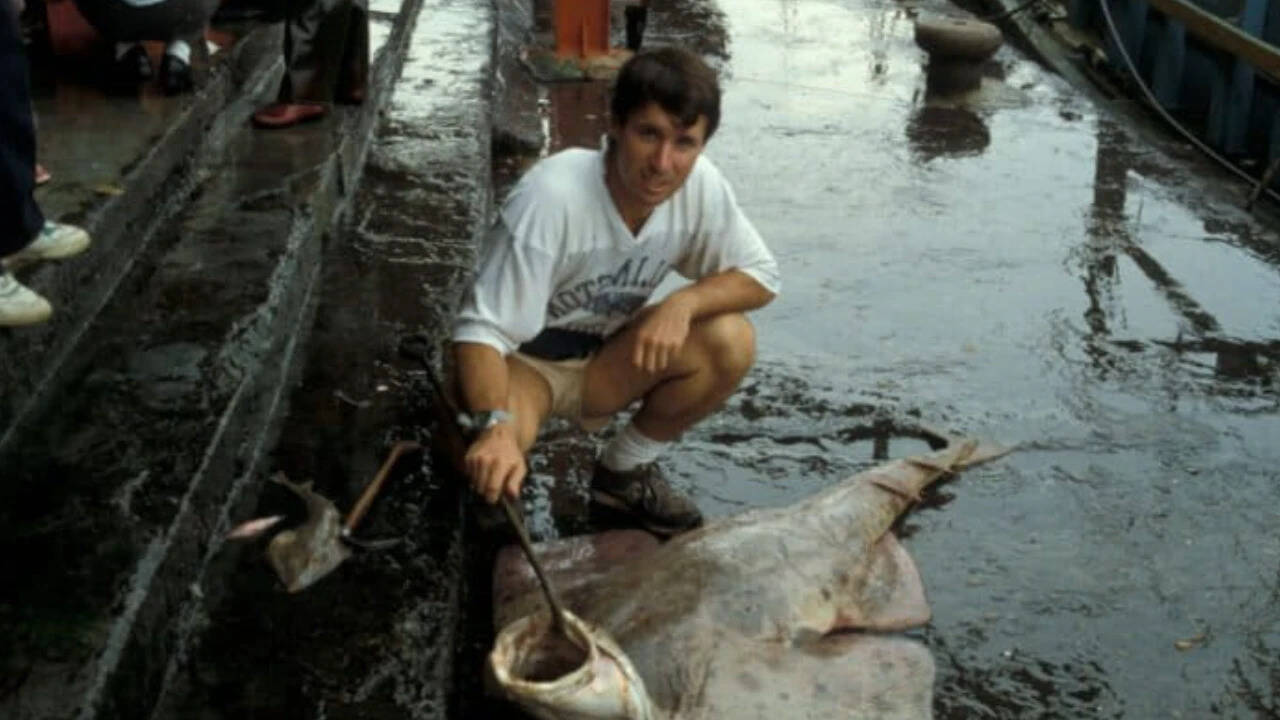
Marine conservation suffers from a severe allocation bias: funding, media attention, and regulatory enforcement concentrate disproportionately on apex charismatic megafauna—specifically the Great White, Tiger, and Bull sharks—while ignoring the vast majority of cartilaginous fishes. Over 1,250 species of chondrichthyans (sharks, rays, and chimaeras) exist globally, yet roughly one-third face extinction threats driven by industrial overfishing and bycatch. Within this crisis lies a specific operational failure: taxonomic blindness. You cannot legally protect, regulate, or manage a species that lacks a formal scientific description, or a species whose population baseline disappeared before modern monitoring began. At 68 years old, California-based marine biologist David Ebert has spent four decades correcting this deficit, formally naming 56 new species and leading global expeditions to locate "lost sharks"—taxa unrecorded in the wild for decades, including specimens unseen since 1926.
The Structural Mechanics of Taxonomic Blindness
Conservation policy relies entirely on binomial nomenclature. International treaties such as the Convention on International Trade in Endangered Species (CITES) and regional fisheries management organizations (RFMOs) require precise species-level identification to enforce catch limits, trade bans, or habitat protections. When a deep-water catshark or an obscure Indo-Pacific angelshark is hauled up as commercial bycatch, fisheries observers frequently log it under generic umbrella categories like "unspecified shark" or lump it together with a morphologically similar cousin. This aggregation masks localized population collapses. If two distinct species are managed as a single stock, the slower-reproducing species can be fished to extinction while catch data for the faster-reproducing species suggests the overall fishery remains stable.
Ebert’s output of 56 newly described species directly dismantles this administrative blind spot. Describing a new species is not a matter of casual observation; it requires rigorous comparative morphology and molecular genetics. Taxonomists must examine hundreds of museum specimens, measure dozens of morphometric ratios (such as snout length relative to mouth width, dorsal fin placement, and tooth row counts), dissect claspers to verify reproductive maturity, and sequence mitochondrial DNA (specifically the COI and NADH2 genes) to confirm genetic divergence from sister taxa.
The Three Pillars of Lost Shark Recovery
Locating species that have vanished from scientific records—some for over a century—requires shifting away from standard pelagic survey methods. Open-ocean tagging and baited remote underwater video systems (BRUVS) work well for reef and coastal predators, but they fail entirely for elusive, benthic, or deep-sea chondrichthyans. Ebert’s methodology relies on three distinct operational vectors:
- Historical Museum Forensics: Before deploying a single research vessel, taxonomists audit dusty, uncataloged jars in natural history collections worldwide. Many "lost" species sit mislabeled on museum shelves, collected during nineteenth- or early-twentieth-century colonial expeditions and forgotten. By establishing exact morphological baselines from these holotypes, researchers determine precise depth ranges and historical geographic coordinates.
- Artisanal Fish Market Intercepts: Deep-sea exploration using dedicated research vessels costs tens of thousands of dollars per day. Local artisanal fishing fleets, however, deploy gillnets and longlines daily across continental slopes and remote archipelagos in developing nations. By inspecting the morning landings at remote fish markets in Taiwan, South Africa, Indonesia, and Mozambique, researchers access specimens pulled from 200 to 1,500 meters deep without funding deep-sea trawlers.
- Environmental DNA (eDNA) Screening: Where physical capture is impossible or unethical due to extreme rarity, filtering water samples for shed cellular material allows researchers to detect the genetic signature of target species. This narrows down vast oceanic search grids into high-probability micro-habitats before physical verification is attempted.
The 1926 Baseline and the Cost Function of Deep-Sea Elusiveness
When a species goes unrecorded since 1926—a timeframe spanning a full century of industrializing ocean extraction—biologists must distinguish between two competing hypotheses: genuine biological extinction versus extreme sampling bias.
In terrestrial ecology, a century without a confirmed sighting almost guarantees extinction, as terrestrial habitats are thoroughly mapped and accessible. In marine environments, particularly the bathyal zone (depths between 200 and 2,000 meters) and remote tropical shelves, the absence of evidence frequently reflects an absence of sampling effort. Many lost sharks are small—often under one meter in length—cryptically colored, and strictly benthic, resting motionless on muddy or rocky substrates where standard pelagic gear never reaches.
The cost function of finding these animals escalates exponentially with depth and geographic isolation. Commercial trawlers avoid rugged, rocky seafloors because boulders tear expensive nets, creating natural refugia for small benthic sharks. Simultaneously, academic funding bodies rarely finance multi-year taxonomic expeditions that lack guaranteed high-profile deliverables. Consequently, a species can persist in a narrow depth band along a remote continental margin for a hundred years without intersecting a single scientific survey.
Life-History Vulnerability: The K-Selected Trap
The urgency behind Ebert’s work stems from the fundamental biology of chondrichthyans. Unlike bony fishes (teleosts) such as cod or tuna, which release millions of eggs into the water column and reach sexual maturity within a few years, sharks operate on extreme K-selected life-history strategies:
- Late Sexual Maturity: Many deep-water and endemic sharks require 10 to 20 years to reach reproductive age.
- Low Fecundity: Litters frequently consist of only one to six pups, produced after gestation periods lasting anywhere from 12 to 24 months.
- Low Intrinsic Rate of Population Increase: Because energy is invested into producing a few large, well-developed offspring rather than millions of larvae, shark populations cannot rebound quickly from sudden mortality spikes.
When deep-water fisheries expand into previously unexploited zones—driven by the depletion of shallow-water stocks and subsidies for fuel and gear—they hit these slow-reproducing populations with immediate, unsustainable mortality. A species restricted to a single seamount or a narrow coastal shelf can be wiped out by a few seasons of intensive bottom trawling before scientists even realize the species exists.
The Operational Limits of Taxonomic Discovery
While naming 56 species and rediscovering century-old ghost taxa represents a massive scientific achievement, taxonomy alone does not halt biodiversity loss. Relying strictly on species description as a conservation mechanism carries three severe structural limitations:
First, the implementation lag. Formally publishing a species description in a peer-reviewed journal like Zootaxa, getting that species assessed by the International Union for Conservation of Nature (IUCN) Red List, and translating that status into national fisheries law takes anywhere from five to fifteen years. Industrial fishing fleets operate on quarterly profit cycles; legal protections routinely arrive after the target population has already collapsed below its minimum viable threshold.
Second, enforcement capacity in data-poor regions. Many lost sharks inhabit the exclusive economic zones (EEZs) of developing nations where maritime enforcement budgets are minimal and coastal communities rely directly on artisanal fishing for protein and income. Declaring a newly rediscovered angelshark or houndshark legally protected means nothing if local fishers lack alternative livelihoods or if port inspectors cannot distinguish the protected species from legal catch.
Third, the taxonomic bottleneck. The global pool of trained chondrichthyan taxonomists is shrinking. Universities increasingly prioritize molecular biology, climate modeling, and computational ecology over classical morphology. As senior experts like Ebert reach their late sixties, the institutional knowledge required to identify subtle anatomical differences across hundreds of obscure shark species faces acute succession risk. Without funded museum positions and dedicated fellowships to train the next generation of systematists, the rate of new species descriptions will plateau while the rate of unrecorded extinctions accelerates.
Strategic Reallocation for Chondrichthyan Conservation
To convert taxonomic discovery into durable biological survival, conservation organizations, academic institutions, and fisheries managers must execute three structural shifts immediately:
- Mandate Precautionary Genus-Level Protections: Fisheries regulators must stop waiting for species-level assessments before restricting catch. When a taxonomist identifies a high-endemism hotspot containing undescribed or data-deficient sharks—such as the southwestern Indian Ocean or the Coral Triangle—regulators should implement immediate spatial closures or gear restrictions covering the entire genus or family until baseline population data is established.
- Institutionalize Artisanal Market Monitoring: Conservation funders must shift capital away from expensive, short-term pelagic tagging expeditions and establish permanent, low-cost landing-site monitoring networks in major artisanal fishing ports. Paying local technicians to photograph and tissue-sample daily bycatch generates continuous, high-resolution biodiversity data at a fraction of the cost of research vessel charters.
- Fund Taxonomic Succession Pipelines: Natural history museums and marine research institutes must ring-fence endowment funds specifically for classical and molecular taxonomy fellowships, pairing senior systematists directly with early-career researchers to transfer morphological expertise before retirement severs the lineage.