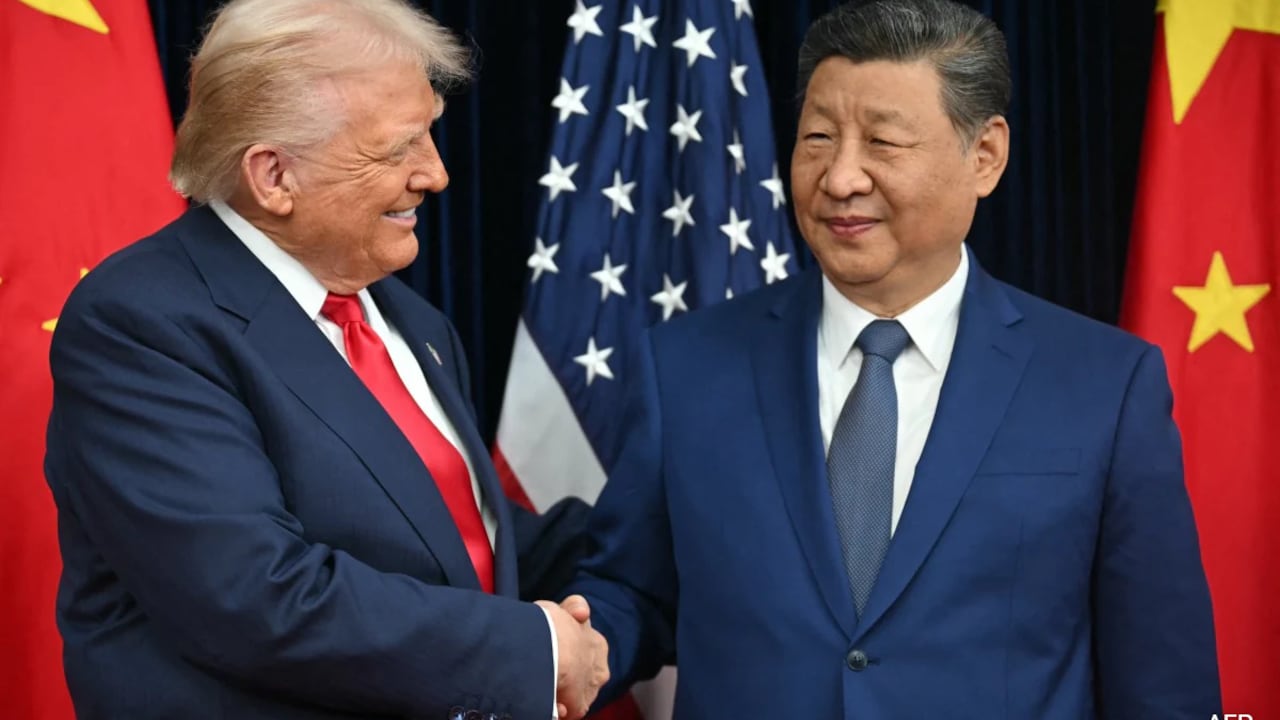
The ink on the latest Beijing summit agreements has barely dried, and the financial press is already writing fairy tales. A thirty-billion-dollar tariff rollback. An institutional framework for artificial intelligence dialogue. The headlines sing with the same tired chorus: the trade war is thawing, pragmatism has beaten posturing, and globalism is crawling back from the grave.
It is a comforting fiction. It is also completely wrong.
To understand why this agreement is nothing more than diplomatic theater, you have to stop reading the press releases and start looking at the balance sheets of the global economy. Thirty billion dollars sounds like a massive concession until you measure it against the sheer scale of bilateral trade between the United States and China, which runs well over half a trillion dollars annually, layered beneath trillions more in interconnected corporate supply chains, intellectual property transfers, and financial dependencies.
Thirty billion dollars is a rounding error on a corporate tax spreadsheet. It is the economic equivalent of throwing a single bucket of water onto a raging forest fire and demanding a medal for firefighting. Yet, boards of directors across the globe are already exhaling, pausing their diversification strategies, and walking right back into single points of failure. That is not just optimism; it is corporate malpractice.
The Arithmetic of Irrelevance
Let us look at the hard math that the mainstream pundits conveniently ignore. Total trade volume between the two superpowers operates at a scale where thirty billion dollars represents approximately three to four percent of total annual goods flow. It is a statistical whisper.
When governments negotiate tariff reductions at this microscopic scale, they are not dismantling a trade war. They are tossing breadcrumbs to domestic lobby groups who are screaming about input costs. It gives politicians a talking point for the evening news and corporate executives an excuse to delay painful structural overhauls.
I have spent two decades advising multinational conglomerates on cross-border risk and supply chain architecture. I have watched executive teams lose hundreds of millions of dollars because they mistook a temporary diplomatic ceasefire for a permanent shift in geopolitical reality. Every time a summit makes the front page with comforting talk of mutual concessions, leaders breathe a sigh of relief, shelve their backup plans for alternative manufacturing hubs, and slide right back into the most brittle supply chains imaginable.
The structural architecture of global trade has shifted permanently from efficiency to national security. In this new reality, a thirty-billion-dollar tariff adjustment does not change your cost of failure. It just makes you feel slightly better while you walk toward the cliff.
The AI Dialogue Fiction
Then there is the centerpiece of the recent visit: the newly minted agreement on artificial intelligence dialogue.
Superpowers do not negotiate intelligence. Artificial intelligence is not a treaty-bound commodity like crude oil, agricultural grain, or sulfur. It is national power distilled into matrix multiplications, training clusters, and tensor cores. When two adversarial states sit across a mahogany table to dialogue about safety, standards, and cooperation in advanced computing, they are not cooperating. They are scouting.
They are mapping each other's vulnerabilities while quietly building unbridgeable moats around their domestic technology ecosystems.
The United States wants to lock China out of advanced extreme ultraviolet lithography machines, gatekeep high-end accelerator chips, and starve its rival of foundational computing power. China wants to achieve complete self-sufficiency in legacy and advanced silicon nodes, decoupling its domestic software stack entirely from Western dependencies.
A scheduled chat between bureaucrats does not suspend the laws of geopolitical gravity. It does not repeal the security imperatives that drive both nations to treat computation as a strategic weapon. Pretending that an "AI dialogue framework" will bridge a chasm of foundational technological mistrust is like two boxers agreeing to discuss defensive posture while winding up for a knockout punch.
Weaponized Interdependence and the Death of Free Trade
Global commerce used to be governed by comparative advantage. If a factory in Shenzhen could assemble printed circuit boards cheaper than one in Ohio, capital flowed to Shenzhen. The system was designed to optimize cost and maximize velocity.
That system is dead.
We now live in an era of weaponized interdependence. Every node of connection is a potential choke point. Tariffs are no longer merely taxes designed to protect domestic industries; they are precision-guided economic ordinances meant to starve competitors of critical inputs while securing absolute monopolies over the industries of the future.
When Beijing and Washington agree to trim thirty billion off the tariff ledger, they are pruning the weeds while the root system of economic nationalism grows thicker, deeper, and more venomous by the month. The underlying export controls, investment screening committees, and entity lists remain entirely intact. The legal machinery designed to decouple strategic sectors is not being dismantled; it is being oiled and sharpened.
If you are running a business that relies on components crossing the Pacific, your risk profile has not improved by one fraction of a percent because of this summit. The weapon is still pointed at your head. The safety is just clicked off for a photo opportunity.
The Strategic Playbook for the Realist
So, what should executives, investors, and operators actually do in light of this diplomatic theater?
First, stop tracking communiques. Diplomatic language is specifically designed to obscure intent and calm markets. If your strategy depends on what two heads of state agree to over dinner, you are gambling, not planning.
Second, embrace absolute bifurcation as your baseline operating assumption. Do not build a supply chain that assumes normalization. Assume that any component, software library, or raw material vital to national security can and will be cut off with thirty minutes' notice via an executive order or regulatory decree.
Third, diversify beyond token compliance. True resilience means redundancy at every level of the stack. If your alternative supplier is just a different factory in the same geopolitical sphere of influence, you have solved nothing. You need localized manufacturing, parallel technological architectures, and an absolute psychological acceptance that the era of friction-free global supply chains is not coming back.
The politicians will keep staging their handshakes. The financial press will keep writing fairy tales about cooperation and calm. But the trenches are being dug deeper every single day.
Ignore the thirty billion. Watch the silicon.