A shredded piece of cotton-linen paper sold for $134,200. Nothing was solved. Not a single mystery cracked.
Clickbait headlines scream that the secret of DB Cooper has reopened fifty-five years after the November 24, 1971 skyjacking. They treat a hammer price at Heritage Auctions like a DNA confession. That is lazy reporting built on cheap nostalgia.
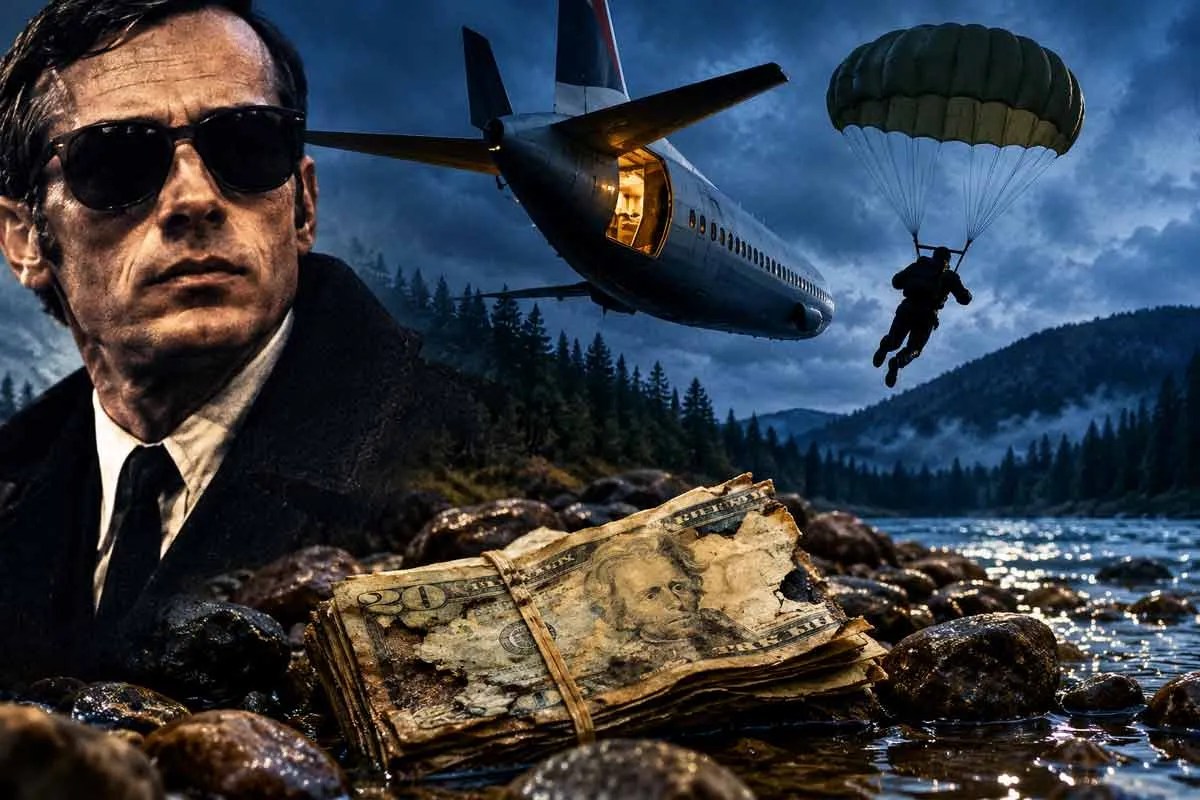
A mangled $20 Federal Reserve note from the 1980 Tina Bar find along the Columbia River crossing the block in October 2026 does not move the investigative needle one millimeter. The FBI closed its active field investigation in July 2016. The serial numbers were logged decades ago. The physical fragment measures barely four and a half inches by an inch and a half.
Calling an auction spike a "reopened secret" confuses provenance—the documented chain of custody and historical origin of an item—with proof. They are not the same thing. One tells you who owned a scrap of paper last week; the other tells you what happened in the Pacific Northwest pitch-darkness in 1971.
What the Competitor Got Wrong About the Auction
The standard coverage follows a predictable script. Recount the Boeing 727 hijacking. Mention the $200,000 ransom. Remind readers that eight-year-old Brian Ingram dug up rotting packets of twenty-dollar bills in 1980. Gasp at a six-figure price tag that converts to more than a crore of rupees.
Here is the flaw in that framing. High-end currency auctions do not price historical breakthroughs. They price scarcity, narrative friction, and ego.
When a $20 bill with missing corners, river silt staining, and PCGS verification sells for $134,200 against a $20,000 pre-sale estimate, the market is telling you something sharp about human psychology, not criminal forensics. Collectors are buying the only unsolved commercial skyjacking in aviation history. Because the story has no neat ending, every physical artifact acts as a blank canvas. Each bidder projects their own theory onto a piece of degraded currency.
I have watched collectors, media producers, and amateur sleuths pour fortunes into chasing "the one clue" for years. I have seen syndicates and true-crime ventures burn through millions chasing deathbed confessions, fringe suspects, and backyard metal-detector sweeps while ignoring basic forensic limits. Most of those efforts end the same way: a press release, a cable documentary, and zero corroboration.
Stop Asking Who DB Cooper Was
"Who was DB Cooper?" is the wrong question. It keeps people trapped in parlor games.
Even if a partial fingerprint, a wool fiber from a clip-on tie, or a distant family tree match surfaced tomorrow, an uncorroborated name does not prove survival or flight. Plenty of men matched the rough description in 1971. Only one jumped off the aft airstair of Northwest Orient Airlines Flight 305 into freezing rain over southwestern Washington.
Ask a sharper question instead. Why did the FBI fail to find a body, a main canopy, or the rest of the cash in the Washougal River watershed—and what does the river erosion on the Tina Bar bills actually reveal about hydrology?
Investigators and aviation specialists—including former lead NORJAK agent Ralph Himmelsbach and later flight-path analysts—recalculated the drop zone using data from Captain Scott and Continental pilot Tom Bohan. Once wind vectors and manual flight adjustments were factored in, attention shifted east toward the Washougal River basin.
Consider how river sediment interacts with currency:
- Hydrodynamic transport: Flowing water and seasonal runoff can move lightweight debris and packaged bills downstream over years, depending on bank structure, dredging, and flood events.
- Material degradation: Cotton-fiber banknotes resist total disintegration far better than standard wood-pulp paper, yet prolonged immersion, abrasion against sand and gravel, and biological activity chew away edges and leave unmistakable physical wear.
- Incomplete recovery: Finding roughly $5,800 to $6,000 in twenty-dollar bills out of a $200,000 ransom leaves more than 97 percent of the cash unaccounted for.
That gap is the real story. If Cooper survived and spent the money normally, bills would have surfaced in circulation once serial numbers went public and newspapers ran reward offers. Almost none did. If he died on impact or from exposure, where is the rest of the payload?
A Thought Experiment on Survival and Secrecy
Imagine a scenario where a seasoned paratrooper or outdoorsman survives the jump with a non-steerable military chute in foul weather, lands deep in timber, and hides the cash before walking out. Even under ideal conditions, keeping $194,000-plus hidden for five decades without triggering bank alerts, lifestyle anomalies, or slip-ups among family takes discipline almost no criminal possesses.
Now flip the scenario. Imagine a man who underestimates the slipstream, cold, or terrain, dies in dense brush, and leaves the money where time and water slowly break it apart. That explains the missing cash without requiring a criminal mastermind who vanished like smoke. Neither scenario is proven beyond doubt. Both are far more useful to analyze than another recycled list of suspects.
What People Also Ask—Brutally Answered
Did the $134,200 auction prove DB Cooper survived?
No. A high bid proves demand among numismatists and true-crime buyers. It does not change physics, weather, or the absence of verified post-jump sightings.
Why did the FBI close the case if money was found?
The money was found in February 1980. The FBI kept investigating for thirty-six more years before suspending active field work in July 2016. At some point, chasing diminishing returns stops being law enforcement and becomes sunk-cost theater. Agencies still accept serial number tips or physical evidence, which is bureaucratic prudence, not an active manhunt.
Is there any downside to treating the auction as a non-event?
Yes—and honesty requires admitting it. Dismissing auction prices as mere hype can blind you to cultural and market signals. High-water-mark sales show how durable American folk myths remain, how third-party grading and provenance tags like PCGS anchor value in alternative collectibles, and how media cycles recycle old mysteries whenever a fresh price tag hits the wire. Ignore the mystery claim, not the market data.
How to Actually Investigate Unsolved Cases Without Getting Played
If you care about cold cases, historical artifacts, or investigative journalism, drop the sensationalist playbook and follow stricter habits:
- Separate price from proof. Whenever a headline links an auction record to a solved crime, check whether new forensic data was actually introduced. Usually, only the owner changed.
- Audit the chain of custody. Look at who authenticated the item, when the serial numbers were matched, and what physical condition the object is in. A torn scrap with verified serial numbers confirms origin, not outcome.
- Test the environment, not just the motive. Reconstruct weather, wind, terrain, water flow, and equipment limits before entertaining clever escape theories.
- Watch for survivorship bias in suspects. Every decade brings a new relative claiming a father, uncle, or neighbor "admitted" to the heist. Memory warps over fifty years; physical and documentary evidence carries far more weight.
A torn twenty-dollar bill sold for big money. The legend got richer. The facts stayed the same.