Skyscrapers generate an ungodly amount of heat. If you walk through downtown Toronto on a humid July afternoon, you are standing inside a massive urban heat island where conventional air-conditioning units hum away, guzzling electricity and spitting hot air onto the pavement.
Except beneath the surface of Lake Ontario, nature handles the heavy lifting for free.
Instead of relying solely on traditional, energy-hungry chillers, Toronto runs a district cooling network that pulls water from 83 metres (roughly 272 feet) down. At that depth, the water sits at a stubborn, refreshing 4 degrees Celsius year-round. Enwave Energy Corporation takes that natural chill and routes it through a network that services roughly 200 buildings across millions of square feet of downtown real estate.
If you want to understand modern urban engineering that actually makes sense, you look at this system.
The Mechanics Behind Deep Lake Water Cooling
Most people assume the lake water is pumped straight into office radiators or air handlers. That would be a plumbing disaster.
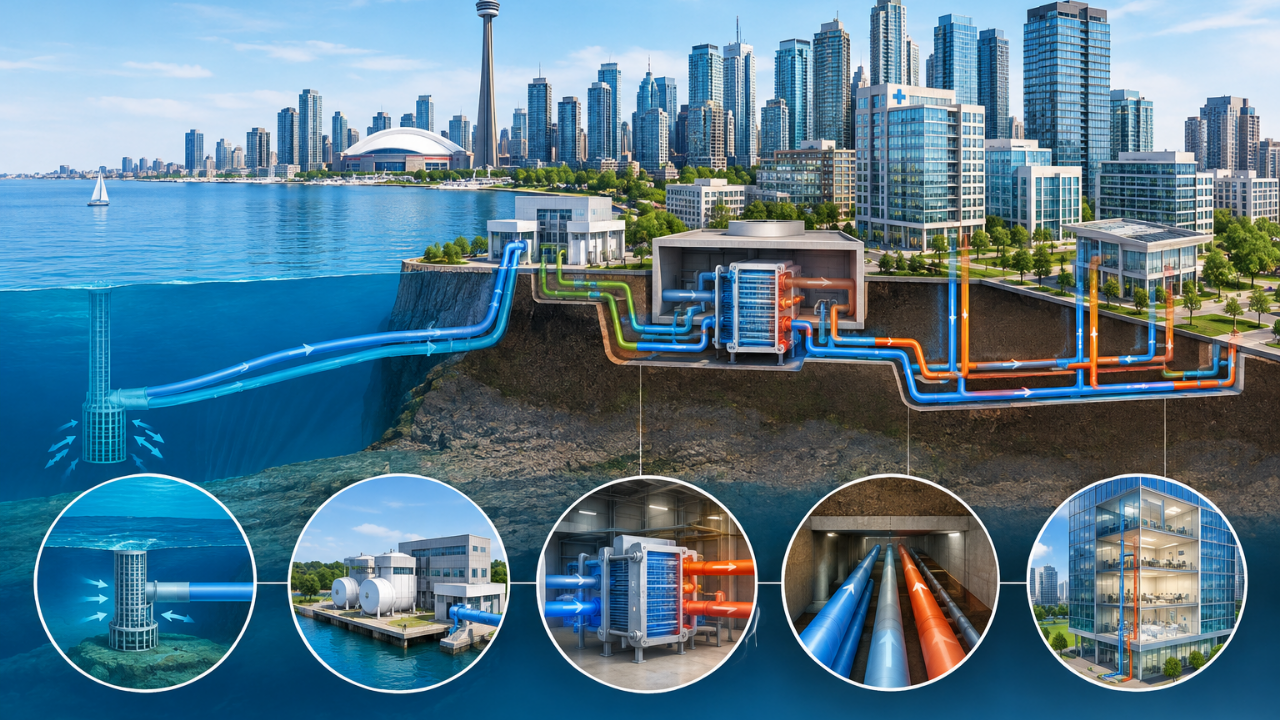
The process is much smarter. Heavy-duty intake pipes stretch miles out into Lake Ontario to tap into the cold, dense water layer. That water travels to the Island Filtration Plant, where it enters the municipal water treatment cycle. Before it ever reaches a tap, it passes through the John Street Pumping Station.
Here is where the magic happens. The frigid lake water flows past plate heat exchangers—essentially thin metal walls that keep the two water supplies completely separate.
- The Lake Side: Cold raw water absorbs heat.
- The Closed Loop Side: A separate network of clean, closed-loop city water gets intensely chilled.
That newly chilled closed-loop water then circulates through underground pipes to cool downtown skyscrapers, hospitals, data centres, and condos. The lake water itself is never contaminated. It simply continues on its journey to become Toronto’s everyday drinking water supply. You might literally drink water that spent the morning cooling a server rack or a hospital ward.
Why Traditional Air Conditioning Is a Losing Battle
Traditional building cooling relies on mechanical chillers driven by massive compressors. These units require huge amounts of electricity—mostly derived from fossil fuels during peak summer demand. When heatwaves strike, the electrical grid strains, brownouts threaten, and building operators watch their energy bills skyrocket.
Toronto's system slashes electricity consumption for cooling by up to 75 percent compared to standard configurations. Buildings hooked into the network don’t need to install or maintain their own bulky chiller plants on their roofs or in their basements. Brookfield Place, a massive downtown commercial complex spanning millions of square feet, completely ditched conventional chillers after connecting to the network.
Maintenance costs drop. Roof space opens up. The local electrical grid avoids a massive strain when everyone cranks their AC at the exact same time.
Scaling Up for a Warming City
Urban infrastructure rarely ages well, but this network has scaled aggressively since launching in 2004. What started as a niche environmental project now services a vast chunk of Toronto's downtown core, spanning over 40 million square feet of floor space.
Recent expansions added deep-water infrastructure and new tunnels to handle mounting urban density and high-density data workloads. Modern artificial intelligence infrastructure generates immense localized heat, and data centres are lining up to tap into district cooling models that can handle massive rack densities without melting local power grids.
Other cities try to copy the blueprint, but geography dictates everything. You need a deep, cold body of water right next to a dense urban center willing to invest heavily in subterranean piping networks. Toronto had the geography and took the gamble. Two decades later, the payoff is clear.
Stop looking at climate adaptation as an impossible expense. Sometimes the best infrastructure upgrade is just paying attention to what is already sitting at the bottom of the lake.


