The air in the Shanhai Tower in Shanghai smells faintly of ozone and expensive espresso. On the thirty-fourth floor, a woman named Zhou Wei stares at a glass whiteboard covered in silicon architecture diagrams. She is thirty-six, the chief operating officer of a hard-tech startup specializing in gallium nitride semiconductors. Her team has solved a heat dissipation problem that has baffled larger Western conglomerates for three years. They have the patents. They have the manufacturing pipeline in Jiangsu.
What they do not have is a way to explain themselves to a pension fund manager in Frankfurt.
To the manager in Frankfurt, Zhou’s company is a collection of geopolitical risks, foreign exchange headaches, and accounting standards written in a language they cannot verify. The distance between Shanghai and Frankfurt is not measured in miles. It is measured in trust.
This is the silent friction slowing down the next generation of global industry. A wave of Chinese innovation—ranging from artificial intelligence clusters to advanced biomechanoids—is sitting on the edge of the mainland, looking outward. The domestic market is immense, but the world is the true testing ground. Yet, crossing that border requires more than just shipping containers. It requires a legal, financial, and cultural translator.
Enter Hong Kong.
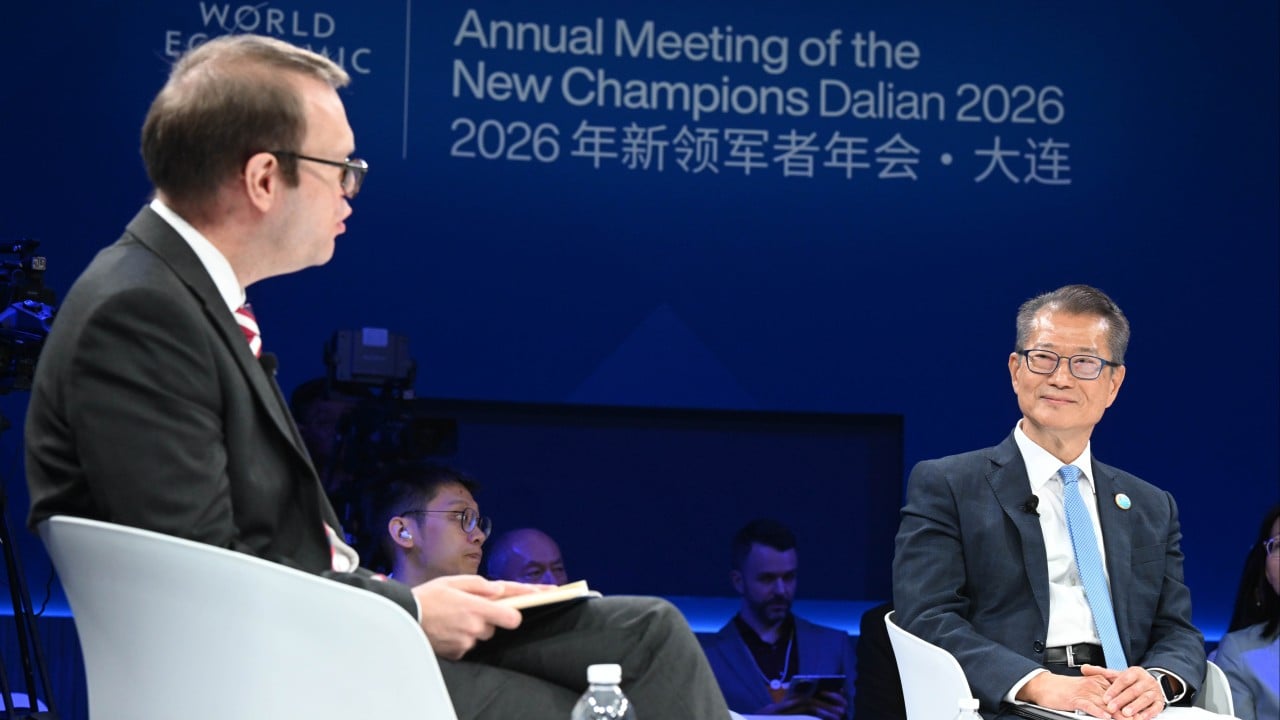
Not the postcard version of neon signs and harbor ferries, but the quiet, hyper-efficient machinery of courtroom benches, compliance offices, and currency clearing houses. When Hong Kong Financial Secretary Paul Chan spent weeks traveling from the corporate hubs of Dalian and Xi'an to the financial stages of Shanghai and Nanjing, he was not merely pitching a city. He was offering a bridge for a massive transition: China Opportunity 2.0.
The Code of the Courtroom
Consider a hypothetical investor named Arthur, sitting in an office building in London. Arthur handles capital for thousands of retirees. He wants exposure to the Chinese artificial intelligence boom. China is pouring billions into nationwide AI infrastructure, creating fields of commercial applications that simply do not exist anywhere else. Arthur knows the growth is there.
But Arthur answers to a board of trustees. He needs to know that if a contract is breached, the dispute will be settled under a legal framework he recognizes. He needs a system rooted in common law.
This is where the translation occurs. When a mainland hard-tech firm chooses Hong Kong for its initial public offering or secondary listing, it isn't just looking for money. The capital on the mainland is plentiful. What the firm is buying is a stamp of institutional rigor. By subjecting its books to Hong Kong’s regulatory framework, the company tells Arthur: We speak your language of accountability.
It is a two-way filter. For the mainland innovator, the city is a launchpad. For the international fund manager, it is the clearest lens available to see through the opaque fog of global market skepticism.
The mechanics of this system depend on an arrangement that sounds dry on paper but functions as a economic miracle in practice: the principle of coexistence under two distinct legal and economic operations. It allows a company to harness the industrial muscle of the mainland while anchoring its corporate governance in a global financial capital. The asset value is unlocked because the global market can finally measure it accurately.
Moving Beyond the Ledger
Money is cowardly. It flees from friction. If a cross-border transaction requires five layers of currency conversion and a stack of bureaucratic permissions, capital will simply stay home or move elsewhere.
To combat this, the financial architecture is changing beneath our feet. For decades, global trade relied entirely on a single, centralized financial pipeline. Today, the world is moving toward a more distributed framework. This is not a sudden fracture or a political boycott; it is a natural diversification. China accounts for a massive slice of global trade, which means more suppliers, buyers, and builders want to settle accounts directly in Renminbi to avoid foreign exchange volatility and slice away unnecessary transaction fees.
Hong Kong has quietly positioned itself as the capital of this shifting tide. It handles the lion's share of offshore Renminbi payments, turning a complex geopolitical transition into a routine corporate utility.
But the ambition extends past traditional ledgers. The financial infrastructure is becoming digital. The Hong Kong government has taken the lead in issuing tokenized bonds, transforming how debt is packaged and traded. By utilizing decentralized ledgers for green finance and commodity trading, they are stripping the administrative fat out of international investments.
The Physical Anchor
It is easy to get lost in the abstractions of venture capital and digital tokens. But innovation eventually requires dirt, concrete, and physical bodies.
To see how this plays out in real life, look at the Northern Metropolis project and the tech zones spreading across the San Tin Technopole near the border with Shenzhen. This is where the translation of trust becomes physical infrastructure. It is an intentional collision of two distinct ecosystems.
On one side of the river is Shenzhen: rapid prototyping, massive supply chains, and an army of engineers who can turn a blueprint into a physical product in forty-eight hours. On the Hong Kong side: intellectual property protection, international clinical trial academies, and direct access to global capital.
Imagine a biomedical startup that has discovered a new compound for treating lung disease. If they stay entirely within the mainland ecosystem, getting international regulatory approval can take a decade of bureaucratic navigation. By using the International Clinical Trial Academy in Hong Kong, the firm can run trials that meet both national and global standards simultaneously. The timeline shrinks. The medicine reaches patients years faster.
This is what Paul Chan refers to when he uses terms like value-adding. It is the elimination of lost time.
The Human Core of the Capital
Back in Shanghai, Zhou Wei makes her decision. Her company will not seek its next major funding round through a mainland exchange, nor will they attempt a direct, complicated listing in New York. They are opening an office in Central, Hong Kong.
Her legal team will be led by a barrister trained in London. Her corporate treasury will operate in a mix of US dollars, Euros, and Renminbi, shifting freely across borders without the friction that stalls operations on the mainland. Her engineers will stay in Jiangsu, but her global face will look out from a tower overlooking Victoria Harbour.
The system is not perfect. It is buffeted by the winds of global politics, strained by doubts, and constantly forced to prove its independence to a cynical world. There are days when the cross-border coordination feels like trying to orchestrate a duet between two musicians playing in different keys.
Yet, when the music works, there is nothing else like it. The city thrives precisely because it handles the tension between two different worlds. It does not try to make Shanghai look like London, nor does it try to turn London into Beijing. It stands in the middle, holding open the door, ensuring that when a brilliant idea rises on one side of the globe, the capital to build it can flow seamlessly from the other.
Zhou Wei cleans her whiteboard. The architectural diagrams remain, but the path forward is clear. The translation is complete.
Paul Chan on Hong Kong's Market Outlook
This interview features Hong Kong Financial Secretary Paul Chan discussing the resilience of capital inflows and how the city continues to anchor its international financial systems amidst shifting cross-border dynamics.