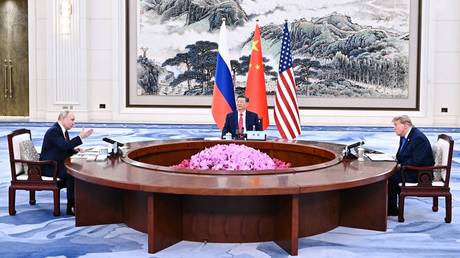
When three nuclear-armed states—the United States, Russia, and China—issue a joint declaration oriented toward peace, the event represents an immediate structural shift in international equilibrium rather than a mere diplomatic courtesy. Mainstream commentary typically treats such announcements as binary outcomes, framing them either as historic breakthroughs or empty rhetoric. Both interpretations fail to account for the underlying incentive structures that drive trilateral cooperation among rival superpowers. A joint declaration between Washington, Moscow, and Beijing functions primarily as a mechanism for risk mitigation, signaling mutual boundaries to prevent unintended escalation while preserving competitive advantage in non-military domains.
To understand the operational value of a trilateral peace framework, analysts must strip away diplomatic phrasing and examine the transaction costs, verification bottlenecks, and strategic asymmetries inherent in any agreement involving Vladimir Putin, Donald Trump, and Xi Jinping.
The Structural Anatomy of Trilateral Signaling
Diplomatic declarations among great powers operate under the principles of non-cooperative game theory, specifically variations of the Prisoner's Dilemma and the Stag Hunt. In bilateral negotiations, two actors manage a single axis of tension. Introducing a third actor transforms the dynamic into a complex balance-of-power calculation where any two parties face the perpetual risk of collusion by the other two.
When a competitor article reports on a "joint declaration towards peace" without examining the text's structural mechanisms, it misses the three primary functions that such a document performs in international statecraft:
- Escalation Dominance Caps: The declaration establishes a shared ceiling on kinetic conflict. By publicly committing to peace, each leader raises the domestic and international political cost of initiating a direct military confrontation. This creates a buffer zone that absorbs minor tactical friction without triggering automatic retaliation.
- Strategic Reallocation: Maintaining high-alert military postures across multiple theaters drains capital and industrial capacity. A stabilized diplomatic baseline allows each state to reallocate resources toward internal economic restructuring, supply chain fortification, or technological development.
- Third-Party Containment: A unified statement from Washington, Moscow, and Beijing signals to regional actors and middle powers that they cannot easily play the three superpowers against one another to extract security guarantees or financial aid.
The absence of a verifiable URL or full primary text in standard reporting requires an analytical distinction between known structural behaviors of these three administrations and educated hypotheses regarding the specific clauses of a joint text. Historically, agreements involving these specific leaders prioritize executive-level bilateralism, transactional reciprocity, and strict preservation of national sovereignty over multilateral institutional oversight.
Deconstructing the Core Incentive Asymmetries
A major flaw in surface-level geopolitical reporting is the assumption that all signatories share an identical definition of "peace." In operational terms, each capital defines stability according to its immediate domestic constraints and strategic vulnerabilities.
Washington's Cost-Benefit Equation
From the perspective of the Trump administration, foreign policy is evaluated through the lens of return on investment, burden-sharing, and direct bilateral leverage. Protracted foreign entanglements and open-ended security commitments represent negative cash flow for the domestic economy. Signing a joint declaration serves a specific operational purpose: it reduces the immediate demand for continuous military expenditure abroad while positioning the executive branch as the primary architect of global stability. The mechanism here is transactional de-escalation—trading diplomatic recognition and reduced rhetoric for tangible reductions in overseas operational tempo and defense subsidies to allies.
Moscow's Security Architecture Requirements
For the Kremlin, peace is functionally defined as the formal recognition of a defined sphere of influence and the neutralization of perceived security threats along its immediate periphery. Prolonged high-intensity conflict imposes severe demographic, industrial, and financial strain, accelerating economic dependence on secondary partners. A trilateral framework offers Moscow a mechanism to bypass regional intermediaries and negotiate directly at the apex of the global hierarchy. By co-signing a document with both Washington and Beijing, Russia reasserts its status as an indispensable pole in global security governance, converting military leverage into diplomatic legitimacy.
Beijing's Systemic Stability Imperative
China's strategic posture is anchored in economic continuity, export market access, and uninterrupted maritime trade routes. Severe geopolitical shocks or kinetic conflicts involving major powers disrupt global supply chains and threaten domestic growth targets. Beijing approaches a trilateral declaration as a macroeconomic stabilizer. By participating as an equal co-signatory alongside the United States and Russia, China reinforces its preferred diplomatic model—one based on state sovereignty and non-interference—while insulating its trade networks from sudden sanctions regimes or kinetic blockades.
The Verification Bottleneck and Enforcement Mechanisms
A declaration of intent is fundamentally different from a binding treaty. In international law and strategic operations, a joint declaration carries political weight but lacks automatic enforcement triggers. Without precise verification protocols, such agreements remain vulnerable to rapid degradation.
Analysts evaluating any tripartite peace framework must assess four critical operational variables to determine whether the text represents a durable equilibrium or a temporary tactical pause:
- Information Asymmetry and Telemetry: True de-escalation requires transparent verification. Historically, arms control and peace frameworks relied on intrusive on-site inspections, satellite telemetry sharing, and joint commission reviews. If a joint declaration omits specific data-exchange mechanisms, each party must rely on unilateral national technical means—such as reconnaissance satellites and signals intelligence—to verify compliance. This creates a lag between action and detection, increasing the risk of miscalculation.
- Ambiguity in Territorial and Jurisdictional Definitions: Diplomatic texts frequently rely on constructive ambiguity to secure signatures. Phrases like "respect for sovereignty" or "indivisible security" carry contradictory operational meanings across capitals. Washington interprets sovereignty through established international borders; Moscow interprets indivisible security as a prohibition against neighboring states joining rival military alliances; Beijing views sovereignty as an absolute shield against external critique of internal governance. When operational friction occurs, these divergent definitions fracture the consensus.
- Sanctions Relief and Economic Sequencing: Peace declarations rarely exist in a vacuum; they are tied to economic normalization. The sequencing of concessions presents a major bottleneck. If one party demands the immediate lifting of financial restrictions before executing troop withdrawals or posture changes, the transaction stalls due to a lack of trust. Durable frameworks utilize escrow-style reciprocity, where measurable physical adjustments on the ground unlock incremental economic or diplomatic adjustments in strict parity.
- The Spoiler Problem: A trilateral agreement between the United States, Russia, and China does not automatically bind their respective allies, proxies, or regional partners. States whose security depends on the continuation of superpower rivalry—or whose territorial integrity is affected by the terms of the declaration—possess strong incentives to act as spoilers. If a regional actor initiates a localized crisis, the three signatories face an immediate stress test: they must either jointly restrain their respective partners or abandon the declaration to defend their credibility.
Cause-and-Effect Chains Missed by Surface Commentary
Standard news coverage tends to treat the signing of a joint document as the culmination of a process. In reality, the signature marks the beginning of an internal bureaucratic and geopolitical stress test. Three distinct second-order effects follow any high-level trilateral stabilization effort.
First, alliance restructuring accelerates. When the dominant security guarantor signals a direct accommodation with primary adversaries, junior allies experience acute abandonment anxiety. In Europe and the Indo-Pacific, allied capitals respond to trilateral US-Russia-China diplomacy by either hedging their bets—opening independent diplomatic channels with Beijing and Moscow—or accelerating indigenous defense procurement to reduce reliance on external security umbrellas.
Second, competition shifts from kinetic to sub-threshold domains. When great powers agree to lower the temperature on conventional military confrontation, competitive energy does not disappear; it migrates. Resources previously allocated to direct military posturing flow into cyber operations, critical mineral supply chain monopolies, semiconductor export controls, currency settlement alternatives, and space-based infrastructure. Peace in the kinetic domain often coincides with intensified friction in the economic and technological spheres.
Third, domestic political opposition mobilizes around concession narratives. In every system—whether democratic or authoritarian—hardline factions view compromise with external rivals as a vulnerability. In Washington, bipartisan critics scrutinize any perceived reduction in deterrence or concessions to authoritarian states. In Moscow and Beijing, nationalist constituencies monitor state media for signs that national security interests have been subordinated to Western economic pressure. Leaders must continuously manage these internal audiences, often using aggressive domestic rhetoric that contradicts the conciliatory tone of the joint declaration.
Limitations of Executive-Driven Diplomacy
While direct leader-to-leader diplomacy bypasses bureaucratic inertia and accelerates decision-making, it carries structural vulnerabilities that limit long-term durability.
- Key-Person Dependency: Agreements forged primarily through the personal rapport or transactional calculations of specific executives lack institutional roots. When leadership changes occur—through election cycles, term limits, or internal political transitions—the incoming administration faces low legal barriers to repudiating a non-binding declaration.
- Absence of Granular Technical Annexes: High-level declarations establish broad principles but rarely resolve technical disputes regarding weapons systems, cyber norms, or maritime exclusion zones. Without dedicated working groups empowered to draft binding technical protocols, minor operational incidents at sea or in the air can escalate rapidly because commanders lack agreed-upon rules of engagement.
- Signal-to-Noise Degradation: Frequent, sweeping declarations that are not followed by rapid, visible changes on the ground degrade the credibility of future diplomatic signaling. Markets, military planners, and foreign ministries quickly discount rhetorical commitments if troop deployments, defense budgets, and sanctions regimes remain unchanged.
Strategic Execution Framework for Decision-Makers
Organizations, institutional investors, and policy planners operating in an environment shaped by trilateral superpower diplomacy cannot rely on headline sentiment. Decision-making must be anchored to observable, verifiable indicators rather than diplomatic phrasing.
To navigate the transition from rhetoric to operational reality, apply a three-tier monitoring protocol over the 90 days following any joint declaration:
- Audit Physical Force Posture and Logistics: Disregard public statements and track observable military indicators. Monitor naval deployment patterns in contested straits, strategic bomber patrol frequencies, artillery ammunition production rates, and forward-deployed logistics hubs. Genuine de-escalation produces measurable reductions in operational tempo and forward-staging within 30 to 60 days.
- Track Regulatory and Financial Unwinding: Peace frameworks only alter macroeconomic risk when backed by administrative action. Monitor treasury departments and commerce ministries for specific general licenses, tariff suspensions, export control exemptions, and the restoration of correspondent banking channels. Until regulatory codes change, capital flows and supply chain risks remain locked in their pre-declaration state.
- Establish Working-Group Continuity Benchmarks: Verify whether the three capitals appoint senior, empowered negotiators to standing bilateral and trilateral commissions within 45 days. The creation of institutionalized communication channels—specifically military-to-military deconfliction hotlines and technical verification panels—is the primary indicator that a political declaration is being converted into a durable operational architecture.