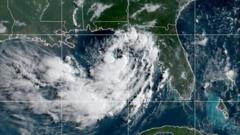
Severe weather events along the United States Gulf Coast represent a predictable sequence of operational disruptions, supply chain bottlenecks, and localized infrastructure stress. Evaluating the threat posed by Tropical Storm Bertha requires moving beyond superficial wind speed metrics to quantify three core mechanisms of loss: hydrological volume, energetic force at landfall, and systemic disruption to energy and maritime transport corridors.
Hydro-Meteorological Failure Vectors
The primary hazard vector associated with mid-tier tropical systems is rarely wind velocity; it is precipitation volume and storm surge mechanics. Tropical Storm Bertha's threat profile breaks down into two core physical drivers:
1. Hydrological Accumulation and Runoff Capacity
When a organized tropical system approaches the low-lying terrain of the Gulf Coast, precipitation efficiency increases due to high precipitable water values in the maritime air mass. The primary risk to regional infrastructure operates along a simple threshold function:
- Infiltration Capacity Exceeded: Coastal soil profiles feature low saturation thresholds. Once rainfall rates exceed localized percolation speed (typically 0.5 to 1.5 inches per hour in clay-heavy coastal plains), 100% of additional precipitation converts directly to surface runoff.
- Urban Drainage Bottlenecks: Civil drainage networks in major Gulf Coast urban areas are routinely engineered for 10-year or 25-year flood events. Storm systems delivering sustained, localized rainfall above 3 inches per hour overwhelm pump capacities, producing rapid urban inundation regardless of atmospheric pressure readings.
2. Barometric Surge Generation
Storm surge elevation correlates with barometric pressure deficits and prolonged wind stress over shallow water rather than sustained peak wind gusts. As Bertha traverses the shallow continental shelf of the northern Gulf of Mexico, onshore wind vector duration drives water inland. Shallow bathymetry amplifies water accumulation, creating physical barriers at river mouths that prevent inland drainage and compounding riverine flood risks.
Supply Chain and Energy Sector Exposure
The Gulf Coast functions as the primary refining, offshore production, and maritime export hub for North American energy products. Disruption mechanics ripple through national supply networks via three distinct transmission channels.
Offshore Platform Evacuation Protocols
Energy operators execute tiered risk mitigation procedures well in advance of center-line landfall predictions:
- Phase One (72 Hours Pre-Landfall): Non-essential personnel evacuation; temporary shut-in of deepwater drilling rigs.
- Phase Two (48 Hours Pre-Landfall): Shut-in of production wells on shallow-water platforms; securing of subsea pipeline manifolds.
- Phase Three (24 Hours Pre-Landfall): Complete evacuation of operational crews; remote monitoring activation.
This precautionary shut-in protocol creates an immediate, artificial contraction in domestic crude oil and natural gas production days before physical storm impacts occur, causing short-term price volatility in spot markets.
Port Operations and Maritime Interruption
The ports of Houston, South Louisiana, and Mobile handle critical volumes of bulk commodities, refined petroleum, and agricultural exports. Storm force winds exceeding 34 knots force maritime authorities to implement vessel traffic restrictions. Draft limitations from post-storm siltation delay vessel turnaround times, creating maritime queue backups that require weeks to clear.
Risk Assessment and Mitigation Standard Operating Procedures
Regional municipal planners, supply chain directors, and facility managers must evaluate risk using empirical thresholds rather than broad public warnings.
Risk Index = (Precipitation Density Rate) x (Drainage Network Vulnerability) + (Surge Height Level above Mean High Water)
Mitigation strategies must account for compounding systemic failures. Facilities reliant on municipal grid power face elevated operational risk due to high-voltage transmission line exposure in coastal wind fields. Backup power systems must maintain minimum fuel reserves for 72 hours of continuous operation, assuming regional logistics networks will be non-functional immediately post-event.
Asset owners operating along the Gulf Coast must immediately audit facility elevation profiles against revised NOAA surge inundation models, establish secondary supply chains outside the direct storm path, and initiate pre-emptive shutdown procedures for assets situated in 100-year flood zones prior to the onset of tropical-storm-force winds.