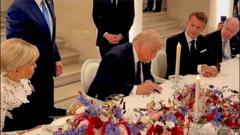
Donald Trump didn't just sign a piece of paper on Wednesday night. He blew up a decade of Republican foreign policy orthodoxy over a plate of dinner at the Palace of Versailles.
Stepping out of a dinner with French President Emmanuel Macron, Trump gave reporters the news directly. "It's signed. Signed in Versailles. Just signed it."
The document in question is a 14-point memorandum of understanding (MoU) with Iran, co-signed electronically by Iranian President Masoud Pezeshkian. It stops a brutal regional war that ignited on February 28, 2026, a conflict that pitted the US and Israel directly against Tehran. But looking at the fine print, this agreement looks less like a total victory and more like a massive tactical retreat wrapped in gold leaf.
For years, the political playbook on Iran was simple: maximum pressure, zero concessions, and total elimination of their nuclear ambitions. Trump himself tore up the 2015 Obama-era nuclear deal, calling it the worst bargain ever made. Now, facing an economic crisis and an upcoming midterm election cycle, Trump just signed an interim deal that gives Tehran things Barack Obama never would have dreamed of offering.
What Iran Gets Right Away
The immediate concessions handed to Tehran are staggering. This isn't a long-term carrot-and-stick arrangement. The US is giving up its primary leverage on day one just to get the oil flowing again.
- Immediate Sanctions Relief: The US Treasury is issuing instant waivers to allow Iran to export crude oil and petroleum products freely.
- End of the Naval Blockade: The United States military must dismantle its naval blockade of Iranian ports within 30 days.
- Return of Frozen Assets: Billions of dollars in frozen Iranian funds will be unfrozen and returned to Tehran's central bank. As Trump put it during his post-G7 remarks: "We have taken their money, it's their money. If we didn't give it back, nobody would ever invest in the dollar again."
- The $300 Billion Fund: The agreement outlines a US-backed economic development and reconstruction fund for Iran. While Trump claims Western taxpayers won't fund it directly—suggesting Persian Gulf states will foot the bill—the US is actively organizing it.
What does the US get in exchange? Iran agrees to reopen the Strait of Hormuz toll-free for a 60-day window. That is it. Nearly one-fifth of the world's oil supply flows through that chokepoint, and its closure sent global markets into a tailspin. Trump is betting the house that lowering gas prices at home will save his party from a midterm drubbing, even if it means funding the very adversary he vowed to crush.
The Nuclear and Missile Reality Check
If you listen to the administration's spin, they will tell you this deal stops an Iranian nuclear bomb. The MoU states that Iran reaffirms it will not build or acquire nuclear weapons. It also tasks the International Atomic Energy Agency (IAEA) with monitoring the "downblending" of Iran's highly enriched uranium stockpile, which currently sits at more than 9,000 kilograms.
But the details reveal deep cracks in that narrative. The agreement doesn't force Iran to ship its 440 kilograms of near-weapons-grade uranium out of the country. It allows them to dilute it on-site. Worse for Washington hawks, the deal says absolutely nothing about Iran's ballistic missile arsenal or its funding of regional proxy groups.
Trump shrugged off those concerns with casual indifference during his press conference. "Missiles are not the problem," he said. "They hurt a little location but they don't blow up the planet." He even conceded that Iran has a basic right to civilian uranium enrichment and needs some ballistic missiles because "other people have some."
Compare that to the initial war aims. The administration explicitly stated the goal of the February war was to destroy Iran's nuclear infrastructure, eliminate its missile programs, and potentially force regime change in Tehran. Instead, the Versailles text explicitly says both nations will "respect each other's sovereignty" and refrain from interfering in internal affairs. Tehran didn't blink; Washington did.
The Looming Clash with Israel
The most explosive part of this deal isn't what happens in the Persian Gulf. It's what happens in the Levant.
The MoU contains language affirming Lebanon's territorial integrity, aiming to halt Israel's ongoing ground invasion against Hezbollah. Iranian officials have already warned that if Israel continues its military operations in Lebanon, the entire peace deal is dead.
This puts the White House on a direct collision course with Israeli Prime Minister Benjamin Netanyahu. Israel went to war alongside the US to neutralize the Iranian threat once and for all. Now, Netanyahu finds himself isolated, facing a deal that lets Iran keep its regional influence and missile tech while securing a massive financial windfall. Unsurprisingly, Israeli media and political figures are already calling the Versailles agreement a betrayal.
The 60-Day Clock Is Ticking
Don't mistake this for a final peace treaty. This is a temporary ceasefire with a 60-day expiration date. The real battle begins now as diplomats try to turn this framework into a permanent settlement.
If you are tracking the fallout of this diplomatic shift, keep your eyes on these specific pivot points over the coming weeks:
- The Geneva Dynamic: Watch whether Vice President JD Vance and Middle East envoy Steve Witkoff can salvage the formal, in-person signing ceremony originally scheduled for Friday in Switzerland. Conflicting signals from Pakistan, Qatar, and Iran suggest the logistics are already fracturing.
- The Enrichment Standoff: Pay attention to the upcoming negotiations over the length of Iran's enrichment moratorium. The US wants a 20-year freeze; Iranian negotiators have made it clear they will not accept anything past 10 years.
- The Oil Market Response: Monitor global crude prices. If the opening of the Strait of Hormuz fails to drop gas prices significantly, Trump loses his primary domestic justification for the deal, leaving him exposed to intense fury from his own party.
Trump insists he retains the upper hand. He warned that if Iran steps out of line during the 60 days, the bombs will start falling again. "It's a memorandum of understanding, and if I don't like it, we'll go back to shooting at them," he stated. But once you hand an adversary $300 billion in economic relief, unfreeze their assets, and lift a naval blockade, putting the genie back in the bottle is a lot harder than dropping a bomb.


