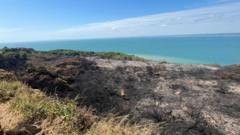
You smell it long before you see it. That dense, acrid reek of ancient vegetation cooking slowly beneath the dirt. Heathland fires look terrifying when flames roar across the surface, chewing through gorse and heather. But the real nightmare happens out of sight. When a fire drops below the surface and turns into a subsurface burn, traditional firefighting rules stop working entirely.
People assume that once surface flames are doused, a wildfire is finished. That assumption destroys ecosystems every single year. Peatlands contain thousands of years of accumulated organic matter, and when this material catches fire underground, it doesn't crackle or roar. It smoulders.
The Physics of a Subsurface Burn
Smouldering combustion is entirely different from flaming fire. It's a slow, flameless chemical reaction where oxygen directly attacks the surface of a solid fuel source like dry peat. You don't need roaring gales or towering walls of fire to sustain it. A tiny spark from a discarded cigarette or a glass bottle can drop into a dry crack in the soil, find a slow drip of oxygen moving through porous earth, and burrow downward.
Once peat ignites underground, it can burn at temperatures around 80 degrees Celsius for months, or even years, completely undetected. Heavy rain won't fix it. Pumping thousands of gallons of water onto the surface often just skims the top, leaving the subterranean furnace completely intact. The thick, insulating layers of surrounding soil trap the heat, meaning the fire can endure through freezing winter conditions and spring thaws, only to pop back up as a brand-new surface flare-up miles away.
Scientists tracking these events in places like the Arctic, Canada, and localized European moorlands call them zombie fires for a reason. They refuse to stay dead.
Why Heathlands Are Sitting Ducks
Most vulnerable heathlands share a common problem: historical drainage and prolonged drought. When you dry out a wetland or a blanket bog to make way for agriculture or forestry, you drop the water table. Peat that should be saturated and spongy turns into dry, powdery carbon fuel.
Sphagnum moss and other native bog plants normally act as natural firebreaks because they hold massive amounts of moisture. Strip that moisture away through consecutive heatwaves, and the ground transforms into a continuous fuse.
When emergency crews arrive at a heathland flare-up, they face an impossible choice. Pouring water on the surface cools the immediate area, but unless crews physically dig out the burning organic layers meters beneath the topsoil, the fire simply creeps horizontally through the root systems. It waits for drier conditions, finds a weak point in the soil profile, and breaches the surface again as a fresh emergency.
The Hidden Carbon Catastrophe
The immediate threat to local hiking trails and wildlife is bad enough, but the wider impact is staggering. Peatlands cover a fraction of the earth's surface, yet they store massive amounts of carbon—more than all the world's forests combined.
When an underground peat fire consumes that ancient soil, it unlocks centuries of stored greenhouse gases in a matter of weeks. This creates a brutal feedback loop. Climate change drives faster atmospheric warming and worse droughts, which dries out peatlands, which triggers more underground burns, which releases more carbon into the air.
Managing these landscapes requires shifting focus away from just fighting active surface flames. Conservationists and land managers are increasingly realizing that ecological restoration must prioritize rewetting bogs and blocking old drainage ditches. If you don't raise the water table back to where it belongs, you're just waiting for the next spark to wake the zombies back up.