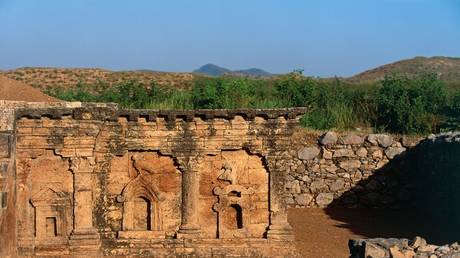
The international heritage elite is having a collective meltdown because Pakistan used modern cement to stabilize the ancient ruins of Taxila.
When news broke that Pakistan’s Department of Archaeology and Museums applied modern masonry techniques to the crumbling walls of Sirkap and the monastic remains of Mohra Moradu, the reaction from Paris was swift, severe, and utterly predictable. UNESCO threatened to relegate the Vedic and Buddhist-era complex to its List of World Heritage in Danger. Editorial boards across South Asia immediately parroted the lazy consensus, decrying the intervention as an act of bureaucratic vandalism that "compromised historical authenticity."
This outrage is not just misplaced. It is actively destructive.
The global heritage preservation framework is built on a toxic, romantic obsession with elegant decay. Western bureaucrats who view the developing world through the lens of a perpetual museum catalog prefer ancient sites to collapse naturally rather than see them reinforced with modern materials. By demanding that cash-strapped nations use archaic, failing conservation techniques to preserve millennium-old stone, UNESCO is forcing the world's most critical archaeological sites into state-mandated oblivion.
The Myth of Pure Material Authenticity
The core of UNESCO's objection to the Taxila restoration rests on the Venice Charter of 1964. This outdated document dictates that any restoration work must use original materials or structurally identical substitutes to maintain "authenticity."
In a pristine laboratory setting, this sounds noble. In the real world, it is an engineering death sentence.
Taxila represents a complex layers of civilizational history, spanning from the Achaemenid and Mauryan empires to Greco-Buddhist and Kushan eras. The original masonry consists of random rubble and diaper masonry bound together by mud mortar or weak lime mixtures. For two thousand years, these walls survived primarily because they were buried under metric tons of protective earth.
Once an archaeological site is excavated, its clock starts ticking backward at an accelerated rate. The moment you expose ancient mud and unreinforced stone to open air, atmospheric moisture, and human traffic, the structural integrity drops off a cliff.
Forcing modern engineers to repair a highly exposed, deteriorating wall with the exact same weak mud slurry used by a third-century builder is not preservation. It is sabotage. Mud and traditional low-fired lime mortars require near-constant reapplication. They wash away in the first heavy downpour, leaving the underlying stones unsupported.
I have seen heritage departments across Asia and Africa spend millions of dollars in a continuous, futile loop: applying traditional slurries every spring, watching them melt every monsoon, and repeating the cycle while the underlying ancient stones slowly fracture and collapse. The moment a local authority loses patience and injects modern Portland cement or stabilized mortars to permanently anchor a failing retaining wall, the international community treats them like cultural criminals.
When Climate Realities Clash With Bureaucratic Fantasies
The lazy consensus ignores a glaring structural variable: the environment of 2026 is radically different from the environment of the third century.
South Asia is currently experiencing unprecedented shifts in weather severity. Monsoon seasons are no longer gentle periods of sustained rain; they are catastrophic, concentrated deluge events. Just a few years ago, the neighboring Indus Valley site of Mohenjo-daro was nearly liquefied by record-breaking rainfall that overwhelmed its traditional mud-brick protective coatings.
When an ancient site faces 1,400 millimeters of rain in a matter of weeks, an unreinforced wall of random rubble will absorb water, expand, experience massive hydrostatic pressure, and blow out from the base.
When Pakistan’s engineers used modern cement and masonry to raise wall heights and fortify the bases at Sirkap and Mohra Moradu, they were performing basic, triage structural engineering. They were creating barriers to divert torrential water away from fragile interior foundations. They chose structural survival over aesthetic purity.
UNESCO’s response was to point to a handbook written by European academics who have never had to manage a site during an Asian monsoon. The organization explicitly warned Pakistan that it previously stripped the Dresden Elbe Valley in Germany and the maritime mercantile city of Liverpool of their World Heritage status for altering their urban profiles.
To compare a functional, living city building a modern bridge or waterfront infrastructure to an underfunded department trying to keep ancient Buddhist monasteries from sliding down a mud bank is intellectually bankrupt. It exposes the profound disconnect at the heart of the global heritage apparatus. UNESCO treats these sites as aesthetic trophies for Western tourists and academic elites, rather than vulnerable, physical structures requiring active, modern defense.
The Financial Impossibility of Western Style Conservation
The preservation purists argue that modern materials like Portland cement are fundamentally incompatible with ancient stone because cement is less permeable than lime, trapping moisture and accelerating internal decay.
Chemically, this is true. Portland cement contains soluble salts and creates a rigid barrier that can cause softer surrounding ancient stones to flake off over decades. The correct, high-level engineering solution is to formulate custom, low-alkali lime-pozzolana mortars that mimic ancient breathability while offering modern durability.
But let’s look at the actual economics.
Formulating, testing, and applying custom-engineered historical mortars requires an army of specialized material scientists, specialized import channels, and decades of sustained funding. Pakistan’s Department of Archaeology and Museums operates on a shoestring budget in an economy fighting severe fiscal crises. They do not have the luxury of importing specialized Italian pozzolana or spending five years running laboratory tests on lime curing rates while a monsoon is actively undermining a Mauryan stupa.
When a local site manager looks at a cracking wall that is about to collapse onto a tourist path, they have two choices:
- Wait for an international grant that may never arrive while UNESCO committees debate the ethics of intervention.
- Go to the local market, buy a bag of standard structural cement, and fix the wall before it falls down.
Choosing the latter is an act of pragmatic stewardship, not vandalism. If the choice is between a structurally stable wall with an ugly, unauthentic cement patch and a pile of authentic, original dust on the ground, any rational preservationist must choose the cement. UNESCO consistently chooses the dust.
The Colonial Undercurrent of Heritage Status
There is an unstated, deeply arrogant colonial dynamic to the entire World Heritage listing process. Western institutions dictate the rules of what constitutes "value" and "authenticity," while developing nations are expected to bear the crushing financial and logistical burden of maintaining these massive open-air museums.
When Pakistan promotes Taxila through tourism campaigns, it is trying to generate the literal revenue required to keep its museums open. Yet, the moment they attempt to modify the infrastructure to handle increased foot traffic, protect visitors from falling masonry, or stabilize a site against flash floods, they are threatened with delisting.
The World Heritage in Danger list is frequently weaponized as a tool of public shaming rather than a mechanism for deployment of resource assistance. If UNESCO were truly committed to the preservation of Taxila, their immediate response to the use of improper masonry would not be a public threat of delisting and a demand for bureaucratic paperwork. It would be an immediate deployment of material scientists, structural engineers, and direct financial aid to provide the high-grade, compatible conservation materials that the local government cannot afford.
Instead, they send a delegation to hold meetings in air-conditioned offices, demand historical impact assessments, and threaten to take away a badge of honor that directly impacts the region's tourism economy.
Dismantling the Premise of the Heritage Panic
The public panic surrounding the Taxila warning is built on three fundamentally flawed premises that need to be dismantled immediately.
Premise 1: Losing UNESCO status is a cultural catastrophe.
It isn't. Losing the status is a bureaucratic technicality. The physical stones of Taxila do not vanish if a committee in Paris removes a line from a website. In fact, shedding the restrictive shackles of UNESCO oversight can often liberate local authorities to implement more practical, aggressive, and long-term structural reinforcements that actually save sites from environmental destruction.
Premise 2: Ancient structures must remain completely untouched to preserve history.
History is a process of continuous modification. The ancient builders of Taxila did not use a single, unchanging technique. Over centuries, Greco-Bactrian, Parthian, and Kushan engineers constantly rebuilt, reinforced, and modified older Mauryan structures using whatever current technology and materials were available to them. Using modern engineering to stabilize a wall is simply the 21st-century layer of that continuous history.
Premise 3: Global heritage organizations know how to manage local sites better than local teams.
The technical visit conducted by UNESCO in June 2026 highlighted the absurdity of this assumption. Local Punjab archaeology teams defended their conservation work because they are the ones on the ground dealing with structural shifts, local soil erosion, and immediate weather patterns. An international inspector who visits a site for three days during the dry season cannot comprehend the structural violence inflicted on an exposed stone wall during a record-shattering monsoon.
Stop Preserving the Decay
If we want the ancient cities of the Indus Valley and the Gandhara civilization to survive the next two centuries, we must abandon the romantic fantasy of the pristine, untouched ruin.
We need to accept that structural stabilization often requires modern, invasive engineering. If a local heritage department uses cement to build a retaining wall, stabilize a foundation, or cap a crumbling structure, that intervention should be judged on whether the building is still standing in fifty years, not whether it satisfies an arbitrary definition of material purity.
The current system forces developing nations to choose between global prestige and structural survival. It is time to reject the bureaucratic blackmail from Paris. Pakistan should not reverse its structural reinforcements at Sirkap and Mohra Moradu merely to appease a committee. If keeping those walls standing means using modern masonry, then build with cement, ignore the threats, and let the purists weep over a stable structure.