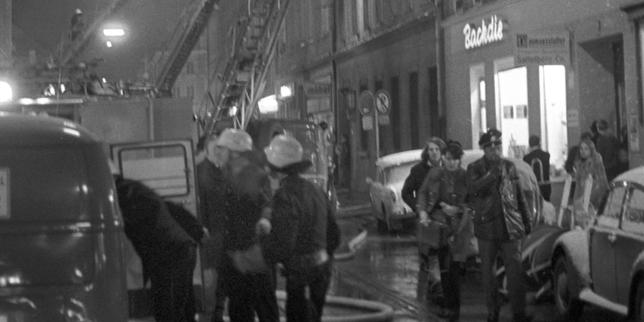
The identification of a deceased right-wing extremist as the primary suspect in the February 13, 1970, Munich Jewish community center arson exposes structural vulnerabilities in post-war West German counter-terrorism architecture. Fifty-six years after an inferno consumed a residential home for Holocaust survivors and claimed seven lives, the closure of the case due to the suspect's death in 2020 underscores an immutable operational reality: investigative latency degrades justice through attrition.
An evaluation of the case requires moving beyond historical narrative to examine the mechanics of investigative breakdown, the categorization of threat actors, and the systemic blind spots that permitted political violence to persist unchecked during the Cold War era.
The Tripartite Failure of Early Investigation
The inability of West German authorities to secure a conviction in the immediate aftermath of the deadliest antisemitic attack in the history of the Federal Republic stems from three distinct structural failures.
- Analytical Fragmentation: Law enforcement agencies split investigative bandwidth across disparate hypotheses, evaluating anarchists, foreign operatives, and psychological instability rather than isolating domestic radicalization vectors. This lack of a unified threat taxonomy diluted resource allocation.
- Forensic Constraints: The technological threshold of forensic science in 1970 restricted the isolation of trace evidence from complex arson accelerants. Without contemporary DNA profiling or digital communications tracking, investigations relied almost entirely on physical witness testimony that quickly degraded.
- Institutional Blind Spots: Post-war West German security structures exhibited a systematic hesitation to fully map the operational depth of right-wing extremist networks, frequently treating isolated incidents as anomalies rather than symptoms of structured radicalization.
These compounding variables created an investigative vacuum. When the original dossier was closed due to a lack of viable leads, the mechanism for accountability stalled indefinitely, illustrating how temporal decay functions as an active asset for perpetrators of historical violence.
Threat Actor Profile and Operational Methodology
The emergence of "Bernd V.," characterized by authorities as a 25-year-old extremist obsessed with Adolf Hitler and possessing a documented history of explosive device fabrication, clarifies the tactical profile of domestic fringe actors during this period.
The cost function of such fringe radicalization is asymmetrical. The perpetrator utilized low-tech delivery mechanisms—an incendiary mixture of gasoline deployed against a structurally vulnerable residential building—to generate catastrophic human loss. The target choice was symbolic and strategic: a community center housing elderly Holocaust survivors maximized psychological terror and underscored the operational impunity enjoyed by domestic violent extremists.
The re-opening of the dossier in April 2025, prompted by a whistleblower providing credible linkage regarding the suspect's whereabouts and activities minutes prior to the ignition, demonstrates that cold case resolution relies heavily on shifting social dynamics rather than institutional initiative. As aging associates approach the end of their lifespans, historical omertà fractures, offering narrow windows for evidentiary recovery.
Systemic Implications for Modern Counter-Terrorism
The Munich cold case yields critical diagnostic takeaways for contemporary threat mitigation. Modern intelligence architectures must account for the persistence factor in extremist radicalization. When investigative files are shelved prematurely, they create an institutional safe harbor for deceased or aging offenders, permanently denying closure to victim cohorts.
To prevent historical investigations from looping into indefinite obscurity, oversight bodies must institute mandatory review triggers for unsolved hate crimes, decoupling cold case triage from political cycles or immediate resource scarcity.
Strategic Action
Enforce mandatory decennial audits of all unresolved politically motivated cold cases using modern data-fusion techniques and familial DNA databases to compress the timeline between witness emergence and prosecutorial action before generational attrition permanently closes the window of accountability.
Munich Israeli consulate shooting: Police suspect attempted terrorist attack
This video provides contextual analysis regarding security threats and historical operational challenges involving Munich law enforcement responses to targeted attacks.