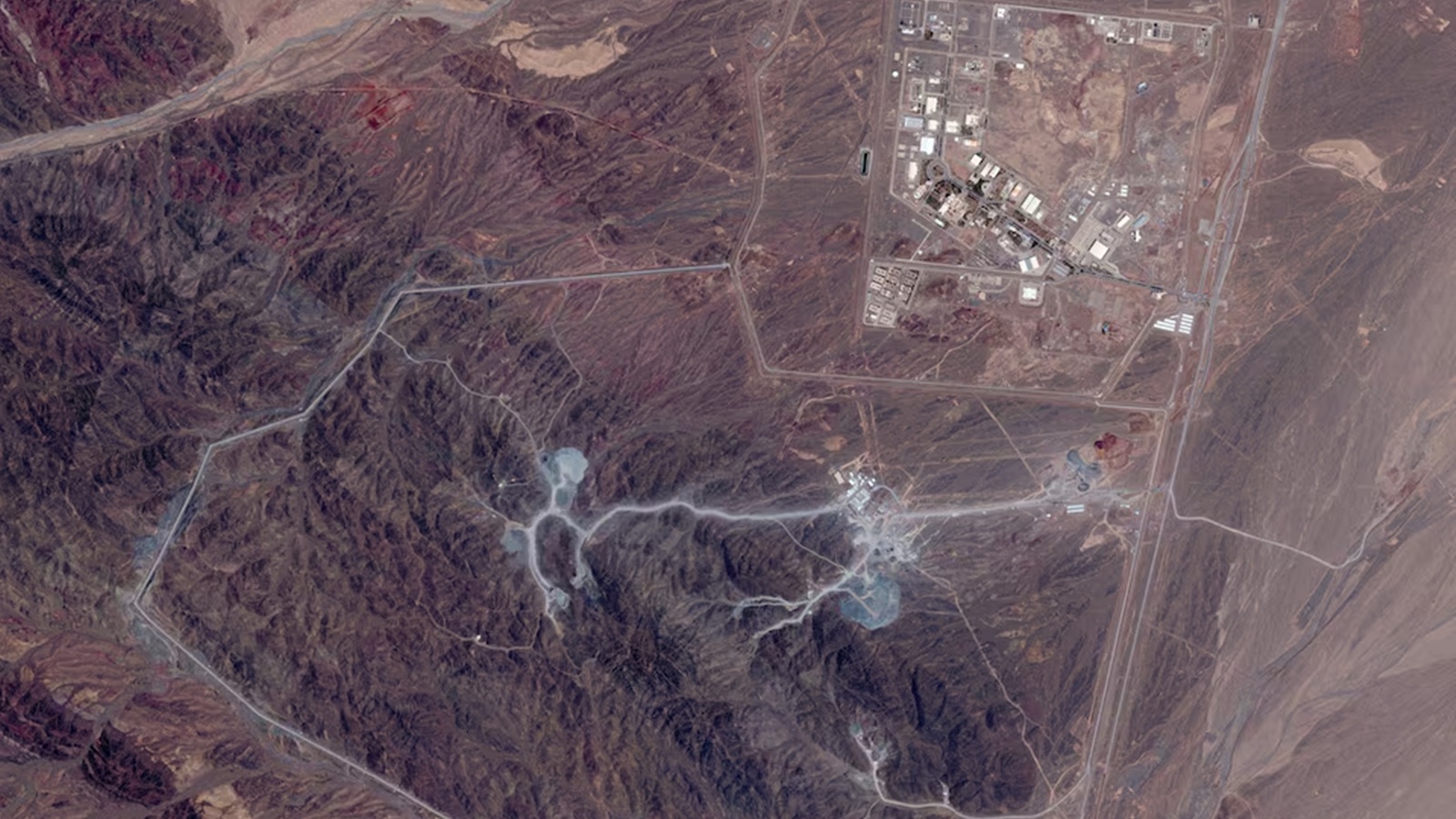
Pickaxe Mountain, a massive underground facility buried deep within Iran's Zagros mountain range, has emerged as the latest flashpoint in the simmering conflict between Washington and Tehran. Formally known as Kuh-e Kolang Gaz La, the heavily fortified site sits just two kilometers from the Natanz uranium enrichment complex. Following US President Donald Trump’s recent declaration of an impending strike on what he termed a possible target for a "big fat shot," the world is forced to look closely at this mountain fortress. Yet behind the bellicose rhetoric lies a stark engineering reality that conventional military planners are reluctant to admit publicly.
Political posturing often crumbles when it meets hard geology. The physical architecture of Pickaxe Mountain suggests that any conventional military strike, no matter how spectacular on television, would likely fail to destroy the facilities hidden inside. To understand why requires looking past the political speeches and looking directly at the granite.
The Geography of Imperviousness
The Zagros Mountains are unforgiving. Underneath their jagged peaks lies some of the densest rock on the planet. While older Iranian nuclear sites like Fordow were built under sedimentary limestone and dolostone, Pickaxe Mountain is carved directly into solid granite.
This difference in rock composition is not just an academic detail. Granite has a much higher compressive strength than limestone. It excels at absorbing and dispersing kinetic energy. When a bomb strikes granite, the shockwave is scattered across the rock mass rather than fracturing it cleanly.
The site has been under construction since late 2020. Satellite imagery captured over the last six years shows massive piles of spoil—the crushed rock excavated from the mountain—accumulating nearby. This volume of excavated earth indicates an underground footprint of immense proportions. Experts estimate the main facility sits anywhere from 80 to 100 meters deep, with some tunnel shafts running under 600 meters of solid overhead cover.
Iran has officially described the facility as a centrifuge assembly plant. It was built to replace the above-ground Natanz centrifuge workshop destroyed in a 2020 sabotage operation. By moving these operations deep into the earth, Tehran sought to put its nuclear manufacturing capabilities entirely out of reach.
The Limits of America's Heaviest Bombs
Air forces cannot simply bomb their way through hundreds of meters of rock. The United States possesses the most sophisticated conventional ordnance in the world, specifically the GBU-57 Massive Ordnance Penetrator, or MOP. This is a 30,000-pound monster designed to be dropped from B-2 stealth bombers. It is engineered to punch through protective layers of earth and concrete before exploding.
But even the GBU-57 has physical limits. It is designed to penetrate up to 60 meters of reinforced concrete or ordinary soil. It cannot drill through hundreds of meters of solid granite.
We have seen this limitation play out before. During the military operations of June 2025, US forces dropped multiple GBU-57 bombs on the Fordow facility. Fordow sits approximately 90 meters underground. While the strikes caused immense surface damage and collapsed some access tunnels, subsequent intelligence assessments indicated the deepest underground chambers remained largely intact.
If a 90-meter-deep facility under softer rock survived the heaviest non-nuclear ordnance in existence, a facility under 600 meters of granite is effectively untouchable by conventional means. A strike on Pickaxe Mountain would damage the external infrastructure. It would shatter the concrete headworks and seal the entrance portals. It would not, however, destroy the machinery inside.
The Strategic Shell Game
Military power is only as good as the intelligence guiding it. Throughout the ongoing conflict, Iran has demonstrated a sophisticated understanding of how to protect its most valuable nuclear assets. They do not keep all their eggs in one basket.
During the strikes in mid-2025, western intelligence observed a curious pattern. Days before US Tomahawk missiles and bunker-busters struck Fordow and Isfahan, heavily guarded convoys departed the facilities. It is widely believed that a significant portion of Iran's stockpile of 60 percent enriched uranium-235 was relocated. Some of it went to Isfahan, which was only hit by lighter standoff missiles. Some of it disappeared into undeclared mountain tunnels.
This is the fundamental flaw in the targeting strategy. Bombing a physical site does not automatically destroy the nuclear material if that material has already been moved. Currently, western intelligence agencies admit they have "no eyes" inside Pickaxe Mountain. No International Atomic Energy Agency inspectors have ever set foot in the complex. Iran has consistently refused to declare it as an active nuclear enrichment site, keeping it outside the scope of standard safeguards agreements.
Without ground-level verification, military planners are targeting empty concrete halls and hypothetical centrifuges. They are swinging at ghosts in the dark.
The Trap of Symbolic Strikes
There is a major difference between a military victory and a public relations victory. A strike on the entrance portals of Pickaxe Mountain would make for dramatic news footage. Plumes of black smoke and collapsed concrete arches would be hailed as a decisive blow.
The reality on the ground would be far different. Such an attack would carry severe, unintended consequences that could permanently damage Western security interests.
First, a purely kinetic strike would provide Iran with the ultimate justification to withdraw entirely from the Non-Proliferation Treaty. It would seal the rift between Tehran and international monitors. If the US bombs the outer shell of Pickaxe Mountain, Iran will simply rebuild the entrances while continuing their work in the deep chambers, entirely hidden from satellite surveillance and international diplomacy.
Second, the political fallout would unite a fractured Iranian domestic audience. The current government would use the strikes to justify a rapid, underground dash toward a fully fledged nuclear deterrent. They would argue that if the West is willing to bomb their territory, they have no choice but to possess the ultimate weapon to guarantee their survival.
Military actions must be judged by their long-term outcomes, not their immediate visual impact. Striking Pickaxe Mountain might satisfy a political urge to look tough, but it would leave the core of Iran's nuclear capabilities intact while removing the remaining diplomatic levers to control them.

