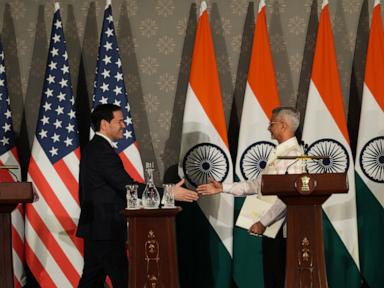
Washington and New Delhi are drifting apart, and everyone in the room knows it.
When U.S. Secretary of State Marco Rubio touched down in India this weekend, he didn't land in an atmosphere of warm strategic embrace. He walked straight into a deep diplomatic freeze. For all the lofty talk about shared democratic values and a free and open Indo-Pacific, the reality on the ground is stark. Relations between the United States and India have plummeted to their lowest point in over two decades.
Rubio's four-day, multi-city tour—stopping in Kolkata, Agra, and Jaipur before digging into heavy bureaucratic sessions in New Delhi—is essentially a high-stakes damage control mission. He's trying to patch up a massive trust deficit that has opened up over the past year. If you look past the carefully staged handshakes with Prime Minister Narendra Modi and Foreign Minister Subrahmanyam Jaishankar, you see two nominal allies deeply frustrated with each other.
The immediate culprit behind this mess isn't hard to spot. Washington's aggressive tariff policies have hit Indian exports hard, while a chaotic U.S. foreign policy has left New Delhi questioning whether America is a reliable partner or a wild card.
The Tariff War and the Cost of Chaos
Let's look at what actually broke the trust. Over the past year, the Trump administration slapped heavy tariffs on major Indian exports. This economic blindside completely upended years of steady progress. To make matters worse, Washington extended these punitive trade measures globally, essentially telling New Delhi that its hard-earned "strategic partner" status didn't exempt it from America-First economic warfare.
Rubio tried to downplay this during his press conferences in New Delhi. He argued that the trade friction isn't specifically about India, pointing out that almost every country he visits complains about U.S. tariffs. But that explanation doesn't fly with Indian policymakers. When you spend a decade aligning your defense and technological systems with a superpower, you expect better than to be treated like an ordinary economic adversary.
An interim trade deal was announced with great fanfare three months ago, but it has stalled completely. Without a finalized agreement, other areas of cooperation are freezing up. There's a growing feeling in New Delhi that Washington is simply too erratic to rely on for long-term economic planning.
The Shadow of the Middle East War
The economic friction is bad, but the geopolitical disconnect is worse. The U.S. military engagement in the Middle East—specifically the war with Iran—has thrown a massive wrench into India's economic machinery.
India's fast-growing economy runs on imported energy. When the conflict boiled over and choked off the strategic Strait of Hormuz, global oil prices skyrocketed. India suffered immediate economic pain. For years, the U.S. pressured New Delhi to stop buying discounted Russian crude oil, promising that American energy products could fill the gap. Now, Rubio is aggressively pushing that same pitch. During his hour-long meeting with Modi, Rubio insisted that U.S. energy can diversify India's supply, explicitly stating that Washington won't let Iran hold the global energy market hostage.
But here is the catch. India has a long history of strategic autonomy and deep, historical ties with Russia. It doesn't want to be told where to buy its oil, especially when American military actions are the very reason global energy markets are in turmoil. Washington's sudden pivot toward a detente with China and its ongoing, frustrating engagement with Pakistan have only deepened India's skepticism. New Delhi sees a U.S. foreign policy that changes with every election cycle, whereas India's security threats remain fixed.
The Real State of the Quad
The true gauge of this trust deficit is the state of the Quad—the alliance between the U.S., India, Japan, and Australia. Rubio's visit includes a Quad Foreign Ministers' meeting on Tuesday. On paper, it looks like a major diplomatic event. In reality, it highlights a quiet, unannounced downgrade of the partnership.
This marks the third consecutive Quad gathering without leader-level engagement. President Trump didn't make it to India for a leader summit, a major disappointment for New Delhi. The group's momentum has stalled, overtaken by Washington's distractions elsewhere and India's growing reluctance to be used as a mere counterweight to Beijing.
Friction naturally exists between America's global strategic ambitions and India's priorities as an emerging middle power. India isn't looking to join a Western bloc. It wants a multi-polar world where it calls its own shots. When Washington acts like a demanding boss rather than an equal partner, India pulls back.
Where the Relationship Goes From Here
Rubio's trip won't magically solve these systemic issues. Nobody expects a sudden upward surge in bilateral ties. The real metric of success for this visit is far more modest. It's about stopping the bleeding.
If Rubio can clear the administrative hurdles delaying the interim trade pact and provide clear, predictable boundaries on energy sanctions, the relationship can stabilize. He extended an invitation for Modi to visit the White House, a classic diplomatic move to keep doors open. He also made a highly symbolic first stop at Mother Teresa's charity headquarters in Kolkata, aiming to soothe concerns among his domestic Christian conservative base regarding the treatment of minorities in India under the Modi government.
Strategic partnerships aren't built on shared values or flowery speeches. They're built on predictability and mutual benefit. Right now, Washington needs to prove it can deliver both. To salvage this alliance, U.S. policymakers must stop treating India as a transactional tool for its immediate geopolitical crises and start treating it as the independent power it is. De-escalating the tariff dispute and offering concrete, stable energy assurances are the mandatory first steps to rebuilding that shattered trust.