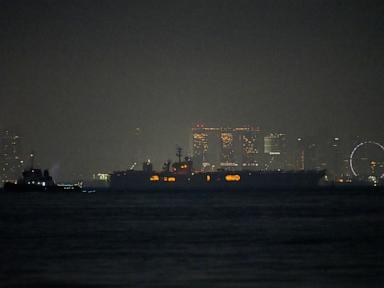
Every major defense outlet is running the exact same comforting narrative today. The USS Abraham Lincoln carrier strike group is steaming past Singapore on its way back to San Diego, concluding a frantic, extended deployment across the Middle East. The mainstream analysis treats this transit as a sigh of relief. A routine rotation. Proof that tensions are simmering down and the machinery of global maritime trade can coast back into neutral.
That interpretation is dangerously naive.
Surface-level observers see a warship heading home and assume the mission accomplished banner can be pulled out of storage. I have spent two decades watching maritime logistics and force posture shifts up close, and I can tell you that the transit of the Lincoln past the Malacca Strait is not a withdrawal. It is an indictment of how modern carrier strike groups operate under asymmetric threat profiles.
The lazy consensus ignores the grinding operational fatigue, the ammunition expenditure rates, and the silent vulnerability of floating super-carriers in confined waters. When a Nimitz-class carrier makes the long slog across the Pacific, the military establishment wants you to focus on the homecoming banners. You should be looking at the maintenance logs instead.
The Myth of Permanent Presence
For thirty years, Washington operated on a simple, arrogant premise. Put a carrier near a crisis zone, and bad actors will behave. It worked against regional navies with zero anti-ship missile capability. It completely shatters against decentralized forces firing commercial drones and ballistic missiles costing a fraction of a single interceptor.
The Lincoln did not leave the Middle East because the region became stable. It left because staying any longer risked a catastrophic operational failure.
Look at the math. A carrier air wing burning through hundreds of standard missiles and millions of dollars in electronic countermeasures to swat down cheap loitering munitions creates an unsustainable fiscal and logistical deficit. When the cost-per-kill metric skews wildly in favor of the enemy, maintaining a permanent presence stops being a projection of power. It becomes an act of strategic attrition against yourself.
Naval analysts love to talk about presence as a deterrent. Real logistics officers know presence is a depreciating asset. Every extra month on station turns propulsion plants into maintenance nightmares and wears crews to the bone. Bringing the Lincoln home is not a victory lap. It is an emergency reset button pressed by a Pentagon realizing that traditional strike groups are dangerously exposed in the post-cold war littoral environment.
What Singapore Got Wrong
When the Lincoln passed Singapore, local commentators framed it through the lens of regional diplomacy and port logistics. They missed the broader geopolitical signal entirely.
Chokepoints like the Malacca Strait are no longer safe havens for heavy naval assets. The proliferation of shore-based sensor networks and advanced missile tech means a carrier transiting narrow waters is effectively moving through a shooting gallery, even in peacetime transit zones. The fact that the Lincoln had to maintain a high-threat posture all the way through Southeast Asian shipping lanes shows how fragile the security architecture of the Indo-Pacific has become.
We pretend that international waters belong to whoever has the biggest deck. That is a comforting fiction left over from the twentieth century. Today, waters belong to whoever can saturate the airspace with affordable kinetic threats faster than a carrier battle group can reload its vertical launch systems.
The Cost of Staying Too Long
Let us look at the hard operational data. Extended deployments do not project strength; they expose systemic decay.
- Reactor and Hull Strain: Nimitz-class hulls operating past their scheduled six-month deployment windows suffer from critical mechanical degradation. Pushing them harder to satisfy political optics invites catastrophic engineering failures far from friendly dry docks.
- Ammunition Depletion: The replenishment vessels servicing the Lincoln have been working overtime. Stocks of advanced interceptors are finite, and the industrial base cannot backfill them at the rate they were expended against asymmetric threats.
- Personnel Burnout: Retention rates plummet when sailors endure nine-month deployments defined by constant general quarters alarms and zero port liberty. A tired crew makes fatal mistakes.
The establishment refuses to admit these trade-offs because doing so undermines the entire architecture of forward-deployed naval hegemony.
The Uncomfortable Truth About Future Conflicts
Imagine a scenario where a future crisis erupts in the Western Pacific while the entire US maintenance fleet faces a multi-year backlog just to patch up the ships coming home from the Middle East now. That is not a hypothetical exercise. That is the exact trap the current deployment cycle is building.
The return of the Lincoln highlights a profound strategic paralysis. We are running legacy assets into the ground fighting asymmetrical battles on unfavorable economic terms, all while our primary geopolitical competitor watches from the sidelines and takes meticulous notes.
Stop reading the homecoming coverage as a good news story. It is a blinking red light on the dashboard of American military strategy. The era of unchallenged carrier supremacy is over, and no amount of flag-waving at the pier in San Diego will change the math.


