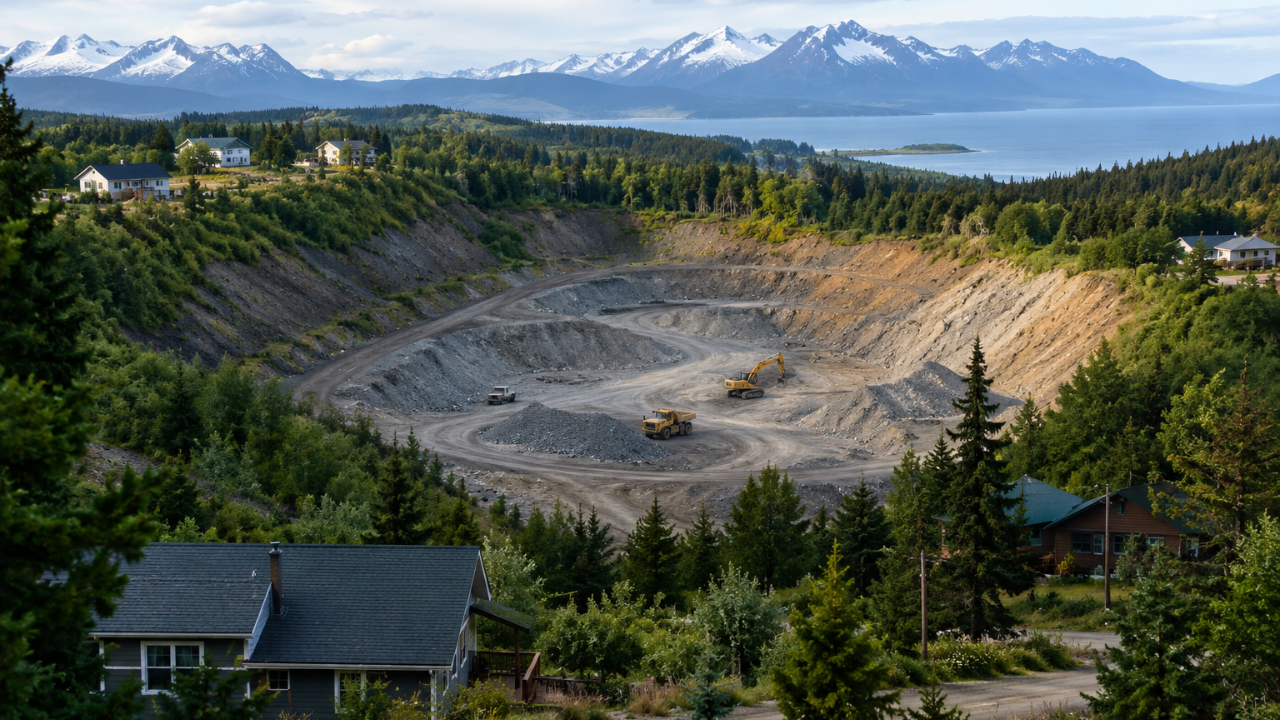
Silence in Alaska is never truly empty.
Step outside on a January morning in a rural valley north of Anchorage, and the quiet has weight. It carries the sharp crack of a birch branch snapping under the load of fresh hoarfrost, the distant, rhythmic thrum of a snowmachine miles away, or the low rush of wind funneling down from the Chugach Mountains. People move to these glacially carved pockets not merely for cheap acreage or elbow room, but for the acoustic sanctuary that comes with living at the edge of the map.
Now, picture what happens when someone proposes dropping an industrial gravel pit right into the center of a natural amphitheater.
That single question—what happens when heavy machinery meets unforgiving geography—sat at the heart of a bitter, multi-year legal war in Alaska that finally reached its breaking point before the state’s highest court. On paper, the ruling looks like dry administrative law: the Alaska Supreme Court blocked a proposed gravel mine after residents fought for years over industrial noise and the unique acoustics of bowl-shaped terrain. In reality, it is a story about what happens when bureaucratic spreadsheets collide with the physics of the human ear, and how a small community refused to let their homes be turned into an echo chamber.
The Physics of a Concrete Bowl
To understand why neighbors fought so ferociously against a seemingly routine resource extraction project, you have to understand how sound behaves when it has nowhere to escape.
On a flat prairie, sound waves radiate outward and dissipate into the open sky, losing energy with every yard they travel. Standard environmental impact assessments—the kind regulatory boards rely on across North America—often model noise using flat-earth assumptions or simple distance-decay formulas. On a spreadsheet, a rock crusher located half a mile away might register at a tolerable decibel level, neatly tucked beneath municipal nuisance thresholds.
Geologists and acoustic engineers know better. A bowl-shaped valley—scoured out thousands of years ago by retreating ice—acts precisely like an inverted acoustic dish.
Consider a hypothetical neighbor, let’s call her Clara, standing on her porch three-quarters of a mile up the ridge from the proposed pit floor. In a flat landscape, the rumble of backup beepers, diesel excavators, and screens shaking tons of aggregate would fade into a dull hum before reaching her cedar siding. Inside a glacial bowl, those low-frequency sound waves hit the dense, sloped walls of the basin and bounce upward and inward, concentrating rather than dispersing. Cold northern air inversions—where a layer of warm air traps freezing air near the valley floor—act like a lid on top of that bowl, reflecting sound waves back down toward the homes clinging to the hillsides.
Living inside an acoustic inversion is maddening. You cannot close a double-pane window to shut out low-frequency industrial vibration; it travels straight through timber framing and settles in your teeth. For years, residents in the dispute tried to explain to local permitting officials that their valley was not a flat line on a zoning map. It was a megaphone pointed directly at their bedrooms.
When Progress Sounds Like a Jackhammer
None of this means gravel is trivial. Anyone who has driven an Alaskan highway after spring breakup—when thawing permafrost heaves asphalt into wheel-swallowing craters—knows that aggregate is the literal foundation of northern infrastructure. Without local gravel pits, road construction costs skyrocket, hauling distances stretch into dozens of expensive miles, and rural development grinds to a halt.
That tension is the classic Alaskan dilemma. The state was built by people who dig, drill, and haul things out of the earth, alongside people who came to Alaska specifically to escape the noise and clutter of industrial life.
For the developers behind the mine, the site looked ideal: rich alluvial deposits, accessible haul routes, and a growing regional appetite for construction material. From their perspective, they were following the rules—submitting applications, proposing berms and operating hours, and arguing that the community needed the resource.
Yet for the families living along the rim of that bowl-shaped basin, the math never added up. Why should a handful of households bear the permanent, round-the-clock psychological cost of industrial noise so that contractors twenty miles away could shave a few dollars off a ton of crushed rock?
Early on, local permitting authorities sided with the project, treating neighbors' warnings about terrain amplification as speculative anxiety rather than hard physical reality. Approvals were granted. Conditions were tacked on—limits on operating hours, promises of earthen buffers—as if a twelve-foot dirt mound could stop low-frequency sound waves from curling over the ridge and cascading across the valley.
The Long Grind of Administrative Exhaustion
Fighting a land-use permit in court is designed to wear ordinary people down.
It takes years. It drains retirement accounts, consumes weekends spent combing through municipal code, and forces schoolteachers, mechanics, and retirees to become amateur experts in administrative law and acoustic modeling. When local boards rubber-stamp a permit, the burden flips entirely onto the residents. Suddenly, the people trying to protect the baseline quiet of their own living rooms have to prove, beyond a shadow of a doubt, that the government failed to do its homework.
I have watched similar battles play out in rural counties from the Pacific Northwest to the Rockies, and the emotional arc is always identical. First comes shock that a massive industrial operation can be approved next door without anyone measuring how sound actually travels across the land. Next comes anger at the dismissive tone of public hearings, where lived knowledge of the local wind and terrain is brushed aside in favor of generic consultant reports. Finally, if a community refuses to fold, comes the slow, grueling march through the appellate courts.
In this Alaskan dispute, the residents did not back down. Through lower court challenges and administrative appeals, they hammered away at a single, foundational flaw in the permitting process: regulators had failed to adequately reckon with the bowl-shaped topography and the real-world noise impacts it would inflict on surrounding homes.
Why the High Court Drew the Line
When the case finally landed before the Alaska Supreme Court, the justices stripped away the bureaucratic fog and looked directly at the mechanics of the decision.
In administrative law, courts generally give wide latitude to local boards and agencies. Judges do not like playing zoning commissioner; they usually defer to agency expertise as long as the record shows officials took a "hard look" at the facts. But deference is not a blank check. When an agency ignores obvious physical realities—or relies on assumptions that contradict the very geography of the site—the law steps in.
The Supreme Court’s decision to block the gravel mine hinged on that exact failure. You cannot evaluate noise in a bowl-shaped valley as though the land were a billiard table. By failing to properly account for how the basin’s steep, enclosing walls would trap and amplify industrial sound, regulators had skipped a vital step in protecting neighboring landowners from severe, predictable harm.
The ruling did not outlaw gravel mining in Alaska, nor did it declare war on resource development. It established something far simpler and far more consequential: geography matters. A permit issued in defiance of basic physics is not a valid permit.
The Invisible Stakes of Quiet
It is easy, from a distance, to treat a dispute over a gravel pit as a localized squabble—just another round of "not in my backyard" politics playing out in a remote corner of the country.
That reading misses the deeper shift happening across rural communities everywhere. As suburban sprawl and infrastructure demand push outward into previously quiet valleys, watersheds, and foothills, the collision between industrial extraction and residential sanctuary is accelerating. Regulatory frameworks written decades ago often measure pollution in chemical parts per million or particulate dust, treating noise as a minor annoyance rather than a genuine environmental hazard.
Modern public health research tells a different story. Chronic exposure to low-frequency industrial noise elevates cortisol, fragments deep sleep, drives up blood pressure, and erodes cognitive focus. Unlike a loud concert that ends at midnight, an industrial pit operates day after day, season after season, turning a home from a place of recovery into a source of low-grade physiological stress. When terrain amplifies that sound, there is nowhere on the property to hide from it.
By blocking the mine, the Alaska Supreme Court validated what residents had been saying since the first survey stakes were driven into the dirt: quiet is not the absence of value. It is a tangible, measurable asset that underpins health, property value, and community life.
Morning in the Basin
Walk back out onto that ridge in the dead of winter now, after the final gavel has fallen and the legal briefs have been boxed up in Anchorage.
The bowl-shaped valley looks the same as it did ten thousand years ago when the glaciers pulled back—steep, timbered slopes cupping a quiet floor beneath a pale northern sky. Down below, no rock crushers grind. No backup alarms pierce the cold air inversions. When a raven calls from the top of a spruce tree on the far side of the basin, the sound still carries cleanly across the snow, echoing softly off the ridges before fading back into the stillness.