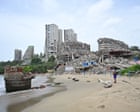
The stench of decomposition hanging over the flattened coastal streets of La Guaira tells the real story of the June 24 twin earthquakes. It's a grim reality that no official press briefing can sanitize. While interim President Delcy Rodríguez stands before television cameras fiercely defending her administration’s emergency protocols, thousands of Venezuelans are digging through the rubble of their own homes with bare, bleeding hands. The official death toll has climbed to 3,342, with more than 16,000 injured, but everyone on the ground knows the worst is yet to come.
The political optics are moving fast, but the heavy machinery is not. Survivors and volunteer rescue workers face a agonizing race against the clock that already feels lost, even as miraculous stories like the rescue of a 43-year-old security guard after eight days under a collapsed mall keep a flicker of hope alive.
The Narrative Clash on the Ground
Walk into the worst-hit areas of La Guaira and you won't see the flawless state-directed operation described in Caracas. You'll see everyday citizens using car jacks, shovels, and sheer muscle to lift slabs of concrete. The disconnect between the government's rhetoric and the reality on the streets is massive.
Rodríguez claims the state deployed 4,000 officials immediately, scaling up to 19,000 in the following days. She insists the government didn't wait hours, let alone days, to activate emergency protocols. Yet, local residents report that for the first 48 crucial hours, official rescue teams were nowhere to be found.
The administration has gone so far as to blame public anger on "propaganda laboratories" and malicious media campaigns. The government even militarized access roads to La Guaira, cutting off citizens trying to deliver direct aid under the guise of keeping routes clear for official vehicles. But when those official vehicles lack the specialized cutting tools and heavy cranes needed to move structural debris, the justification wears thin.
The Battle Over the Real Body Count
One of the most contentious points of the crisis is the true scale of human loss. The information ministry’s confirmed death toll of over 3,000 is widely considered a conservative baseline. A digital database set up by the political opposition has recorded more than 38,000 missing person reports.
When pressed by foreign journalists about reports that the United Nations is quietly procuring 10,000 body bags for the relief effort, Rodríguez deflected, stating the government refuses to speculate and only provides rigorously verified numbers.
For forensic technicians like Joel Mirabal, the numbers aren't abstract politics—they are an exhausting, round-the-clock labor. Working for over a week straight without a break, Mirabal notes that identifying the recovered bodies is becoming a monumental struggle. In a majority of cases, a neighbor or surviving relative is present to help, but severe decomposition means teams are forced to rely on distinct tattoos, old scars, or fragments of recognizable clothing.
Substandard Housing and Shifting Blame
The disaster has also re-opened deep wounds regarding the country's infrastructure. Several signature social housing projects, originally built under the previous socialist administration, collapsed entirely during the 7.2 and 7.5 magnitude tremors. This has sparked intense public scrutiny over structural integrity, cutting corners, and skipped safety inspections.
The government has quickly moved to deflect blame. In recent briefings, the administration claimed that roughly 80% of the collapsed structures were actually private developments, though they haven't provided public data or registries to back up the assertion.
The Geopolitical Tightrope
What makes this disaster uniquely complex is the shifting political backdrop. Rodríguez took power as interim leader in January following the U.S. removal of Nicolás Maduro. Her emergency mandate was set to expire right as the earthquake aftermath peaked, creating an undercurrent of intense political vulnerability.
Unlike past Venezuelan disasters—such as the 1999 Vargas mudslides, where then-President Hugo Chávez famously rejected American aid—the current interim government has thrown the doors open to international assistance. The administration has welcomed teams from 33 different countries, explicitly thanking U.S. officials for committing over $300 million in aid and deploying 900 military personnel for rescue operations. Even revenue from Venezuelan oil production, currently managed under U.S. Treasury oversight, is being unlocked for disaster relief.
The United Nations Development Program estimates the physical damage to infrastructure sits at a staggering $6.7 billion, representing roughly 6% of the nation's gross domestic product. Rebuilding will take years, and the political survival of the current leadership hinges entirely on how this recovery is managed.
What Needs to Happen Next
For the families waiting outside the ruins, the political blame game doesn't matter. Survival does. If you are looking to support the relief efforts or keep track of the unfolding situation, focus on these critical areas:
- Support Grassroots and International Logistics: Channel donations toward verified international organizations like the UN Development Program or active field hospitals on the ground that have direct, negotiated access to the affected zones.
- Prioritize Identification and Forensic Resources: Aid groups must pivot resources toward forensic identification kits and DNA mapping tools to prevent mass anonymous burials, helping families achieve closure.
- Demand Independent Infrastructure Audits: Future international reconstruction funds must be tied to strict, independent structural audits of both public and private housing projects to ensure a disaster of this scale never repeats.