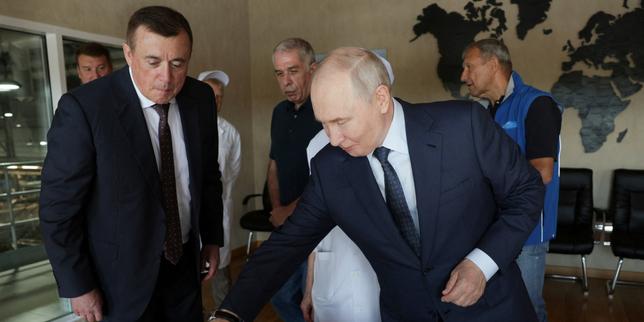
The media narrative writes itself with predictable exhaustion. Vladimir Putin touches down in the Southern Kurils, Tokyo issues a stiff diplomatic protest, editorial boards scream about sovereignty violations, and analysts nod sagely about frozen conflicts.
Everyone misses the actual story.
Tokyo is not outraged because international law was violated. Tokyo is furious because Putin just exposed the quiet, humiliating truth that Japanese foreign policy has spent decades trying to hide: the Northern Territories dispute is a ghost story, and Japan no longer has the leverage to wake the dead.
Let us strip away the diplomatic theater. For seventy years, Japan’s strategy regarding the Etorofu, Kunashiri, Shikotan, and Habomai islands has relied on a comfortable fantasy. Tokyo assumed that if it maintained a polite, rigid posture, kept handing over economic cooperation packages, and waited out Moscow's structural decline, geography would eventually surrender to patience.
That calculus is dead. Putin’s visit is not a sudden escalation born of regional paranoia. It is a calculated display of geopolitical permanence. Moscow has fortified the archipelago with anti-ship missile systems, air defense batteries, and permanent economic zones. They are not bargaining chips anymore. They are unsinkable aircraft carriers anchoring Russia's Pacific posture.
When bureaucrats in Kasumigaseki draft their formal condemnations, they use words like illegal occupation. Let us look at the actual mechanics of statecraft rather than legalistic fiction. Sovereignty belongs to whoever can project power and defend it. Russia can do both in the Sea of Okhotsk. Japan cannot.
The Myth of the Peace Treaty Mirage
For decades, the carrot dangled before Japanese Prime Ministers was the elusive peace treaty. Every administration from Abe to Kishida has chased this diplomatic white whale, convinced that domestic political legacy lay in securing the return of even two of the four islands—the Habomai islets and Shikotan—as outlined in the vague 1956 Soviet-Japanese Joint Declaration.
This was always a delusion.
I have sat in closed-door security briefings where defense analysts treated the two-island formula like a mathematical proof. It never was. Moscow understood the arithmetic long before Tokyo did. Returning any fraction of the Southern Kurils to Japan means handing the United States military an unhindered geographic corridor straight into the Sea of Okhotsk, directly threatening Russia's strategic nuclear submarine bastions.
No Russian leader—reformist, autocrat, or otherwise—will ever sign away sovereign control over waters vital to their second-strike nuclear deterrence. To believe otherwise requires a staggering ignorance of basic military geography.
When Putin flies into those islands, he is telling Washington and Tokyo simultaneously that the security architecture of the Far East is fixed. The peace treaty is a dead letter because the strategic price for Moscow is infinitely higher than any economic benefit Tokyo could ever supply, sanctions or no sanctions.
Economic Leverage is a Two-Way Street That Tokyo Misread
For years, Tokyo believed its checkbook was magic. The lazy consensus in foreign policy circles argued that Russia’s economic isolation would eventually force the Kremlin to trade real estate for Japanese investment, energy technology, and industrial capital.
That theory crumbled against the reality of Eurasian redirection.
Russia does not need Tokyo's capital anymore, because Beijing and New Delhi are buying hydrocarbons in volumes that make Japanese trade preferences look like rounding errors. When Japan joined Western sanctions following the invasion of Ukraine, it didn't punish Moscow; it permanently evicted itself from any remaining seat at the bargaining table.
Let us be precise. Tokyo sacrificed its independent diplomatic leverage in the Russian Far East to maintain alignment with Washington. That may be a rational choice within the broader framework of the US-Japan security alliance, but let us stop pretending it was a strategy to recover the islands. You cannot abandon neutral mediation, slap your neighbor with crippling sanctions, and then act surprised when they cement control over contested territory with zero regard for your feelings.
The economics of the Kurils have shifted entirely. Moscow is pouring federal subsidies into developing local infrastructure, marine processing plants, and tourism projects. They are integrating the islands deeper into the Sakhalin Oblast administrative grid. Every billion rubles spent there is another nail in the coffin of Japanese irredentism.
The Domestic Political Trap of Perpetual Grievance
Why does Tokyo keep playing a hand it knows is busted? Because the Northern Territories issue has become a domestic political insurance policy.
Politicians use the dispute the way old men use a broken watch: it doesn't tell time, but you keep it in your pocket because your grandfather gave it to you. Admitting that the islands are lost forever requires an uncomfortable national conversation about constitutional revision, military normalization, and the hard limits of American security guarantees in East Asia.
It is much easier to issue ritualistic condemnations every time a Russian official visits Etorofu. It satisfies the nationalist wing of the Liberal Democratic Party, reassures voters that principles are being upheld, and requires zero actual risk.
Meanwhile, reality marches on.
Imagine a scenario where Tokyo abruptly drops the territorial claim, signs a pragmatic trade and fisheries agreement, and normalizes relations based on the status quo. The outrage would be deafening. The political class would hyperventilate. Yet, it would be the first honest act of Japanese diplomacy in half a century. It would free up billions in diplomatic capital and mental bandwidth to focus on actual, immediate threats in the East China Sea and the Taiwan Strait, where Japan's security is genuinely on the line.
Instead, Tokyo stays anchored to a romanticized map.
The Geopolitical Cost of Living in the Past
Clinging to a lost cause isn't harmless nostalgia. It actively degrades strategic coherence.
While Japan ties down diplomatic resources protesting visits to volcanic islands guarded by Bastion missile systems, the real security architecture of the Pacific is shifting beneath its feet. China and Russia are conducting joint naval patrols through the Tsushima Strait. North Korea is modernizing its ballistic arsenal.
By prioritizing a dead territorial dispute with a nuclear-armed neighbor that holds all the cards, Japan projects weakness rather than resolve. It signals to Beijing and Pyongyang that Tokyo is paralyzed by historical grievances rather than adaptable to modern power dynamics.
Putin knows this. His flight to the Kurils was a stress test. He pressed against Tokyo's diplomatic armor and found hollow fiberglass.
Stop pretending that a change of administration in Moscow will suddenly unlock the gates of Etorofu. Stop pretending that international tribunals will rewrite the geography of the Sea of Okhotsk.
The islands are gone. The sooner Tokyo accepts that reality, the sooner it can start playing the game as it is played today, not as it was mapped in 1945.