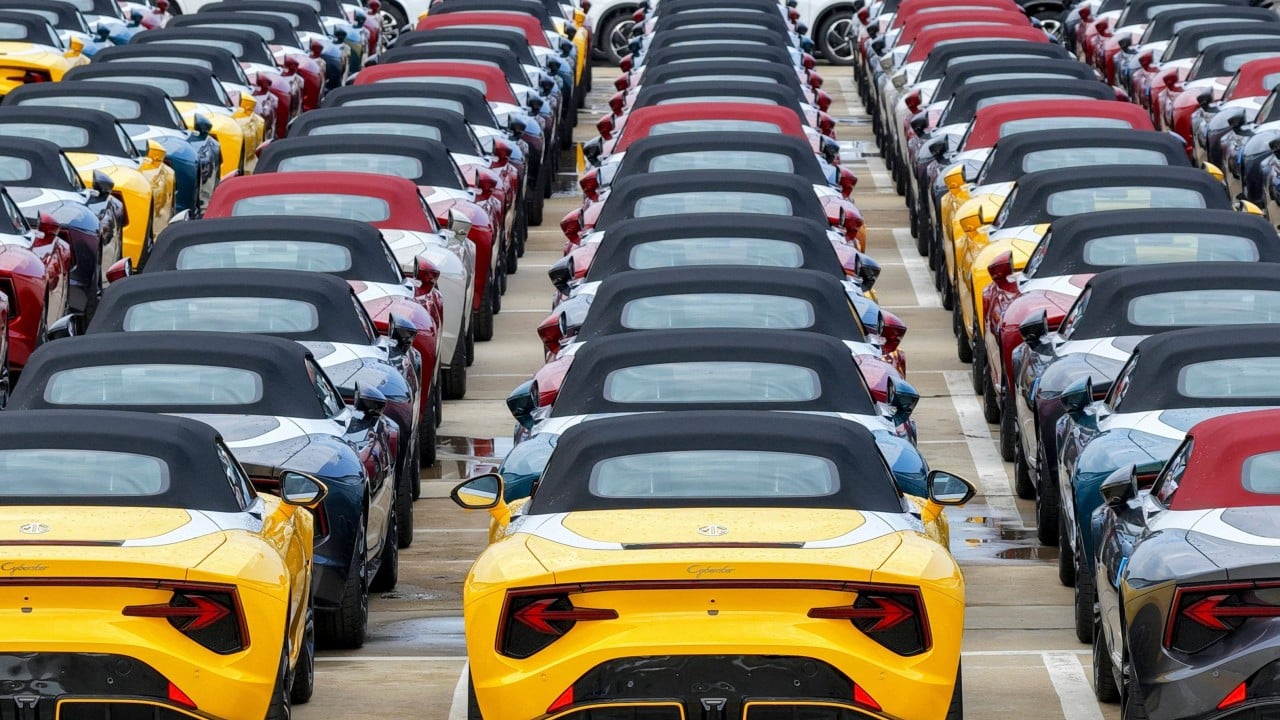
Wall Street analysts are falling over themselves to raise export forecasts for Chinese electric vehicles. They see a massive wave of battery-powered cars rolling out of Shanghai and Guangzhou, ready to capture global market share. The math looks simple on a spreadsheet. China has the scale, the battery supply chain, and an undeniable cost advantage.
But the banks are getting it wrong. They are tracking production capacity while completely ignoring the brutal mechanics of global trade protectionism, logistics bottlenecks, and local market friction.
I have watched investment banks hype manufacturing booms for two decades. They always make the same mistake. They assume that if you build it cheaper, the world will let you sell it.
The lazy consensus says that Chinese EVs will inevitably replicate the global expansion of Japanese automakers in the 1970s or South Korean brands in the 1990s. This comparison is fundamentally flawed. When Toyota and Hyundai expanded, they faced standard tariff regimes and eventual domestic political pushback, yes, but they were operating within a shared geopolitical framework with the West. Today, Chinese EV makers are driving straight into a geopolitical brick wall.
The Tariff Trap
The consensus view treats tariffs like a temporary speed bump. The thinking goes: even with a 100% tariff in the United States or a 38% duty in the European Union, Chinese manufacturing efficiencies are so deep that these companies can still turn a profit or at least break even while undercutting the competition.
This ignores how modern trade policy actually works. Tariffs are not static numbers meant to raise revenue; they are political firewalls designed to stop a specific outcome. If a 38% tariff does not stop Chinese imports, the European Commission will raise it to 60%. If that fails, they will implement non-tariff barriers, such as stringent data security regulations, supply chain traceability requirements, and local battery-sourcing mandates.
Consider the reality of the European market. To bypass these barriers, Chinese manufacturers are rushing to build factories inside the EU, in countries like Hungary and Spain. But localized manufacturing completely erases the exact cost advantage that made them dominant in the first place.
Building a vehicle in Europe means dealing with local labor unions, strictly regulated energy costs, complex environmental permitting, and a fragmented regional component supply network. BYD or Geely operating inside the EU will not achieve the same margins they manage in Shenzhen. The moment they localize to survive the politics, their cost structure matches the very legacy automakers they are trying to disrupt.
The Shipping Illusion
Even if we look strictly at the mechanics of exporting from Chinese ports to Western dealerships, the financial model breaks down. Wall Street assumes that shipping capacity will scale linearly with factory output. It will not.
Automobiles are not shipped in standard containers. They require specialized Roll-on/Roll-off (RoRo) vessels. The global RoRo fleet is severely constrained. While Chinese automakers have started ordering their own massive car carriers, building a fleet takes years.
Furthermore, shipping a 2.5-ton battery-heavy SUV across oceans is an incredibly energy-intensive and expensive logistical feat. Port congestion, rising maritime insurance premiums due to geopolitical instability in major shipping lanes, and localized distribution costs add thousands of dollars to the landed cost of every single vehicle.
When you factor in the cost of establishing a completely new spare parts inventory and service center network across a continent, the "cheap Chinese EV" disappears. A car that costs $20,000 to build in China easily becomes a $45,000 car by the time it sits on a dealership lot in Munich or London. At that price point, they are no longer competing with cheap entry-level models; they are fighting head-to-head with established premium brands that possess decades of consumer trust.
Dismantling the "People Also Ask" Assumptions
Whenever this topic comes up, investors ask variations of the same flawed questions. Let us dismantle them one by one.
Can Chinese EV makers just pivot to emerging markets like Southeast Asia and Latin America?
They are doing this right now, but the math does not scale to support Wall Street's massive growth forecasts. The total addressable market for high-tech, battery-powered vehicles in Brazil, Indonesia, or South Africa is a fraction of the market in Western Europe or North America.
These regions lack the charging infrastructure required for mass adoption. More importantly, consumer purchasing power in these markets favors dirt-cheap internal combustion engine vehicles or basic hybrids, not software-defined premium EVs. You cannot offset the loss of the European market by selling lower-margin vehicles in regions with weak currencies and volatile economies.
Won't their battery dominance guarantee victory?
China commands over 70% of global lithium-ion battery production capacity, largely thanks to giants like CATL and BYD. This is a massive advantage inside China. But exporting that advantage is incredibly difficult.
Western subsidies, like the Inflation Reduction Act in the United States, specifically exclude vehicles that use batteries manufactured by entities of concern. Europe is implementing its own Battery Passport regulations, requiring strict carbon footprint accounting from the raw material mine to the assembly line. China's battery advantage is being actively neutralized by Western legislation, turning a massive asset into a localized stranded asset.
The Blind Spot of Software and Data Sovereignity
The modern EV is not just a car; it is a rolling data center equipped with cameras, radar, and constant cloud connectivity. This is the ultimate blind spot in current export forecasts.
Western governments are already looking at Chinese vehicles through the lens of national security rather than simple trade competition. The United States has already moved to ban Chinese connected vehicle software and hardware due to data privacy concerns. Expect the EU and other Western-aligned nations to follow suit with varying degrees of severity.
Imagine a scenario where a Chinese EV brand spends five years and billions of dollars establishing a dealership network in a major European country, only for the local government to pass a law banning over-the-air software updates from foreign servers or prohibiting the vehicles from driving near government infrastructure. The regulatory risk is binary—it is a zero or a one. Wall Street analysts cannot model binary geopolitical risks on a standard discounted cash flow spreadsheet, so they choose to ignore it.
What Savvy Capital Should Do Instead
If you are allocating capital based on the assumption of a massive, unhindered Chinese EV export wave, you need to re-evaluate your thesis immediately. Stop buying the narrative that manufacturing capacity equals market capture.
Instead of backing the OEMs that face direct political and regulatory fire, look at the unheralded segments of the supply chain that win regardless of who builds the car or where it is assembled.
- Look to Sub-Tier Component Specialists: Invest in the neutral arms dealers of the automotive world—companies specializing in advanced power electronics, thermal management systems, and specialized lightweight materials. These components are desperately needed by Western legacy automakers trying to catch up, as well as Chinese firms trying to localize inside tariff walls.
- Bet on Hybrid Infrastructure: Pure battery electric vehicles are bearing the brunt of the trade war and infrastructure friction. Plug-in hybrids and extended-range electric vehicles are quietly capturing consumer demand because they bypass the immediate need for a massive public fast-charging network.
- Expect Domestic Consolidation: The real story in China is not a global export explosion, but a massive domestic consolidation. Over a hundred domestic EV brands are burning cash in a brutal price war. Most will go bankrupt. The few survivors will inherit the largest automotive market in the world, but their playground will remain largely domestic.
The investment banks will keep raising their export targets because big numbers make for compelling research notes. But manufacturing capability is meaningless without market access. The global automotive market is fracturing into distinct regional zones guarded by intense political protectionism. The thesis of global EV dominance via export is dead. Treat the forecasts accordingly.