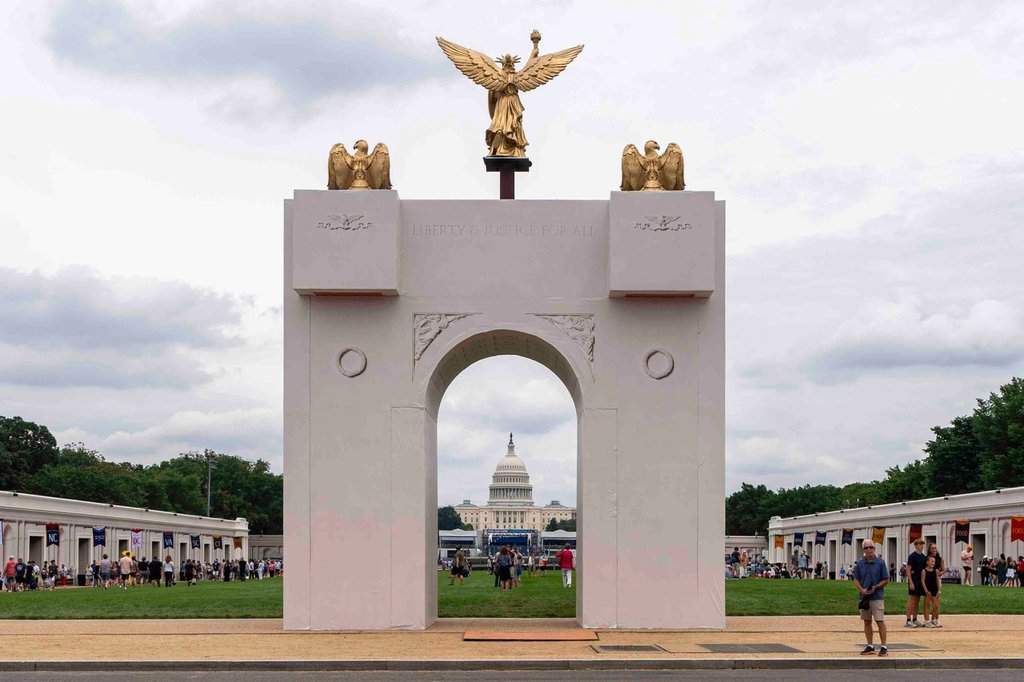
Every time a public figure proposes monumental architecture or a military-linked installation in the nation capital, the pundit class loses its collective mind. Headlines erupt with hand-wringing over authoritarian aesthetics, wasteful spending, and the desecration of some pristine civic dream. The consensus is lazy, predictable, and fundamentally ignorant of how sovereign power operates in physical space. When news breaks about planned arches or military complexes in Washington, commentators rush to frame it as a bizarre vanity project or an eccentric historical anomaly. They are wrong.
Capitals are not town squares. They are command nodes. They are built to project permanence, intimidate rivals, and anchor the psychological weight of a global empire into stone, steel, and concrete. Pretending that Washington is a neutral zone of civic virtue where architecture serves only democratic modesty is a comforting fairy tale told by people who have never studied how states actually survive.
Let us look past the partisan hysteria and examine what is actually happening when raw state power intersects with urban design.
The Myth of the Neutral Capital
The prevailing narrative treats Washington as if it were designed by a committee of mild-mannered urban planners who wanted nothing more than tree-lined avenues and quiet neoclassical harmony. This is historical revisionism of the highest order. Pierre Charles L'Enfant did not draft a master plan for a peaceful farming community. He laid out a Baroque grid system explicitly engineered for military defense, troop movement, and artillery command fields. Every major radial avenue in Washington was designed with a dual purpose: civic grandeur and field-of-fire control.
When critics foam at the mouth over militarized architecture in the capital, they betray a profound historical illiteracy. Capitals throughout human history—from Rome to Paris to St. Petersburg—were physical manifestations of state authority. They were designed to awe the citizen and terrify the adversary. The moment a government forgets that its capital is an operational fortress, it starts decaying from the center out.
The modern insistence that government architecture should look like a suburban corporate campus is a recent, fragile delusion. It assumes that global superpowers can maintain hegemony through soft-focus aesthetics and polite diplomacy while ignoring the brutal architecture of statecraft. Monuments are not decorations. They are structural arguments made of granite.
Why Scale Matters in Statecraft
Scale is the primary language of power. Small buildings invite negotiation; massive structures demand submission. When a state builds an arch or a fortified complex, it is signaling permanence in a world of shifting alliances and transient political cycles.
Consider the reaction to recent proposals for monumental arches or military installations in the capital district. The immediate response from elite commentators is mockery. They treat grand construction as a symptom of insecurity or megalomania. But history teaches the exact opposite. Weak states build temporary offices. Strong states build enduring monuments that outlive dynasties.
When an administration proposes anchoring military infrastructure directly into the symbolic heart of the capital, it is doing something very specific. It is collapsing the distance between civilian governance and hard power. For decades, Washington has tried to maintain a polite fiction that its military might exists somewhere out there, hidden in foreign bases or remote desert installations, untainted by the domestic seat of government. Bringing military architecture back into the visual vocabulary of the capital is not an escalation; it is an act of radical architectural honesty.
The Economics of Permanent Stone
Critics love to talk about budgets when monumental projects are announced. They tally up the estimated costs, wave spreadsheets around on television, and shriek about fiscal responsibility. But this critique relies on a fundamental misunderstanding of state expenditure.
Governments do not spend money on monuments the way a household budgets for groceries. State capital projects are economic anchors, employment engines, and long-term capital investments that accumulate cultural equity over centuries. The Parthenon was considered a scandalous waste of Athenian funds by contemporary cynics. The Eiffel Tower was denounced by the artistic elite of Paris as a grotesque iron monster. Today, those exact projects define the global identity and tourism economies of their respective nations.
When you build a military complex or a monumental arch in Washington, you are not just pouring concrete. You are employing specialized labor, securing supply chains for domestic steel and engineering talent, and creating a physical asset that will generate value and prestige for generations. The financial panic surrounding these projects is almost always political theater masking a deeper ideological discomfort with the physical manifestation of national power.
The Architectural Psychology of Deterrence
Deterrence is not just about aircraft carriers and nuclear codes. It operates on a psychological level through visual saturation. An adversary looking at a capital city needs to see a state that is deeply entrenched, physically formidable, and culturally unshakeable.
When Washington softens its aesthetic—when every new federal building looks like an insurance agency headquarters with tinted glass and passive-aggressive plantings—it sends a subtle signal of retreat. It suggests a government that is ashamed of its own apparatus, apologizing for its own reach.
A military complex integrated into the capital architectural framework changes the psychological calculus. It reminds every lobbyist, foreign diplomat, and domestic political actor that the state possesses both bureaucratic machinery and ultimate coercive force. This is not about warmongering; it is about realism. Peace is maintained when power is visible, undeniable, and impossible to ignore.
Dismantling the Civic Garden Fallacy
The most persistent delusion among urban commentators is the belief that Washington should function like a pristine park where citizens can peacefully commune with democracy. This view ignores the reality of modern governance. A capital is an arena of competing global interests, intelligence operations, and systemic pressure.
When proposals for arches or fortified zones emerge, the outcry centers on the idea of ruining the urban fabric. This complaint reveals a startling lack of perspective. Cities are living organisms that must adapt to changing threats and geopolitical realities. Freezing a capital in a permanent nineteenth-century postcard aesthetic is a recipe for strategic obsolescence.
If the nature of national security requires integrating command structures and monumental markers into the urban core, then the city must evolve. Clinging to the fantasy of an unarmed, pastoral capital in the twenty-first century is like navigating modern cyber warfare with a musket.
The Unspoken Fear of Permanent Power
Why do critics react with such visceral fury to military architecture in the capital? The answer has little to do with zoning laws or architectural style. It stems from a profound anxiety about the centralization of state authority.
For decades, political factions have fought over the soul of Washington. One side envisions a decentralized administrative state operating quietly behind anonymous glass facades. The other recognizes that power, when hidden, becomes unaccountable and decadent. Monumental architecture forces power out into the open. You cannot ignore an arch. You cannot pretend a military complex does not exist when it dominates the skyline.
By bringing these elements into plain view, such projects strip away the bureaucratic veil. They force citizens and politicians alike to look at the machinery of the state directly, without the comforting filter of neutral urban design. That confrontation makes people uncomfortable. But discomfort is often the first sign that reality is breaking through the illusions.
The Architecture of Imperial Confidence
History is littered with empires that fell not because they lacked resources, but because they lost the will to visually and physically assert their dominance. When a great power retreats from monumentalism, it signals an internal rot. It signals an elite class that is more comfortable managing decline from a glass-walled conference room than standing proudly beneath granite arches.
Consider the physical layout of rival capitals across the globe. Beijing, Moscow, London—none of these global power centers apologize for their architectural weight. They understand that a capital is a physical manifestation of sovereignty. When Washington attempts to disguise its power behind polite neoclassical facades and timid zoning restrictions, it looks uncertain of its own mandate.
An arch is not merely decorative masonry. It is a threshold. It marks the boundary between the ordinary municipal sprawl of the country and the concentrated core of sovereign command. A military complex embedded within the capital demonstrates that the ultimate guarantor of order is never far from the seat of legislation. Critics call this intimidation. Realists call it coherence.
Addressing the Skeptics
The standard counter-argument from fiscal hawks and civil libertarians usually runs along predictable lines: taxpayer money should not be spent on vanity projects, and militarizing a civilian city invites authoritarian overreach.
Let us dismantle both objections with cold logic.
First, the taxpayer argument ignores how federal appropriations actually function. The billions spent on monumental infrastructure do not vanish into a black hole; they circulate directly through domestic manufacturing, heavy industry, engineering firms, and union labor pools. If a government is going to spend capital, investing in durable public assets that endure for centuries provides vastly superior long-term return on investment compared to ephemeral administrative subsidies or bloated bureaucratic consulting fees.
Second, the civil liberties argument inverts cause and effect. A nation does not become tyrannical because it builds an arch or a military headquarters in its capital. Tyranny grows in the dark, administrative corners of an unchecked executive state operating out of windowless office parks. Transparency is found in stone. When power is monumental, it is accountable to public view. You can see it, critique it, measure it, and debate it. Hidden power—the kind housed in anonymous bureaucratic labyrinths—is where true democratic accountability goes to die.
What Real Strength Looks Like
We live in an era of ephemeral digital politics, where policies change with every news cycle and national identity is treated as a branding exercise. In this fluid environment, physical architecture is an anchor.
When a nation builds something heavy, permanent, and unapologetically powerful, it is making a bet on its own survival. It is saying that the state is not a temporary tenant in a rented office building, but a permanent historical actor with roots sunk deep into the earth.
The critics will continue to carp. They will write their opinion pieces, bemoan the loss of aesthetic purity, and calculate imaginary budget deficits. Ignore them. They are measuring the future with a broken ruler. A great capital needs stone, steel, and muscle. It needs monuments that dwarf the individual and structures that signal an unbroken will to endure. Anything less is just administrative management pretending to be a civilization.