Millionaires are buying up the world's best dinosaur bones, and it's ruining paleontology.
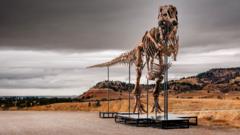
With Sotheby's positioning the 38-foot Tyrannosaurus rex skeleton nicknamed "Gus" for a massive auction in New York with estimates hitting $30 million or more, the frenzy around prehistoric relics has officially reached a boiling point. It follows a predictable, frustrating pattern. A massive, beautifully preserved apex predator gets dug out of private land, hits a glossy auction block, and vanishes into the private collection of an anonymous tech mogul or hedge fund manager.
To the public, these multi-million-dollar auctions look like a thrilling marriage of high society and natural history. To actual scientists, it's a disaster.
The cash flood in high-end fossil auctions isn't just driving up prices; it's actively locking researchers out of the history of our planet. When a specimen like Gus or the record-shattering $44.6 million Stegosaurus "Apex" goes to the highest bidder, science usually loses.
The Replicability Crisis in Private Living Rooms
The biggest problem with selling a T. rex to a private collector boils down to one foundational rule of science: replicability.
If a paleontologist publishes a paper about a dinosaur, other scientists must be able to look at the exact same bones to verify the findings. They need to measure the jaw, analyze the bone density, and run new scans as technology improves. When a fossil sits in a secure, permanent public museum collection, anyone with the right credentials can walk in and study it.
When a fossil hangs over a billionaire's fireplace, that access vanishes.
A private owner can change their mind at any time. They can deny entry to a specific researcher, sell the bones to an even more reclusive buyer, or simply pack it away in a climate-controlled storage facility to accrue value like a piece of fine art. According to a study published in Palaeontologia Electronica by paleontologist Thomas D. Carr, more than half of the world's scientifically useful T. rex fossils are currently held in private or commercial hands rather than public trusts. Out of 141 analyzed specimens, 71 are locked away from peer review.
If a future team of scientists can't access a fossil to check a previous claim about how T. rex grew or moved, the original research becomes practically useless. It can't be tested. In the scientific community, if a finding can't be tested, it isn't real science.
Missing the Most Crucial Chapters of Dinosaur Growth
The public wants to see massive, bone-crushing adults. Because of that, the commercial market puts an astronomical premium on size. But for researchers, the giant adults aren't the only pieces of the puzzle.
We actually know very little about how a baby T. rex turned into an eight-ton adult. To understand that growth trajectory, paleontology desperately needs subadult and juvenile specimens. These smaller, fragile fossils are incredibly rare, but they also happen to be highly sought after by commercial outfits because they fit neatly into smaller luxury spaces.
Carr's data shows that roughly 20% of privately held T. rex fossils are juveniles or subadults. Because these younger dinosaurs remain locked behind closed doors, we can't answer basic questions about their development, sexual dimorphism, or how their hunting habits shifted as they aged.
Commercial dealers argue they're doing public good by rescuing these bones from natural erosion. Legally, they're right to dig them up if they have permission from private landowners. Since the historic 1997 auction of "Sue" for $8.36 million, commercial teams have actually discovered nearly 2.4 times more T. rex specimens than public institutions.
But finding them isn't the same as saving them for humanity. Only about 11% of those commercially discovered fossils ever find their way into a public museum trust. The rest become high-status decor.
The Downstream Effects on Landowners and Research Access
The multi-million-dollar price tags flashing on television screens have broken the relationship between academic researchers and everyday landowners.
For decades, paleontologists could knock on a rancher's door in places like the Hell Creek Formation of South Dakota, ask to look around their property, and dig up fossils for the price of a handshake and mutual respect. Landowners were often thrilled to help advance science.
Now, everyone knows what a T. rex is worth.
Ever since "Stan" pulled in $31.8 million at Christie's in 2020, researchers have been systematically locked out of private lands. Landowners are realizing they're sitting on potential lottery tickets. Why let a university team dig up a skeleton for free when a commercial outfit will pay massive up-front fees or offer a cut of a future Sotheby's auction?
University paleontology departments operate on shoestring budgets. They rely on grants that barely cover gas, truck maintenance, and plaster wraps. They can't compete with the capital of commercial extraction companies. A single $30 million auction layout could fund entire university Earth science departments for decades. Instead, that capital goes into a single private transaction.
Where We Go From Here
If you want to support actual science rather than the luxury fossil market, stop treating dinosaurs like fine art.
If you're a private citizen looking to fund paleontology, don't buy a bone to keep in your home. Direct your capital toward funding museum field expeditions or establishing trusts that purchase these specimens specifically to donate them immediately to public research repositories.
For the rest of us, vote with your feet. Spend your weekend dollars at accredited natural history museums that maintain open, transparent public research collections. When these institutions have the backing of the public, they have a much better shot at courting the massive philanthropic donors needed to outbid oligarchs on the auction block. If we don't change how we value these discoveries, the world's most famous dinosaur will continue to become nothing more than a rich person's trophy.