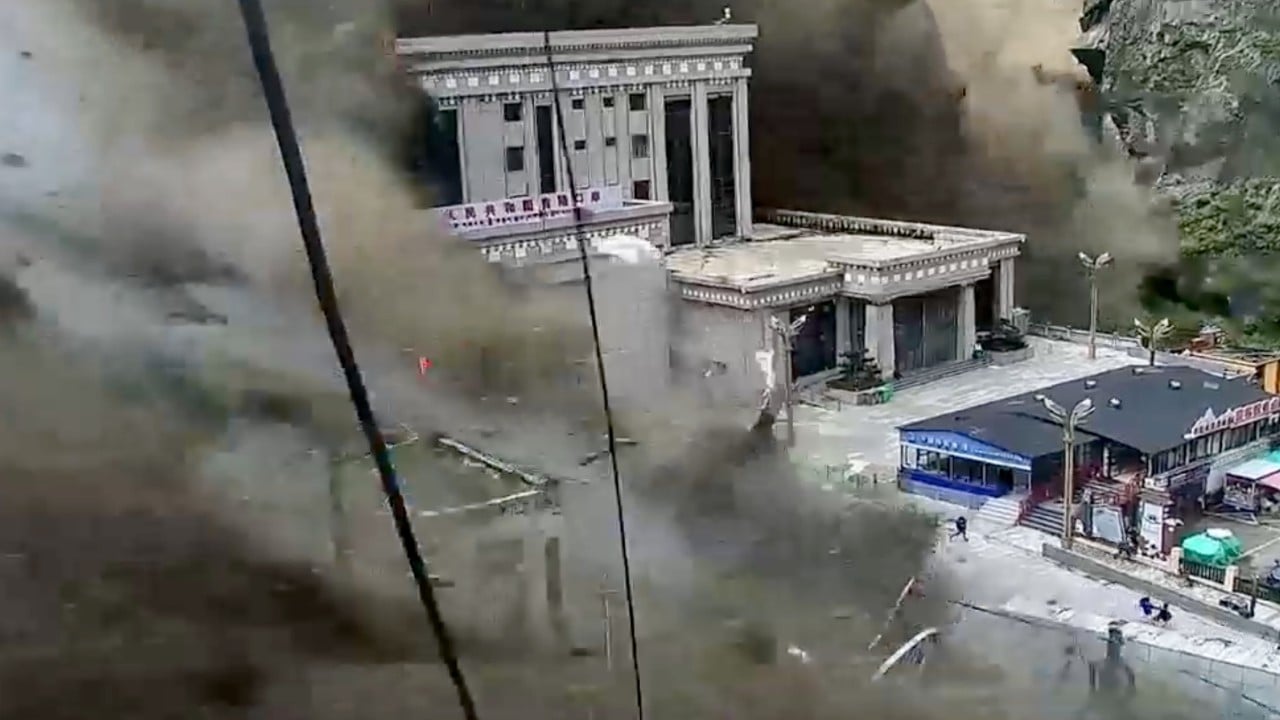
The air in the high valleys does not simply chill as night approaches; it hardens. You can taste the slate and the dry dust of ancient moraines, a metallic tang that settles at the back of the throat long before the monsoon winds shift. For generations, people living along the jagged seams where China and Nepal meet have measured time not by clocks, but by the behavior of the slopes above them. A mountain is never just rock. It is a ledger. Every freeze, every thaw, every tremor writes a line of accounting that the valley below must eventually settle.
We talk about disasters as if they arrive with fanfare. We expect a warning bell, a gradual crescendo, a window of grace where human adrenaline can outpace gravity. That is a comforting fiction. Learn more on a connected issue: this related article.
Consider a hypothetical villager named Dawa, resting his hands on a dry-stone wall in a border settlement. Below him, a glacial river churns a milky turquoise, fed by ice fields thousands of meters up. Dawa knows every contour of the ridge line. He knows which boulders are anchored by deep-rooted scrub and which are loose shingle waiting for a heavy rain. When the sound begins, it does not register as thunder. Thunder rolls. This sound tears. It is a low, subterranean groan, like iron twisting inside a furnace, followed instantly by a wall of kinetic fury that turns a mountainside into a liquid avalanche.
Recent scientific findings regarding the catastrophic China-Nepal floods lay bare a terrifying reality. When a high-altitude debris flow breaks loose, human reaction time becomes entirely irrelevant. Researchers tracking these catastrophic events have mapped the velocity and mass of these hyper-concentrated slurry floods, discovering a hard, unyielding truth: no one could have outrun it. Additional analysis by Associated Press highlights similar views on the subject.
To understand why, you have to look at the mechanics of what the researchers found. A standard flash flood is water mixed with mud. Dangerous, yes, but fluid. What hit these border regions was something fundamentally different. It was a debris flow, a dense, viscous composite of boulders the size of delivery trucks, uprooted pines, gravel, and mud, all moving at highway speeds down a vertical drop. This is not water finding a path. This is a mountain collapsing into a battering ram.
Physics offers no mercy here. When millions of cubic meters of saturated moraine give way—often triggered by glacial lake outbursts or sudden, torrential monsoon bursts—the descent is nearly instantaneous. The gradient is too steep, the volume too immense, and the density too high. If you are in its path, the math of your survival is reduced to zero before your brain even registers the sound of the snap.
We struggle to accept this. Modern culture has trained us to believe that technology, alerts, and quick reflexes can outwit almost any crisis. We look at early warning systems as magical shields. But the data from the China-Nepal border exposes the sobering limits of preparedness when facing the raw, unfiltered architecture of the planet. Satellites can photograph a swelling glacial lake weeks in advance. Sensors can measure rainfall down to the millimeter. Yet, the exact trigger point—the precise microsecond a slope decides to let go—remains hidden behind the chaos of natural variables.
The emotional core of this reality is heavy. It forces us to confront our fragility in spaces where we are merely temporary guests.
Walking through these valleys after the dust has settled, the silence is deafening. The landscape has been rewritten overnight. Old paths are erased; new cliffs stand where terraced fields once caught the morning sun. The survivors do not talk about running. They talk about the wind changing direction, a sudden vibration in the soles of their feet, and then the dark.
We must shift how we view these events, moving away from the illusion of control and toward a deeper, more humble respect for high-altitude dynamics. The research is not merely a collection of grim statistics; it is a profound map of our boundaries. It tells us that engineering can fortify a bridge, and sensors can buy precious minutes for a downstream town, but nature still holds margins where escape is simply a mathematical impossibility.
The mountain does not malice. It does not plot. It simply yields to the eternal, unyielding pull of the earth, reminding us that we live at the mercy of forces that measure time in millennia while we measure it in heartbeats.


