November wind always carries a specific kind of chill. It smells like wet leaves, damp wool, and the faint, metallic tang of approaching winter. For anyone who has ever stood in an American town square on the eleventh day of the eleventh month, that chill is inseparable from the sound of a lone bugle echoing off brick walls and the heavy, rhythmic silence of a crowd holding its breath.
Veterans Day is supposed to be a pause. It is the one morning on the calendar set aside to look backward, to honor the debt owed to those who wore the uniform, and to stand quietly beside the people who came home carrying memories they rarely speak aloud. Yet, when a president steps up to a podium on that morning to defend an active, controversial military conflict, the quiet breaks. The past collides violently with the present.
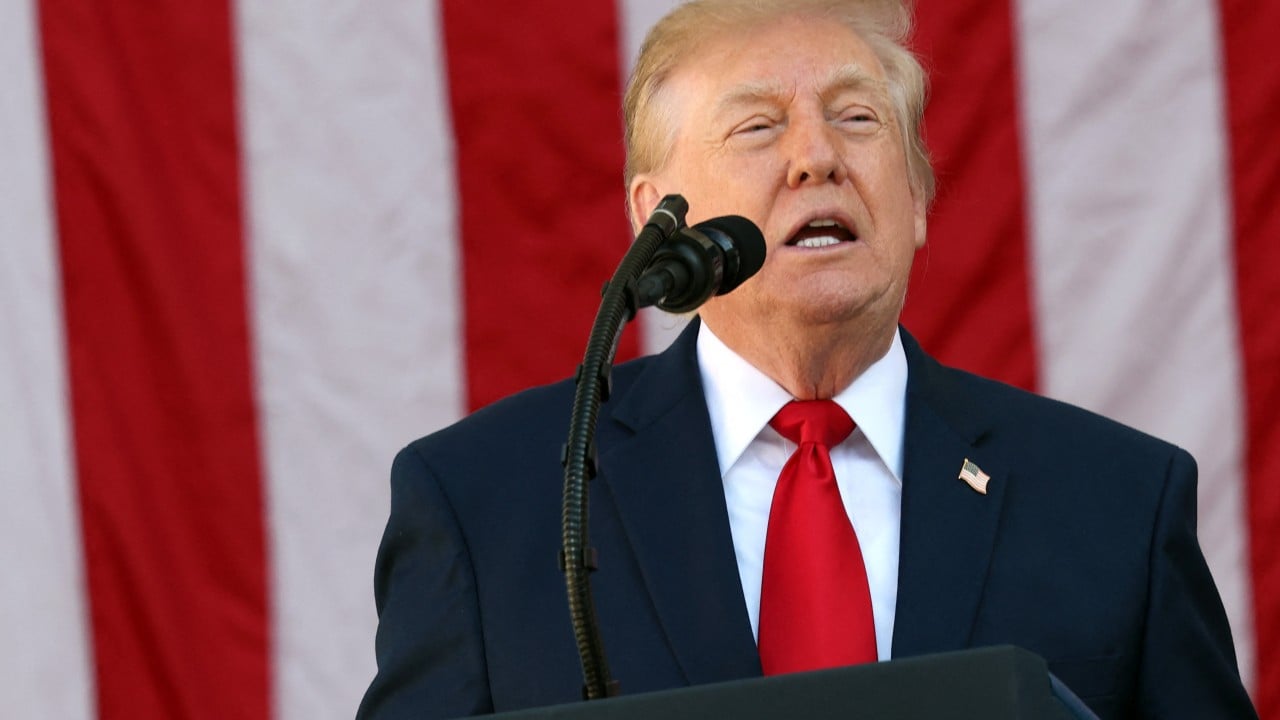
Consider what happened when President Donald Trump took the stage for his Veterans Day address, using the solemn occasion to mount a vigorous defense of U.S. military engagement with Iran. On paper, news reports summarize the event in dry, clinical strokes: the commander-in-chief addressed veterans, framed the conflict as a necessary measure for national security, and pushed back against domestic and international critics.
Cold facts. Clean lines. Completely devoid of the trembling tension that actually fills the air when those words are spoken aloud.
To understand why a speech like this lands like a thunderclap, you have to step away from the press releases and look at the people sitting in the folding chairs. You have to look at the invisible stakes weighing on the shoulders of families who know exactly what happens when policy turns into deployment orders.
The Anatomy of a Defense
When a leader defends a war on a day meant for honoring past service, the rhetoric must walk a razor-thin wire. According to accounts of the address, Trump framed the administration's actions against Iran not as a war of choice, but as an unavoidable confrontation required to neutralize existential threats and protect American lives. Supporters of the administration's position argue that decisive military deterrence is the only language adversarial regimes understand, pointing to decades of proxy conflicts, regional instability, and nuclear ambitions as proof that diplomatic patience had reached its end.
Listen closely to the structure of that argument, and you can hear the mechanics of political persuasion at work. In public speeches, Trump consistently relies on themes of strength, resolve, and the refusal to appear weak on the global stage. By linking the current conflict in Iran to the legacy of past American veterans, the speech sought to cast today's troops as the direct inheritors of a continuous mission to keep threats far from American shores.
Yet, outside the perimeter of the podium, a fiercely different perspective holds ground. Critics of the conflict, including anti-war advocates, foreign policy analysts, and opposing lawmakers, view the engagement through an entirely different lens. To them, escalating military action in the Middle East risks repeating the costly, open-ended entanglements of the early twenty-first century. They argue that military force rarely produces lasting political stability in the region, and they question whether the administration has clearly defined what victory actually looks like—or what the exit strategy might be.
Both sides claim to speak for the soldier. One side argues that projecting overwhelming strength is the surest way to protect service members and prevent larger catastrophes; the other insists that keeping troops out of prolonged, uncertain conflicts is the highest form of respect a nation can offer its military.
The Kitchen Table Calculus
To grasp what those competing arguments actually feel like on the ground, consider a hypothetical scenario—a composite of countless real households across the country.
Picture a kitchen table in a mid-sized town in Ohio or North Carolina. Let us call the family the Millers, though their names could be anything. On the counter sits a half-empty pot of coffee, a stack of unopened bills, and a television playing the Veterans Day broadcast on low volume. Mark, fifty-four, served two tours in the early 2000s. His knees ache when the barometer drops, and he still wakes up at three in the morning checking the locks on the doors. Beside him sits his twenty-one-year-old son, Lucas, who enlisted right out of high school and is currently stationed overseas.
When the president speaks from the podium about deterrence, strategic necessity, and unwavering resolve, Mark does not hear talking points. He hears the specific whine of turbine engines on a tarmac at midnight. He remembers the weight of body armor pressing into his collarbones until his shoulders went numb.
For Mark, the argument for strength makes intuitive sense. Having lived through the consequences of geopolitical hesitation, he understands the fear that letting a threat grow unchecked only guarantees a bloodier reckoning later. If projecting power keeps his son's base from coming under missile fire, he wants that shield held high.
Across the table, however, his wife, Elena, hears the exact same words and feels a cold knot tighten in her stomach. For her, a speech defending an active conflict does not sound like a shield; it sounds like an open-ended commitment with no expiration date. She remembers the years when Mark came home physically intact but emotionally unreachable, staring at walls as if he were still scanning a horizon nobody else could see. When critics warn about mission creep and the human cost of escalation, Elena does not need a policy paper to understand the risk. She has already lived through the aftermath once.
That is the invisible fracture running straight through the country whenever a leader justifies war on Veterans Day. The debate is rarely a neat collision between hawks and doves. More often, it is a collision between two deeply held fears inside the very same living rooms: the fear of failing to stop a danger before it strikes, and the fear of sending another generation into a crucible from which nobody returns unchanged.
The Echoes of History
History shows us that American presidents have long used patriotic holidays to rally public resolve during times of conflict. Think of it like a lighthouse beam sweeping across dark water: in moments of national uncertainty, leaders try to anchor their current decisions to the bedrock of shared national sacrifice. During World War II, the Korean War, and the long decades of the Cold War, Veterans Day—and Armistice Day before it—frequently served as a stage to remind the public that freedom requires vigilance and that current hardships are part of a larger, noble continuum.
However, the historical record also carries a warning about the fragility of public consensus. When the objectives of a conflict feel distant, complex, or shifting, speeches alone struggle to carry the weight of public doubt. During the Vietnam era and again during the prolonged operations in Iraq and Afghanistan, the gap between official assurances from Washington and the lived reality of military families grew wide enough to reshape American politics for generations.
I have always found it striking how easy it is for observers far removed from the military to talk about conflict in abstract terms. Pundits speak of "theater dynamics," "escalation ladders," and "strategic calculus" as if they were moving wooden pieces across a tabletop map. Those metaphors are tidy. They make war sound like a chess match played by rational actors who can simply reset the board when the game is over.
War is never chess. A better analogy is pulling a thread on a tightly woven wool sweater: you know where you are tugging, and you have a clear reason for wanting that single loose strand gone, but you can never fully predict which seams three inches away will suddenly unravel.
In the Middle East, every thread is connected to a dozen others. Regional alliances, energy markets, civilian populations caught between rival powers, and the delicate balance of deterrence all shift the moment force is applied. That complexity is precisely why the public reaction to Trump's defense of the Iran conflict remains so sharply divided, and why even seasoned analysts admit that the long-term trajectory of the region carries profound uncertainty.
What the Crowd Remembers
As the Veterans Day ceremony draws to a close, the speeches fade, the cameras pack up their tripods, and the motorcades pull away toward the highway. The political commentators immediately begin dissecting the phrasing, measuring the applause lines, and debating whether the president's message resonated with voters or alienated skeptics.
Yet, long after the news cycle moves on to the next headline, the people who actually attended the ceremony remain standing in the cold.
An older veteran in a faded cap covered in brass pins slowly folds his lawn chair. A young mother adjusts the scarf around her toddler's neck, glancing down at her phone to see if a message has come through from a time zone eight hours ahead. Nobody in that park is thinking about polling data or cable news panels. They are thinking about promises kept, promises tested, and the quiet hope that the next November morning will find everyone they love standing beside them on solid ground.
The wind picks up across the square, scattering dry oak leaves against the base of the granite memorial, while the last brass notes of the bugle seem to hang suspended in the gray autumn air.