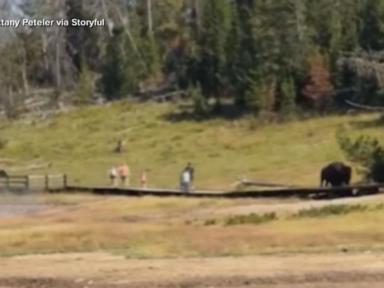
National parks operate under a persistent operational paradox. They invite millions of visitors to experience untamed ecosystems while expecting those visitors to instinctively master the behavioral rules of wild animals. When a visitor approaches a large mammal, the resulting crisis is rarely an isolated accident of fate. It is the predictable failure of human risk assessment against a backdrop of wildlife biology.
Deconstructing an incident where a bison charges a child in Yellowstone requires moving past the visceral shock of the footage and examining the underlying variables. Human proximity decisions, animal stress thresholds, and park infrastructure limitations combine to create predictable failure points. Wildlife management requires viewing these events not as freak occurrences, but as structural breakdowns in spatial discipline.
The Behavioral Mechanics of Bison Agitation
Bison are not domesticated livestock. They are large herbivores weighing up to two thousand pounds, capable of sprinting thirty-five miles per hour. Their physical stature belies an agility that catches observers off guard. Understanding why a charge occurs requires mapping the animal's stress response triggers.
The Spatial Threshold Model
Every wild animal maintains a variable flight zone and an absolute critical distance. When a human breaches the flight zone, the animal moves away to re-establish a comfortable buffer. When a human breaches the critical distance, the animal transitions from flight to fight.
Visitors consistently miscalculate this boundary because bison appear docile when grazing. This perceived passivity masks a high-strung nervous system. The animal does not calculate intent; it calculates threat proximity. A child moving toward a bison represents a fast-moving, unpredictable stimulus that compresses the critical distance faster than the animal can process or flee.
Physiological Stress Indicators
Bison exhibit explicit pre-charge warning behaviors that are frequently ignored or misread by untrained observers. These signals form a sequential escalation ladder.
- Tail flagging or lifting from its natural downward position
- Head lowering accompanied by side-to-side sweeping motions
- Pawing the earth and tossing dust or dirt into the air
- Grunting, snorting, or emitting low-frequency vocalizations
- Body orienting squarely toward the perceived threat
When these indicators appear, the animal has already reached its cognitive threshold. The subsequent charge is a defensive maneuver designed to neutralize a perceived predator or intruder, not an unprovoked act of aggression.
Human Cognitive Biases in Wildlife Settings
The interaction between tourists and megafauna is governed by predictable cognitive failures. Visitors enter national parks with mental models shaped by urban environments, media portrayals, and sanitized encounters with captive animals.
The Familiarity Bias
Bison share physical traits with cattle, leading observers to apply domestic behavioral assumptions to wild megafauna. This heuristic fails dangerously. Domestic cattle have been bred for generations to reduce reactivity to human presence. Bison retain completely wild instincts, meaning their startle and defense mechanisms are fully active.
The Scale Distortion Error
National park landscapes are vast. Visitors often view animals from hundreds of yards away through telephoto lenses or binoculars, creating a false sense of intimacy and safety. When humans enter the physical space of the animal, they underestimate how rapidly a massive creature can close the intervening gap. A distance that feels safe to a human standing still is well within the tactical striking range of a charging animal.
The Social Proof Effect
Crowd behavior heavily dictates individual risk tolerance. If a visitor sees other tourists standing close to a bison without immediate negative consequences, they assume the behavior is safe. This collective descent into poor judgment creates clusters of vulnerable individuals who reinforce each other's bad decisions.
Infrastructure and Management Constraints
Yellowstone spans over two million acres, hosting millions of annual visitors with a finite ranger workforce. Physical enforcement of spatial rules is mathematically impossible across every trail, thermal basin, and roadside pullout.
The Enforcement Gap
Park regulations mandate maintaining a distance of at least twenty-five yards from all wildlife, and at least one hundred yards from bears and wolves. However, rangers cannot be ubiquitous. The system relies heavily on voluntary compliance. When voluntary compliance breaks down, the mitigation strategy shifts from prevention to post-incident rescue and public relations management.
Signage and Communication Failures
Standard warning signs relying on text-based rules often fail to modify behavior. Abstract numbers like twenty-five yards lack visceral meaning for visitors unfamiliar with field measurements. Furthermore, warning fatigue sets in when visitors encounter hundreds of cautionary notices daily. The communication architecture must shift from passive warnings to active spatial barriers or immediate social friction when rules are violated.
Systemic Interventions for Risk Reduction
Mitigating wildlife conflicts requires redesigning the interface between visitors and the park environment. Relying on human self-restraint has proven insufficient.
Environmental Architecture
Physical design can dictate behavior more effectively than signage. Narrow boardwalks, elevated viewing platforms, and natural physical barriers constrain movement and prevent visitors from stepping into open terrain where close encounters occur. Where paths intersect common wildlife corridors, hard architectural boundaries must replace open-access meadows.
Educational Reframing
Park communication must transition from a legalistic compliance model to a tactical survival model. Instead of telling visitors what they are not allowed to do, education programs should train visitors to recognize the biological triggers of animal aggression. When a visitor understands that tail flagging precedes a four-hundred-yard pursuit, the calculus of proximity changes from a desire for a photograph to an awareness of physical vulnerability.
Consequence Structures
Current deterrence mechanisms lack immediate feedback loops for minor infractions. By the time a rule-breaker faces consequences, the interaction has usually escalated into an emergency. Increasing ranger presence at high-density wildlife viewing zones, coupled with immediate, visible enforcement actions, disrupts the social proof cycle that encourages risky behavior.
Protecting both human visitors and wildlife populations demands a strict adherence to spatial reality. The landscape does not negotiate its terms, and wild animals do not adjust their biology to accommodate human ignorance. Managing the interface requires treating distance not as a suggestion, but as an absolute boundary line.