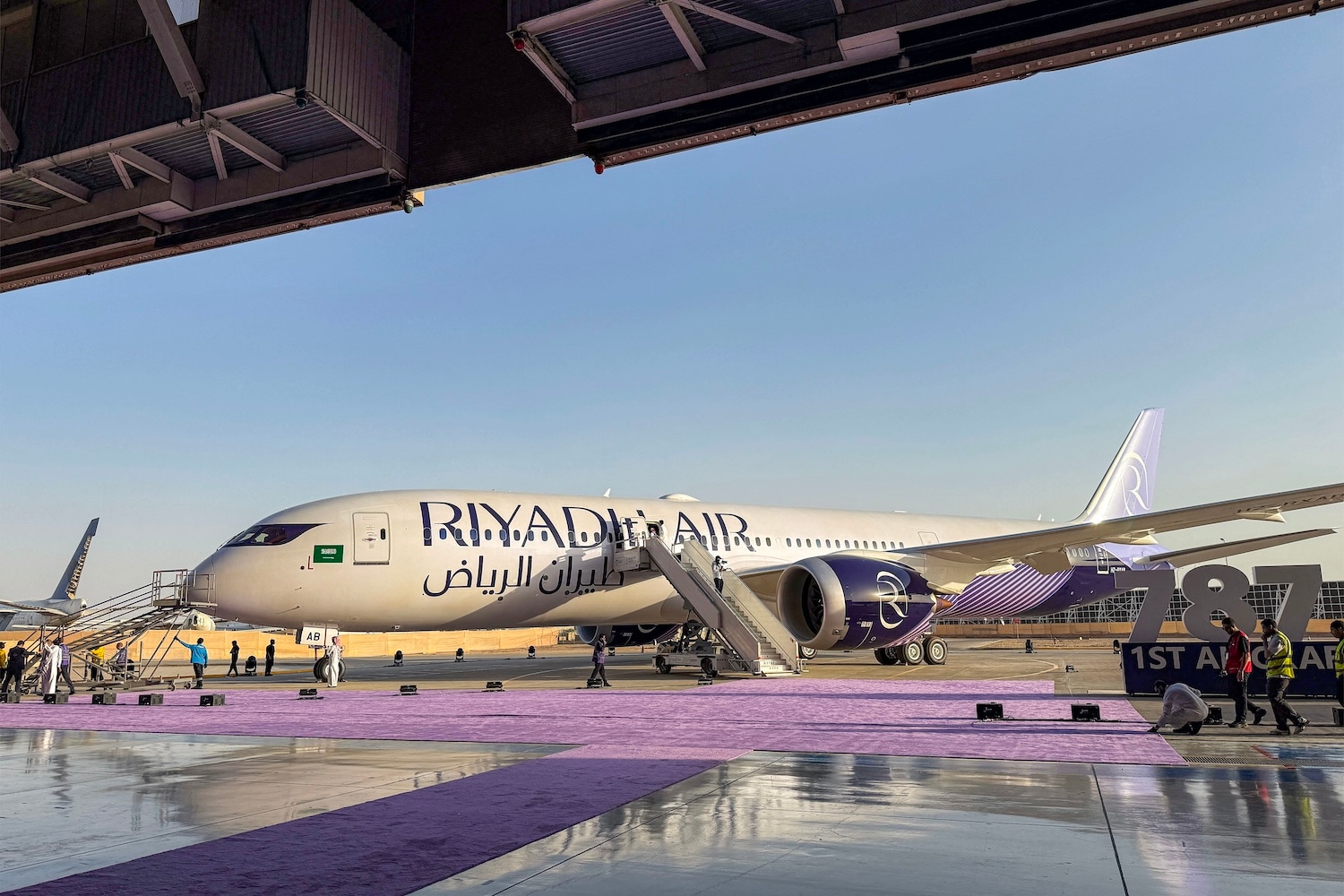
Aviation media loves a big spreadsheet. When Riyadh Air finalized its order for up to 157 aircraft, the industry collective instantly copy-pasted the same predictable narrative. They framed it as a direct, existential threat to Emirates and Qatar Airways. They mapped out a new tri-polar order in Gulf aviation. They treated fleet size as a proxy for market conquest.
They are completely misreading the board.
Buying planes is the easy part. Anyone with a sovereign wealth fund and an open delivery slot at Boeing or Airbus can assemble a massive fleet. But the lazy consensus assumes that global aviation is a game of pure capacity. It is not. It is a brutal war of geography, network density, and structural economics.
Riyadh Air is not launching a year late into a wide-open market. It is crashing into a mature, hyper-saturated ecosystem with a structural disadvantage that money cannot easily fix.
The Point-to-Point Fallacy
The foundational error in the competitor’s analysis is the assumption that Riyadh Air will simply clone the hub-and-spoke models of Dubai and Doha.
Emirates and Qatar Airways did not build their empires by serving their local populations. They built them by turning tiny geographic footprints into global transit funnels. Dubai International Airport and Hamad International Airport are massive machines designed to move a passenger from London to Sydney, or Mumbai to New York, with a brief, high-margin pit stop in the desert.
Saudi Arabia’s stated strategy for Riyadh Air is fundamentally different. The kingdom wants a carrier that brings people to Saudi Arabia to support its Vision 2030 tourism and business mandates. This is a point-to-point strategy disguised as a hub-and-spoke network.
I have watched airlines pour billions into forcing a point-to-point model on a market that prefers transit options. The math rarely works out.
- Transit Traffic: Thrives on high-frequency, low-margin connecting pairs that fill seats across a massive matrix of destinations.
- Destination Traffic: Relies heavily on premium business travel and high-spending tourists.
Saudi Arabia is spending hundreds of billions to build giga-projects like NEOM and the Red Sea Project. But building luxury resorts does not automatically generate the consistent, year-round corporate yield required to sustain 157 widebody and narrowbody aircraft. Riyadh Air is being built backward. Usually, demand creates an airline. Here, the airline is being created to force demand into existence.
The Transfer Passenger Myth
Let’s dismantle the "People Also Ask" query that dominates every aviation forum: Can Riyadh Air steal significant market share from the Big Three (Emirates, Qatar Airways, Etihad)?
The short answer is no, not without destroying its own yields.
Aviation mechanics rely on network density. Consider a traveler flying from Paris to Bangkok.
[Paris] ---> (Dubai Hub: 2-Hour Window) ---> [Bangkok]
Emirates wins this passenger because they offer multiple daily flights, creating a highly optimized connection window. For Riyadh Air to steal that passenger, it cannot just match the price. It has to offer a comparable or superior schedule.
But Riyadh Air’s primary mandate is to funnel traffic into Riyadh. If they optimize their bank of flights for transit passengers to compete with Dubai, they compromise the schedules required by high-yield business travelers coming to the capital for government contracts. You cannot optimize a single hub for both strategies simultaneously without doubling your fleet and hemorrhaging cash on half-empty planes during off-peak hours.
Furthermore, the geographic advantage of the Gulf is already split. Dubai has the commercial infrastructure. Doha has the premium service reputation. Abu Dhabi has the targeted boutique footprint. Riyadh sits inland, adding unnecessary flight time for specific major flow corridors like Europe to India compared to its coastal rivals.
The Talent Bottleneck No One Talks About
An airline is not a collection of aluminum and carbon fiber tubes. It is an operational ecosystem.
The competitor's piece notes the scale of the jet order but ignores the human capital crisis staring the industry in the face. The global aviation sector is facing a severe shortage of qualified captains, first officers, line maintenance engineers, and seasoned network planners.
I have seen legacy carriers stall expansion plans not because they lacked planes, but because they lacked Type-Rated crews to fly them.
Riyadh Air is entering the market at the absolute worst time to recruit top-tier talent. Emirates and Qatar Airways have spent decades building crew communities, schools, and attractive expatriate lifestyles in cities that have been Westernized for a generation. Riyadh is transforming rapidly, but it still faces a steep cultural and reputational hurdle when competing for the same finite pool of global aviation professionals.
To peel away a senior A350 or B787 captain from Dubai, Riyadh Air cannot just match the tax-free salary. They have to pay a massive premium. When your baseline labor costs are artificially inflated from day one just to get planes in the air, your cost per available seat-kilometer ($CASK$) skyrockets.
Supply Chain Realities vs. Press Release Fantasy
The headline screams "157 jets on order," as if Boeing and Airbus will simply deliver them in a shiny fleet next Tuesday.
Let's look at the actual industrial reality. The aerospace supply chain is broken. Delivery delays are no longer an anomaly; they are the baseline standard. Boeing is grappling with severe production caps and quality control audits. Airbus is choked by engine delivery delays and cabin component shortages.
When an airline announces it is launching "a year late," that is rarely a strategic choice. It is usually a symptom of a supply chain that cannot deliver the hardware on time.
Imagine a scenario where Riyadh Air builds its entire marketing, staffing, and airport infrastructure around a projected delivery schedule of 20 aircraft a year, only to receive eight because of a delivery bottleneck. The fixed costs remain. The salaries are paid. The airport slots sit empty. The burn rate of capital in that scenario is catastrophic, even for a sovereign fund.
The Cannibalization Problem
The ultimate contradiction in the Saudi aviation strategy is the existence of Saudia (Saudi Arabian Airlines), based in Jeddah.
The official narrative claims Saudia will focus on religious tourism (Hajj and Umrah) and the Western region, while Riyadh Air handles the capital and premium business travel. This looks clean on a PowerPoint slide in a boardroom. In reality, it creates immediate internal friction.
Saudia is not a small, regional operator. It is a massive legacy carrier with its own significant widebody fleet and global network.
- Both airlines are funded by the same ultimate shareholder.
- Both airlines compete for the same domestic slots and airspace capacity.
- Both airlines will inevitably overlap on high-yield trunk routes to London, New York, and Paris.
When Riyadh Air launches a flight from Riyadh to London Heathrow, it isn't just taking a slice of Emirates' pie. It is directly cannibalizing Saudia’s existing premium traffic from the central region. Instead of creating a unified front against regional competitors, the kingdom is funding an expensive, internal civil war for domestic market share.
The Real Cost of Buying Market Share
To survive the first five years, Riyadh Air will have to resort to aggressive yield dumping. They will be forced to price their tickets below cost to convince loyalty-bound flyers to abandon Emirates Skywards or Qatar Airways Privilege Club.
We know how this story ends. Etihad attempted a rapid expansion strategy in the 2010s, pouring billions into equity alliances and aggressive capacity growth to catch up with Emirates. It resulted in billions of dollars in losses, forced restructuring, and a painful retreat to a much smaller regional footprint.
Riyadh Air’s financial backing means it won't go bankrupt, but it does not exempt it from the laws of economic gravity. A fleet of 157 aircraft is a massive financial liability if the load factors are propped up by discounted fares.
Stop looking at the order book. Stop treating aircraft handovers as wins. Riyadh Air is entering a game where the rules were written by its neighbors twenty years ago, and simply buying a larger deck of cards won't change the hands they are dealt.