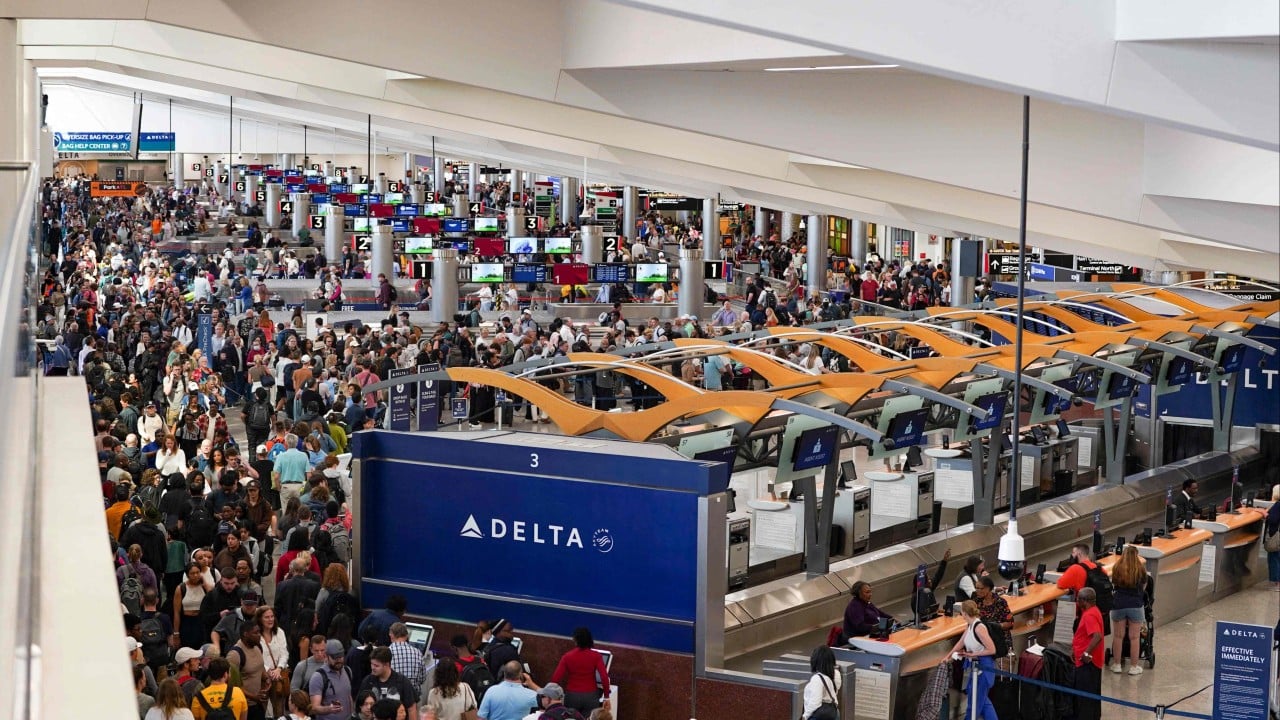
The legacy media is currently obsessing over the wrong fight. While unions bicker with bureaucrats about staffing levels and Democrats trade barbs with the Trump administration over the "optics" of Immigration and Customs Enforcement (ICE) at airport terminals, they are missing the systemic shift happening under their noses. This isn't a debate about immigration policy. It is a fundamental redesign of the American transit hub into a high-friction surveillance node.
The "lazy consensus" suggests that putting ICE in airports is merely an enforcement expansion. It isn't. It is the final nail in the coffin for the Fourth Amendment at 30,000 feet. We are witnessing the birth of the "Internal Border," where your right to move is contingent on your willingness to be scanned, indexed, and vetted by an agency that operates with nearly zero judicial oversight within 100 miles of any coastline. Meanwhile, you can read related events here: The Cold Truth About Russias Crumbling Power Grid.
The Myth of Efficient Enforcement
The administration claims this move will "streamline" security. That is a tactical lie. Anyone who has spent five minutes in an operations center knows that adding layers of disparate federal agencies with overlapping jurisdictions creates a logistical nightmare, not a streamlined process.
When you introduce ICE into a space already governed by the TSA and Customs and Border Protection (CPB), you aren't increasing safety. You are increasing friction. You are creating a "Who's on First?" routine where the victim is the traveler’s time and the taxpayer’s wallet. I have watched agencies burn through nine-figure budgets trying to "sync" databases that were never meant to talk to each other. The result is always the same: longer lines, more "random" secondary screenings, and a massive bill for hardware that will be obsolete in twenty-four months. To understand the bigger picture, we recommend the recent article by NPR.
The 100 Mile Exclusion Zone Fallacy
Most Americans believe the Constitution protects them everywhere on U.S. soil. They are wrong. Under the "border search exception," the government’s power to conduct warrantless searches is significantly expanded at any port of entry. But here is the kicker: the "border" isn't just a line on a map.
According to federal regulations, the government’s "border zone" extends 100 air miles inland from any external boundary. Since most major U.S. airports fall within this zone, two-thirds of the American population currently lives in a region where ICE and CBP claim the authority to operate with reduced constitutional constraints. By normalizing ICE’s presence in the terminal, the administration is effectively turning the entire airport infrastructure into a permanent, warrantless search lab.
Biometrics Is the Real Engine
Don't be fooled by the uniforms. The real story isn't the agents; it's the algorithms. The push for ICE at airports is the trojan horse for a universal biometric entry-exit system.
- Facial Recognition: It isn't just for "convenience" at the gate.
- Behavioral Analysis: AI-driven "spotting" that flags "suspicious" physiological markers.
- Data Aggregation: Linking your flight manifesto to your financial records and social media footprint in real-time.
The competitor’s article focuses on the "criticism from unions." Who cares? The unions are worried about overtime pay and shift rotations. They aren't worried about the fact that we are building a digital panopticon. When an ICE agent stands at a gate, they aren't just looking for people with expired visas. They are the human interface for a massive data-mining operation that treats every traveler as a data point to be harvested.
Why the "Security" Argument Fails
The standard defense is "If you have nothing to hide, you have nothing to fear." This is the mantra of the uninformed. Privacy isn't about hiding crime; it's about maintaining the boundary between the individual and the state.
When we allow ICE to become a fixture of domestic travel, we accept a "guilty until proven innocent" framework. You are required to prove your right to exist in that space. If the database glitches—and it will—you are the one who misses your flight, loses your job, or ends up in a holding cell while a bureaucrat in D.C. hits "refresh" on a legacy server.
Imagine a scenario where a software update at the National Targeting Center (NTC) triggers a false positive for 0.5% of travelers. In an airport like Hartsfield-Jackson, that is hundreds of people a day being detained because an algorithm hallucinated a threat. This isn't hyperbole; it is a statistical certainty in high-volume data environments.
The Union Disconnect
The unions aren't protesting the ethics of the plan; they are protesting the workload. They want more funding, more staff, and more power. By framing the debate as a "staffing crisis," the media allows the government to "solve" the problem by throwing more money at it.
More money means more tech. More tech means more surveillance.
We are being sold a "fix" for a problem that was engineered to justify the expansion of the security state. The "clash" between the administration and the Democrats is theater. Both sides agree on the premise that the airport must be a fortress; they only disagree on who should hold the keys and how much the guards should get paid.
The Actionable Reality for the Traveler
You cannot "opt-out" of the future, but you can stop being a passive participant.
- Demand Human Verification: When a biometric gate fails or "flags" you, do not just stand there. Demand a supervisor and a manual override immediately.
- Audit Your Digital Trail: Realize that your travel data is being fed into the Automated Targeting System (ATS). Every "voluntary" program like TSA PreCheck is a data-sharing agreement. You are trading your privacy for five minutes of saved time.
- Watch the "Secondary" Room: The real "ICE at airports" story isn't happening at the gate. It's happening in the windowless rooms where people are being held without access to counsel because they are technically "not in the country" yet, even though they are standing in the middle of Queens.
The Dismantling of Public Space
Airports used to be "non-places"—transitory zones of commerce and travel. They are being converted into "high-intensity enforcement zones." By introducing ICE into the domestic flow of a terminal, the government is erasing the distinction between international and domestic travel.
If you are flying from Phoenix to Chicago, why should you encounter an agency tasked with international border enforcement? The answer is simple: the government no longer recognizes the distinction. To the state, every movement is a potential threat, and every citizen is a potential suspect.
The "outrage" from the media is a distraction. They want you to argue about the wall while they build a cage out of fiber-optic cables and facial recognition cameras. The presence of ICE at the airport isn't an "immigration policy." It is an infrastructure project designed to ensure that you never truly leave the sight of the state.
Stop asking if we have enough agents at the terminal. Start asking why the terminal has become a border crossing for people who never left the country.
The airport isn't a gateway anymore. It's a checkpoint. And you are already through the gates.