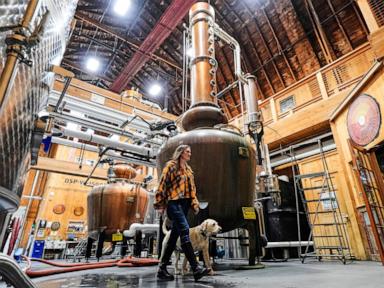
The air in the barrel room is heavy, thick with the "angel’s share"—that portion of whiskey that escapes through the wood and into the rafters. It smells of damp oak, vanilla, and a sharp, metallic ghost of grain. For a century, this scent was coded as masculine. It belonged to the man in the flannel shirt, the executive in the mahogany-row office, or the rugged frontiersman of the advertising imagination.
But if you look closely at the dust on the floor or the precision of the char on a new cask, you start to see a different story.
Whiskey is changing. Not just the liquid in the bottle, but the hands that tilt the glass and the minds that decide when a spirit has reached its peak. It is a quiet revolution, measured in parts per million and aging cycles.
The Myth of the Gendered Palate
For decades, the spirits industry operated under a collective delusion. Marketing departments whispered that women wanted clear spirits—vodka, gin, perhaps a sugary liqueur. Whiskey was framed as a dare, something harsh to be conquered by men.
The data tells a more complicated truth. Women now represent nearly 40 percent of whiskey consumers in the United States. They aren’t just drinking it; they are seeking out high-rye mashes, barrel-strength finishes, and the smokiest Islay malts available.
Science suggests this shouldn't be a surprise. Studies in sensory analysis often show that women, on average, possess a higher density of fungiform papillae—the tiny bumps on the tongue that house taste buds. They are often "supertasters," capable of detecting subtle notes of stone fruit or leather that a less sensitive palate might miss. In the world of blending, where the difference between a mediocre batch and a gold-medal winner is a razor-thin margin, these biological advantages are not just interesting; they are profitable.
Consider a master blender standing before a hundred samples. Each vial represents years of investment and thousands of dollars in overhead. If she can detect a hint of sulfur or an off-note in the grain before it hits the bottling line, she saves the distillery’s reputation. This isn't about "feminizing" the drink. It’s about technical mastery.
From the Kitchen to the Copper Still
The history of whiskey is often presented as a lineage of fathers and sons. However, if we peel back the labels, women have always been the silent architects of the still. In the 18th and 19th centuries, distilling was frequently a domestic chore, an extension of the kitchen or the farm. Women managed the fermentation of grains and the medicinal tinctures that preceded modern bourbon.
When the industry moved from the homestead to the factory, women were pushed to the sidelines. They became the "hostesses" or the faces in the advertisements, draped over barstools to sell a lifestyle they weren't supposed to actually enjoy.
The shift back to the center began out of necessity and blossomed into excellence. We see it in the rise of figures like Victoria Eady Butler, the great-great-granddaughter of Nearest Green. Green was the enslaved man who taught Jack Daniel how to make whiskey. Today, Butler isn't just a descendant; she is a four-time Master Blender of the Year. She isn't there because of a name. She is there because her palate is a finely tuned instrument.
She represents a broader movement of women who are no longer asking for a seat at the table. They are building their own tables, often with better wood and a more sophisticated guest list.
The Stakes of the Pour
Why does this shift matter? It matters because whiskey is a cultural signifier. To be excluded from the "whiskey club" was, for a long time, to be excluded from the rooms where deals were made and legacies were cemented.
When a female distiller chooses a specific char level for a white oak barrel, she is making a business decision that will not see a return for four, six, or twelve years. That is the definition of long-term vision. The industry is realizing that a diversity of perspectives leads to a diversity of flavor profiles. We are seeing finishes in wine casks, experimental grain bills, and a move away from the "old boys' club" aesthetic toward something more transparent and inclusive.
The stakes are also financial. The global whiskey market is worth billions. Ignoring half the population based on outdated stereotypes was never a sustainable business model. The "female whiskey drinker" isn't a niche market; she is the market. She is the one buying the premium bottles, attending the tastings, and joining the private barrel clubs.
The Invisible Barriers
Despite the progress, the road remains uneven. A woman walking into a high-end whiskey bar still occasionally faces the "pink tax" of social expectation. A bartender might suggest a cocktail when she asks for a neat pour of a rare bourbon. Or a fellow patron might offer an unsolicited lesson on how to "properly" appreciate the peat.
These are the small frictions of a culture in transition. But the friction is where the heat is, and heat is what drives the distillation process.
Modern female distillers face a double burden: they must be better than their male counterparts just to be considered equals, and they must navigate an industry that wasn't built for them. Yet, they are winning. They are winning because whiskey doesn't care about the gender of the person who made it. It only cares about the quality of the water, the purity of the yeast, and the patience of the aging process.
A New Ritual
Think about the ritual of a glass of whiskey. The weight of the crystal. The way the light catches the amber liquid. The slow swirl to see the "legs" crawl down the side of the glass.
In the past, this ritual was a performance of power. Today, it is a performance of discovery. Women are leading the charge in education, forming tasting groups that strip away the pretension and focus on the chemistry and the craft. They are asking questions about sourcing, about non-chill filtering, and about the environmental impact of the white oak industry.
This isn't a trend. Trends are fleeting, like the bubbles in a soda. This is a structural realignment. The industry is recognizing that the most talented people should be in charge, regardless of whether they fit the historical "look" of a distiller.
The next time you pull a cork, look at the label. Somewhere behind that brand is a person who spent years waiting for that liquid to be ready. Increasingly, that person is a woman who saw a barrier and decided to distill it into something better.
She is in the lab, testing the ABV. She is in the rickhouse, checking the temperature. She is at the tasting table, identifying a note of scorched cinnamon that no one else noticed.
The amber liquid hasn't changed its chemical composition, but its soul is evolving. The glass is no longer half-empty or half-full; it is being refilled by a new generation that knows exactly what it’s worth.
The angel’s share still rises to the rafters, but the people watching it rise finally reflect the world outside the distillery walls. The heavy scent of the barrel room doesn't belong to a man anymore. It belongs to anyone with the patience to wait for the spirit to speak.