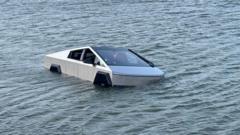
The physical constraints of automotive engineering cannot be overridden by software marketing. When a driver intentionally steered a Tesla Cybertruck into Grapevine Lake, Texas, to engage its publicized Wade Mode, the vehicle quickly stalled, flooded, and required extraction by local emergency services. This failure highlights a major gap between consumer understanding and mechanical reality. The incident is not a random case of user error; it is a direct consequence of a fundamental friction between software-defined vehicle features and the rigid principles of hydrostatic pressure and fluid dynamics.
To understand why this failure occurred, one must look at the specific engineering limits of the vehicle, the legal frameworks governing amphibious transit, and the psychological impact of feature branding.
The Hydrostatic Reality: Engineering Limits vs. Public Perception
The primary error in consumer interpretation stems from a misunderstanding of what Wade Mode actually does. It is not an amphibious conversion system; it is a temporary, software-controlled environmental adaptation.
Tesla’s technical specifications define clear limits for the system:
- Maximum Depth Boundary: 32 inches (815 mm), measured strictly from the flat bottom of the tire.
- Velocity Envelope: 1 to 3 mph (2 to 5 km/h).
- Pre-requisite State: All doors and windows completely sealed, vehicle speed under 20 mph prior to activation, and a mandatory delay window while the cabin acoustics and battery vault pressurize.
The vehicle's physical architecture relies on a specialized sealing sequence. When Wade Mode is activated, the air suspension raises the ride height to its maximum level. Concurrently, the vehicle uses its onboard air compressor to pressurize the high-voltage battery enclosure. This positive pressure asset is designed to prevent water ingress through minor gaps or seals by ensuring that internal air pressure exceeds external hydrostatic pressure.
$$P = \rho g h$$
The hydrostatic pressure equation explains the physical breakdown that occurs beyond the specified limits. Here, $P$ is the hydrostatic pressure, $\rho$ is the fluid density, $g$ is the acceleration due to gravity, and $h$ is the depth of submersion.
As depth ($h$) increases past the 32-inch threshold, the external fluid pressure scales linearly. Once this value exceeds the maximum positive pressure generated by the vehicle's internal compressor, the pressure differential flips. Water is then forced into the sensitive battery housing and drive units.
Furthermore, entering a lake via a boat ramp introduces dynamic fluid forces (ram pressure) that far exceed static hydrostatic calculations. The moment the vehicle encountered the deeper, unmapped topography of Grapevine Lake, the fluid level bypassed the 32-inch threshold. This led to immediate water ingress, electrical isolation faults, and total powertrain immobilization.
The Regulatory Gap: Why an Off-Road Vehicle is Not a Watercraft
The driver's subsequent arrest by the Grapevine Police Department highlights a secondary, non-engineering failure mode: the legal status of an amphibious passenger vehicle. The operator was charged with operating a vehicle in a closed section of a park, lacking a valid boat registration, and multiple water safety equipment violations.
This legal friction exists because state and federal laws categorize vehicles by their operational environment rather than their theoretical capabilities. Under Texas Parks and Wildlife regulations and broader maritime frameworks, any motorized platform operating in a navigable waterway must comply with specific watercraft standards.
The operational disconnect involves three specific legal requirements:
- Hull Registration: If a vehicle travels through deep water where it ceases to touch the ground and relies on displacement buoyancy, it functions legally as a vessel. It must possess a state-issued hull registration number and display valid validation decals.
- Mandatory Safety Payload: Marine vessels must carry specific safety assets, including one Coast Guard-approved personal flotation device (PFD) per passenger and an onboard marine-grade fire extinguisher. The driver in the Texas incident lacked all required safety gear.
- Environmental and Land-Use Violations: Boat ramps are engineered specifically for the trailers of buoyant watercraft. Deploying an 8,500-pound wheeled asset into a protected municipal water supply violates local park zoning rules, leading directly to criminal charges.
The assumption that an off-road vehicle can legally operate as a watercraft ignores these strict regulatory frameworks.
The Marketing Bottleneck: Feature Naming and Consumer Risk
The root cause of this incident lies in a cognitive bias created by product branding. Feature naming conventions often lead consumers to overestimate what a vehicle can actually do.
[Brand Marketing: "Wade Mode" / "Boat Capability"]
       │
       ▼
[Consumer Interpretation: Amphibious Operation]
       │
       ▼
[Environmental Application: Deep Water Entry]
       │
       ▼
[Physical Reality: Pressure Boundary Breach] ──► Mechanical Failure
When product marketing suggests a vehicle can briefly function as a boat, it creates a false sense of security. Consumers often focus on the broad conceptual promise while ignoring the technical disclosures buried in the owner's manual.
Tesla’s official terms explicitly shift all liability to the user. The manual notes that the driver is solely responsible for verifying water depth and underwater terrain conditions. It also states that any damage or water ingress resulting from aquatic operation voids the vehicle warranty.
By treating a highly sensitive high-voltage battery pack as an amphibious hull, users run an immense financial and physical risk. The vehicle's flat underbody can easily get stuck on soft mud or hidden rocks, as occurred in this lake incident. This leaves the heavy vehicle stranded as water pressure slowly degrades its seals.
Strategic Playbook for High-Voltage Aquatic Operations
To prevent catastrophic asset loss and legal liability, fleet managers and private operators must treat water crossings as high-risk engineering events. If a water crossing cannot be avoided, operations should follow a strict technical protocol:
- Verify Depth and Substrate Structure: Never enter a body of water without first measuring the exact depth using a physical gauge. The underwater terrain must be solid rock or gravel; soft mud or silt will cause the heavy vehicle to sink, lowering its effective clearance below the 32-inch safety threshold.
- Execute the Sealing Cycle: Activate the vehicle's specialized water mode while completely stationary on dry land. Wait for the system to fully elevate the suspension and pressurize the battery enclosure before moving forward.
- Control Speed and Wave Formations: Enter the water at a steady speed of 1 to 2 mph. Do not accelerate quickly, as this creates a bow wave that raises the local water line above the hood and air intakes, bypassing the vehicle's protective seals.
- Maintain Directional Control: Drive straight through the hazard without stopping or turning sharply, as lateral movements can destabilize the vehicle on uneven underwater surfaces.
- Inspect the Vehicle Post-Crossing: Once back on dry ground, keep the vehicle running to let the mechanical components drain. Inspect the brakes, steering linkages, and electrical connections for any signs of debris or water ingress before returning to normal speeds.