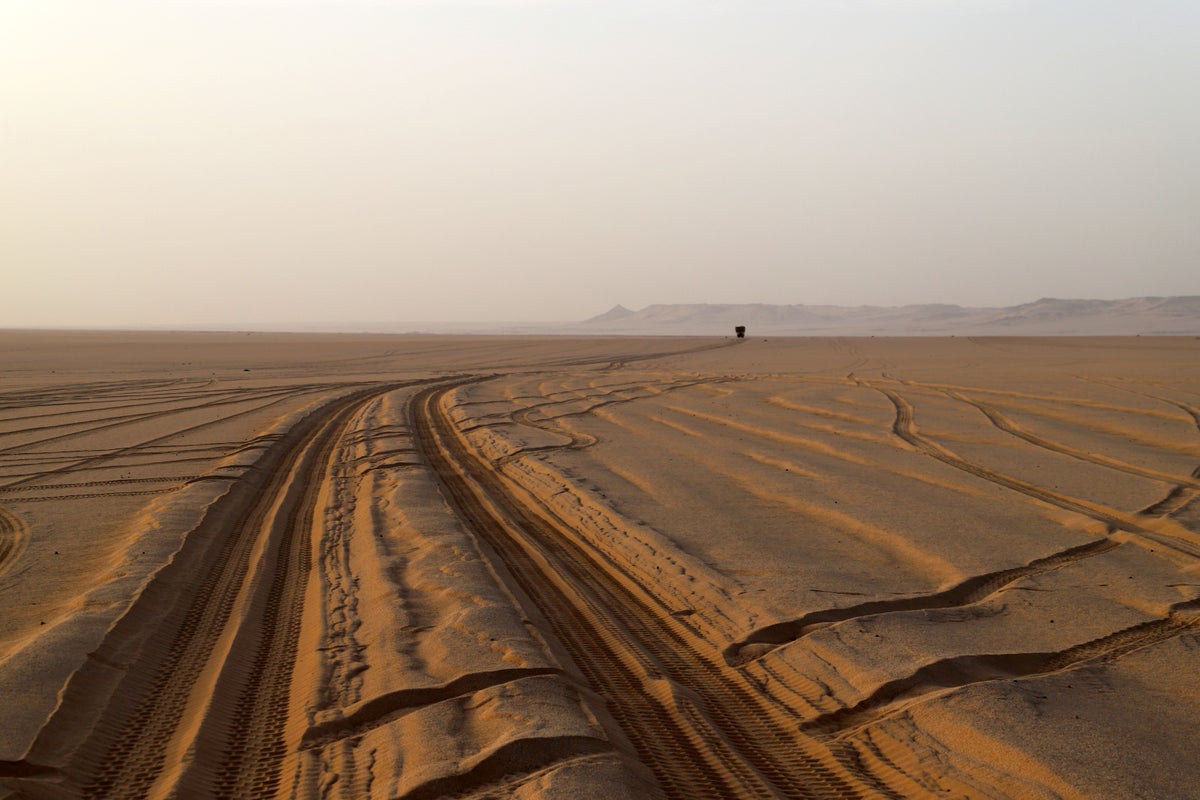
The loss of 49 lives in the Sahara Desert due to a vehicle breakdown is not an isolated tragedy; it is the predictable outcome of a highly fragile, unregulated logistics network operating under extreme thermodynamic constraints. When a transport vehicle fails in the desert, it triggers a rapid cascade of mechanical, physiological, and environmental failures. Traditional reporting treats these events as unfortunate anomalies. A rigorous operational analysis reveals that they are the direct mathematical consequence of compounding risks within irregular migration corridors.
To understand why these transit failures are so consistently lethal, the entire journey must be deconstructed through three core frameworks: transport supply chain vulnerabilities, environmental thermodynamic loads, and the structural absence of emergency mitigation infrastructure.
The Triad of Borderland Transit Vulnerabilities
The logistics of irregular transit across the Sahara rely on a deeply compromised operational model. Unlike commercial freight networks that optimize for safety margins and redundant systems, irregular networks optimize for evasion. This optimization creates three systemic points of failure.
1. The Operational Failure of Evasion-First Routing
To bypass official checkpoints and surveillance architecture, transport operators deviate from established, maintained roadways. They utilize peripheral, unmapped tracks through deep sand and rocky terrain. This choice introduces a severe trade-off:
- Compounded Mechanical Stress: Driving through soft sand increases engine load, accelerates transmission wear, and elevates tire blowout risks due to friction-induced heat.
- Asymmetric Isolation: By maximizing the distance from law enforcement, operators simultaneously maximize the distance from potential rescue. Every kilometer shifted away from a checkpoint to avoid detection exponentially increases the search-and-rescue radius if the vehicle disables.
2. Structural Maintenance Deficits and Capital Constraints
The vehicles deployed in these corridors—frequently aging, multi-ton flatbed trucks or highly modified utility vehicles—operate far beyond their intended lifecycles.
- Lack of Redundancy: Operators rarely carry specialized diagnostics, comprehensive toolsets, or critical replacement parts like spare water pumps, belts, or multiple spare tires.
- Overloading Corridors: Maximizing profitability requires packing vehicles well past their gross vehicle weight rating (GVWR). An overloaded vehicle operating in deep sand requires higher RPMs, causing rapid thermal escalation in the engine block and increasing the likelihood of catastrophic drivetrain failure.
3. The Single-Point Failure of Communication Lack
In standard logistics, a mechanical breakdown is an inconvenience because communication networks enable rapid recovery. In the deep Sahara, the absence of satellite communication tools means a breakdown instantly freezes the logistics chain. The network relies entirely on line-of-sight visibility or the assumption that another vehicle will happen across the same irregular track—an event with a low statistical probability.
The Thermodynamic and Physiological Breaking Point
When a vehicle immobilizes in the Sahara, the survival timeline is governed by the laws of thermodynamics and human physiology, not luck. The transition from an operational transit state to a mass-fatality event occurs with brutal speed.
+---------------------------+
| Vehicle Mechanical Failure|
+-------------+-------------+
              |
              v
+---------------------------+
|   Loss of Mobile Shade    |
+-------------+-------------+
              |
              v
+---------------------------+
| Accelerated Dehydration   |
+-------------+-------------+
              |
              v
+---------------------------+
| Fatal Hyperthermia (40°C+) |
+---------------------------+
The Hydration Depletion Equation
The human body requires a baseline volume of water to maintain core homeostasis, particularly through sweating, which utilizes evaporative cooling to keep core temperature below 37°C. In ambient temperatures exceeding 40°C with low relative humidity, an individual exposed to direct sunlight can lose between 1.0 and 1.5 liters of water per hour through perspiration alone.
If a group of 50 individuals is stranded with only nominal water rations (often stored in uninsulated plastic containers that accelerate evaporation and chemical leaching), the math of survival collapses within 24 to 48 hours.
The physiological decline follows a strict trajectory:
- Mild Dehydration (1–5% body weight loss): Impaired cognitive function, severe thirst, reduced cardiovascular efficiency as blood volume decreases.
- Severe Dehydration (6–10% body weight loss): Cessation of sweat production as the body attempts to preserve blood pressure, leading to a rapid spike in core temperature. Headaches, delirium, and loss of motor coordination follow.
- Hyperthermic Shock (10%+ body weight loss): Core body temperature breaches 40°C. Organ systems begin to fail, cellular proteins denature, and hypovolemic shock precipitates cardiac arrest or comatose states.
The speed of this degradation explains why search teams routinely find entire groups deceased within a short radius of the broken-down vehicle. The window for self-rescue or walking to safety is virtually non-existent; attempting to walk during peak daylight hours simply accelerates the hydration depletion rate, shortening the survival window from days to hours.
Market Dynamics Driving High-Risk Transit
The persistence of these high-fatality incidents cannot be understood without examining the economics of the irregular migration market. These networks function as unregulated, high-demand service industries with distinct market characteristics.
Information Asymmetry and Displaced Risk
A profound information asymmetry exists between the transport operators (smugglers) and the consumers (migrants). Consumers lack the leverage to inspect the mechanical integrity of the vehicle, verify the presence of satellite communications, or audit the volume of water provisions secured for the journey.
Because payment is typically collected upfront or secured via transnational informal remittance systems (such as Hawala), the operator's financial risk is mitigated before the journey begins. The physical risk is borne entirely by the passengers. If a vehicle fails irreparably, the operator faces capital loss (the vehicle) and potential legal jeopardy, but the passengers face existential termination. This asymmetric risk distribution disincentivizes operators from investing in high-cost safety redundancies like satellite phones or secondary support vehicles.
Regulatory Tightening as a Risk Multiplier
Geopolitical interventions that focus exclusively on physical deterrence and checkpoint density alter the market dynamics without reducing demand. When traditional, safer routes are militarized or heavily monitored, operators adapt by shifting to more treacherous, deeper desert tracks.
This displacement effect increases the length of the journey, the total time exposed to hostile environments, and the probability of encountering impassable terrain. Consequently, policy measures designed to halt transit frequently increase the lethality of the transit that does occur by forcing it into lower-margin, higher-risk zones.
Structural Bottlenecks in Search and Rescue Interventions
When a breakdown occurs, the structural limitations of regional governance and geography severely constrain successful intervention.
- Massive Spatial Scale: The areas where these breakdowns occur span tens of thousands of square kilometers of featureless terrain. Without precise coordinates via GPS-enabled distress beacons, aerial reconnaissance is akin to finding a pinpoint in a moving sea of sand.
- Resource Scarcity: Regional authorities in transit countries often lack the aviation assets, fuel reserves, and specialized desert vehicles required to execute large-scale, deep-desert search operations.
- Delayed Activation Times: Because there is no automated tracking of these departures, a vehicle is usually only missed days after it fails to arrive at its destination. By the time an alarm is raised, the physiological survival window of the passengers has already closed.
Decentralized Risk Mitigation Strategies
Addressing the lethality of Sahara transit corridors requires moving away from the binary framework of total interdiction versus unmonitored passage. Since demand for transit remains inelastic due to deep-seated socioeconomic drivers, reducing fatalities requires target-specific interventions designed to inject resilience into the transit environment.
Distributed Water Security Infrastructure
The establishment of geolocated, solar-powered water stations along known migration axes—even irregular ones—could decouple vehicle failure from immediate physiological collapse. These stations, maintained by international humanitarian organizations or local civil society groups, require ruggedized, low-maintenance designs to survive the environment. Providing accessible hydration points alters the survival equation from a 24-hour countdown to an extended multi-day window, allowing time for discovery or rescue.
Low-Power Emergency Beacon Networks
Deploying decentralized, solar-powered emergency call boxes or distress radio beacons at strategic intersections in the deep desert offers a high-return vector for risk reduction. These systems do not require broader cellular infrastructure; they utilize long-range, low-power radio frequencies or satellite uplinks to transmit automated distress coordinates directly to regional rescue hubs when triggered.
By lowering the barrier to distress signaling, the time elapsed between mechanical failure and resource deployment shrinks dramatically, shifting the operational paradigm from recovery to active rescue.