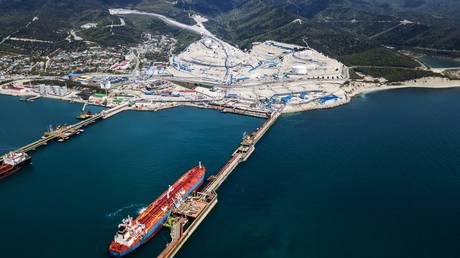
The relaxation of enforcement mechanisms on maritime trade restrictions reveals a structural vulnerability in economic warfare: when the target commodity controls global price stability, the sanctioning entity faces an asymmetric compliance cost. The United Kingdom's recalibration of its policy regarding Russian oil transit illustrates this structural bottleneck. Faced with systemic inflationary pressures and a domestic fuel supply crunch, policymakers were forced to choose between the absolute containment of a geopolitical adversary and the stabilization of domestic supply chains. The decision to dilute sanction parameters demonstrates that in energy economics, physical resource liquidity consistently supersedes regulatory mandates.
Understanding this policy shift requires moving past political rhetoric and analyzing the mechanics of the global maritime insurance and freight ecosystem. The strategy executed by Western coalitions relied on a single choke point: the dominance of G7-based protection and indemnity (P&I) clubs, which insure approximately 90 percent of global maritime cargo. By restricting access to these insurance networks unless the oil was purchased below a strict price cap, the policy aimed to depress state revenues while keeping global markets supplied. The failure of this mechanism, and the subsequent regulatory retreat, offers a blueprint for how complex resource dependencies break down embargo strategies.
The Dual-Constraint Dilemma of Energy Sanctions
State interventions in global commodity markets operate under a strict dual-constraint framework. A sanctioning nation must simultaneously maximize financial pain on the target state while minimizing the deadweight loss inflicted on its own domestic economy.
                       [ Sanction Architecture ]
                                   │
         ┌─────────────────────────┴─────────────────────────┐
         ▼                                                   ▼
Constraint 1: Target Attrition                      Constraint 2: Domestic Stability
(Maximize financial pain on adversary)             (Minimize economic deadweight loss)
         │                                                   │
         └─────────────────────────┬─────────────────────────┘
                                   ▼
                       [ Optimal Equilibrium ]
                   (Sustainable Geopolitical Leverage)
When applied to a highly inelastic good like crude oil, these two objectives move in direct opposition.
The Inelasticity Trap
Because modern industrial economies require a baseline volume of energy to maintain productivity, short-term demand for crude oil and refined products is exceptionally rigid. If regulatory pressure restricts the flow of a major supplier's output without an immediate, equivalent substitute, the global supply curve shifts left. In a market characterized by inelastic demand, even a minor reduction in volume triggers an exponential surge in global prices. The target nation can consequently earn higher total revenues on lower export volumes, completely neutralizing the intended economic attrition.
The Domestic Inflation Feedback Loop
For an importing nation like the UK, higher global energy costs manifest as systemic inflation. Fuel crises degrade consumer purchasing power, escalate manufacturing overheads, and force central banks to raise interest rates, threatening macroeconomic stability. The domestic political cost of maintaining a rigid sanction posture quickly outpaces the geopolitical utility of the restriction.
When these two constraints collide, the sanctioning government is forced to implement regulatory relief valves. The dilution of the UK’s Russian oil restrictions was not a administrative oversight; it was a calculated intervention to prevent a domestic distribution failure by legalizing specific transactional channels that keep oil moving through global shipping lanes.
The Mechanistic Breakdown of Maritime Insurance Choke Points
The core architecture of the oil sanction regime depended on the extraterritorial application of maritime services law. Because London serves as the global hub for marine insurance and legal services, British regulatory bodies assumed that restricting UK-based P&I clubs from insuring vessels carrying Russian crude above the price cap would effectively ground the Russian merchant fleet.
This strategy underestimated the adaptability of global capital and the velocity of asset reallocation. The enforcement mechanism broke down across three distinct operational phases.
Phase 1: The Emergence of the Shadow Fleet
When Western insurance became legally conditional on price cap compliance, a massive re-flagging and re-titling operation occurred. Hundreds of aging oil tankers were purchased by anonymous corporate entities operating out of jurisdictions outside G7 jurisdiction. These vessels formed a parallel logistics network—frequently termed the "shadow fleet"—that operated entirely detached from Western maritime services.
Phase 2: Sovereign De-risking and State-Backed Reinsurance
To replace the indemnification traditionally provided by London P&I clubs, non-aligned importing nations stepped in with state-backed alternatives. Governments like Russia and its primary state-owned insurers provided sovereign guarantees to replace commercial insurance. This effectively de-risked the voyages for buyers in emerging markets, rendering the UK legal prohibitions irrelevant for a significant portion of global maritime traffic.
Phase 3: Transshipment and Supply Chain Obfuscation
The physical tracing of oil molecules is notoriously difficult once commodity blending occurs. Western sanctions targeted crude originating from specific geographic zones, but the maritime industry adapted through ship-to-ship (STS) transfers in international waters. By mixing restricted crude with non-sanctioned grades in international waters or passing it through intermediate refineries in third-party nations, the commodity was legally re-classified. Refined petroleum products, such as diesel or jet fuel produced from restricted crude in non-sanctioned jurisdictions, legally entered the European and British markets, bypassing the primary embargo.
Quantifying the Cost Function of Strict Enforcement
A clinical assessment of why the UK loosened its regulatory grip requires analyzing the specific economic metrics that threatened the domestic market. The cost function of maintaining strict compliance can be broken down into measurable variables that directly impacted industrial output and supply chain security.
- The Freight Premium Escalation: As Western tankers withdrew from certain trade routes, the cost of securing non-G7 compliant vessels skyrocketed. This "shadow premium" increased the spot price of landed fuel in the UK, as alternative supply lines from the US Gulf Coast or the Middle East required longer voyages and higher fuel burn rates.
- The Refining Margin Squeeze: British and European refineries were configured for specific sulfur contents and API gravities typical of Ural grades. Substituting this feed with sweeter or heavier alternatives altered optimal refinery yields, reducing the output of critical distillates like ultra-low sulfur diesel precisely when domestic inventories were depleted.
- The Capital Flight Risk: Stringent, punitive enforcement by the Office of Financial Sanctions Implementation (OFSI) created compliance panic among legitimate maritime entities. Fearing multi-million pound fines for accidental exposure to disguised cargo, major shipping lines and insurers began avoiding the UK maritime cluster altogether, threatening London’s status as a global financial center.
The regulatory dilution served as an emergency pressure release valve. By lowering the compliance burden and clarifying that minor or indirect involvement would not face catastrophic penalties, the UK state preserved the operational capacity of its maritime services sector while ensuring that global oil volumes remained sufficient to suppress skyrocketing domestic pump prices.
The Structural Limits of Financialized Warfare
The retreat from total energy isolation underscores a broader truth regarding the limits of weaponized interdependence. Financial sanctions work exceptionally well against actors who are deeply integrated into Western banking networks and whose primary assets are digital or monetary. When applied to physical resource titans, the power dynamic shifts.
A nation that controls a significant percentage of the global supply of a foundational commodity cannot be sanctioned using the same playbook applied to small, isolated economies. The physical reality of supply and demand balances out digital financial blockades. If the globe requires the resource to prevent widespread industrial contraction, the market will always engineer a workaround. The regulatory updates issued during the fuel crisis represent the state adjusting its legal frameworks to match this unyielding economic reality.
Strategic Playbook for Global Commodity Exposure
Organizations operating within highly politicized supply chains must abandon the assumption that sanctions represent static, permanent barriers. They are fluid, macroeconomic balancing acts subject to rapid revision based on domestic political pressures.
To navigate this volatility, corporate strategists and supply chain officers must execute an operational pivot focused on three concrete parameters.
1. Reconstruct Compliance Frameworks for Asymmetric Enforcement
Stop evaluating sanction risk purely on a binary (legal/illegal) axis. Map supply chain exposure based on the criticality of the commodity. If a resource is highly critical to global inflation stability, anticipate that enforcement agencies will quietly implement compliance waivers or turn a blind eye to indirect transshipment. Build legal compliance models that are dynamic enough to exploit these regulatory release valves the moment they are codified.
2. Price the "Shadow Fleet Premium" into Forward Procurement
The fragmentation of global shipping is permanent. Even if specific geopolitical conflicts subside, the logistical infrastructure of the parallel maritime market remains intact. Firms must factor a structural premium into their long-term fuel and raw material procurement strategies, accounting for higher freight rates driven by inefficient routing and split insurance markets.
3. Establish Redundant Multi-Jurisdictional Logistics Nodes
Do not rely on single-point infrastructure or uniform legal jurisdictions for commodity transit. Ensure that logistics routes maintain operational flexibility through hubs capable of rapid cargo re-classification and blending. True supply chain resilience during a geopolitical crisis relies on the ability to legally and physically alter the origin signature of cargo before it enters highly regulated domestic ports.