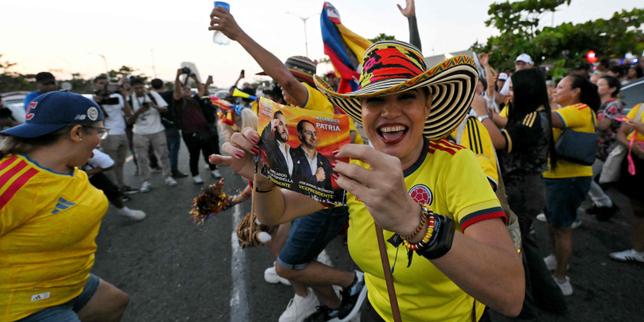
The results of the first-round presidential election in Colombia establish a definitive structural realignment of the nation's political spectrum. By advancing far-right challenger Abelardo de la Espriella and left-wing senator Iván Cepeda to the June 21 runoff, the electorate has rejected traditional center-right institutionalism and centrist incrementalism. This consolidation of support—where the two leading candidates combined for roughly 85% of the total vote—is not merely an expression of ideological division; it is the mathematical outcome of a deeply polarized electorate responding to distinct, systematic frameworks of governance, security, and economic management.
To evaluate the upcoming runoff objectively, one must look past the superficial media narratives that reduce the contest to a battle of personalities. The race is a mechanistic clash between two fully articulated models of state authority. Understanding the outcome requires an analysis of the structural failures of the current administration, the strategic allocation of the conservative vote, and the specific policy mechanisms proposed by both campaigns to address Colombia's fiscal and security crises.
The Strategic Miscalculation of First-Round Direct Capitalization
The primary strategic objective of the ruling leftist coalition, Pacto Histórico, was to secure an outright victory in the first round by surpassing the 50% threshold. The campaign strategy relied on replicating the 2022 electoral coalition of President Gustavo Petro, which successfully mobilized working-class voters, youth cohorts, and marginalized regional populations through a rhetoric of structural transformation.
This strategy encountered a structural bottleneck. Senator Cepeda finished the first round with 40.9% of the vote, failing to secure the required majority and underperforming relative to internal campaign projections.
The breakdown of the left’s first-round strategy can be attributed to two distinct operational variables:
- The Depletion of Anti-Establishment Momentum: In 2022, the progressive coalition capitalized on acute social unrest and widespread economic dissatisfaction following the pandemic. In 2026, as the governing faction, the left had to defend an administrative record marked by legislative gridlock and deteriorating public safety metrics. The structural incentive for swing voters to support a message of systemic change shifted away from the incumbent party.
- The Friction of the Centrist Bloc: The campaign’s explicit objective to win in the first round required absorbing moderate, centrist voters who previously backed independent or reformist platforms. However, the polarizing nature of the administration's platform created an ideological barrier, preventing the migration of these voters to Cepeda and leaving his base limited to the core ideological left.
Consequently, Cepeda enters the runoff in a defensive posture. In a two-candidate race, the remaining center-right and independent votes tend to consolidate against the incumbent platform, making a runoff structurally disadvantageous for a governing left-wing candidate who failed to build a broad-based coalition in the initial round.
The Collapse of Institutional Conservatism and the Rise of Populist Right Mechanics
The most significant electoral shift of the first round was the collapse of Senator Paloma Valencia’s candidacy. Representing the traditional, institutional right-wing establishment, Valencia finished with less than 7% of the vote, an outcome that contradicted early-year polling.
This collapse represents a wholesale migration of the conservative electorate toward Abelardo de la Espriella, who secured 43.7% of the vote. This shift can be analyzed through a framework of political market differentiation.
The Security Market Efficiency
Valencia proposed an institutional expansion of state capacity: increasing ground troops, deploying drone surveillance, and utilizing traditional legal channels. De la Espriella bypassed institutional orthodoxy entirely, adopting an operational model heavily influenced by Salvadoran President Nayib Bukele and former United States President Donald Trump. His platform offers an unconstrained exercise of state power, promising the construction of private mega-prisons, the resumption of aerial glyphosate fumigation, and immediate kinetic actions against illicit trafficking logistics. For an electorate experiencing heightened anxiety over citizen security, de la Espriella’s model offered a direct utility maximize relative to Valencia’s procedural approach.
The Outsider Premium
As a prominent attorney and political outsider running under his Defensores de la Patria movement, de la Espriella decoupled himself from the historical baggage of traditional political parties. This allowed him to capture both orthodox conservative voters and anti-incumbent populists. Valencia’s campaign remained tethered to institutional norms, leaving her exposed to an electorate favoring disruptive alternatives.
Bi-Causal Frameworks of National Security
The core divergence between the two remaining candidates lies in their diagnostic frameworks for Colombia’s internal conflict and public safety challenges. This divergence produces completely incompatible policy prescriptions.
+-----------------------------------------------------------------------+
|                       DIAGNOSTIC FRAMEWORKS                           |
+-----------------------------------------------------------------------+
|                                                                       |
|  [Structural Framework - Cepeda]      [Deterrence Framework - Espriella]
|  Socioeconomic Inequality              Sub-Optimal Cost of Criminality|
|            │                                         │                |
|            ▼                                         ▼                |
|  Systemic Violence                    Institutional Weakness & Impunity |
|            │                                         │                |
|            ▼                                         ▼                |
|  Negotiated Settlement & Subsidies    Militarized Kinetic Interdiction |
|                                                                       |
+-----------------------------------------------------------------------+
The Structural Framework (Iván Cepeda)
This model posits that violence and illicit economies are symptomatic of underlying socioeconomic deficits, specifically rural isolation, land inequality, and lack of macro-economic opportunities.
The policy mechanisms derived from this framework emphasize the "Total Peace" strategy: ongoing negotiations with disparate insurgent factions and criminal syndicates, state-funded social subsidies to disincentivize criminal recruitment, and a transition away from punitive drug policies toward crop substitution programs. The operational limitation of this framework is its reliance on the good-faith compliance of criminal actors who operate with high profit margins from cocaine production, often resulting in territorial expansion during ceasefires.
The Deterrence Framework (Abelardo de la Espriella)
This model operates on standard rational choice theory: criminal activity occurs because the expected benefit outweighs the probability and severity of state punishment. The objective is to drastically alter the cost-benefit equation for criminal enterprises.
The policy mechanisms include the construction of 10 maximum-security private prisons located in isolated geographies, mandatory labor for inmates, and the authorization of lethal force against violent disruptions. In terms of counternarcotics, the strategy dictates the immediate reintroduction of aerial fumigation and the tactical interdiction of transit vectors via maritime and aerial assets. The structural limitation of this framework is the potential for systemic human rights violations, severe friction with international legal frameworks, and the fiscal strain of maintaining a heavily militarized state apparatus.
Fiscal Realities and Economic Contradiction
The implementation of either candidate's platform will face immediate macroeconomic constraints, primarily dictated by Colombia's fiscal deficit, sovereign debt obligations, and tax revenue capacity.
Cepeda’s economic model relies on expanding the domestic welfare state through a broadened tax base, targeting high-net-worth individuals and corporate rents, alongside targeted public spending reductions in non-essential sectors. The strategy aims to stimulate domestic consumption by increasing the purchasing power of lower-income demographics.
The primary risk of this approach is capital flight and the degradation of private fixed asset investment, particularly in the extractive industries, which remain a primary source of foreign exchange reserves. If tax increases suppress private sector growth, the state's capacity to fund its expanded social liabilities will diminish, creating a structural fiscal trap.
De la Espriella advocates for a classic supply-side model combined with private-sector-led infrastructure development. He proposes deregulation, corporate tax optimization to incentivize foreign direct investment, and the privatization of state assets, including prison infrastructure.
The structural bottleneck here is the immediate upfront cost of his militarized security apparatus. Constructing high-security mega-prisons and resuming widespread aerial fumigation require significant capital allocations. If corporate tax cuts fail to generate rapid macroeconomic expansion, the short-term result will be an expansion of the fiscal deficit, putting upward pressure on domestic inflation and sovereign borrowing costs.
Runoff Coalition Mechanics and the Equilibrium Point
With the first-round data established, the June 21 runoff will be determined by the allocation efficiency of the uncommitted voter blocks. The primary variable is the disposition of the 7% of voters who backed Paloma Valencia, along with smaller centrist and independent factions.
The historical pattern of Colombian runoffs suggests that conservative voters, even those committed to institutional norms like Valencia's supporters, display a high rate of consolidation when faced with a left-wing alternative. De la Espriella is structurally positioned to capture the vast majority of this 7%, as well as voters driven by anti-incumbent sentiment regarding the current Petro administration.
To counteract this consolidation, Cepeda must pivot from an ideological base strategy to an emergency coalition-building strategy. This requires abandoning pure structural rhetoric to appeal directly to urban centrist voters who are alienated by de la Espriella’s aggressive style and disregard for traditional institutional checks and balances. Cepeda must frame the election not as a choice between left and right, but as a choice between institutional preservation and populist authoritarianism.
However, this pivot presents a tactical paradox. If Cepeda moderates his platform too aggressively to capture the center, he risks depressing voter turnout among his highly ideological, low-income base. Conversely, if he maintains his core structural rhetoric, he solidifies the ceiling of his support, allowing de la Espriella to win by simply absorbing the displaced conservative and moderate votes. The candidate who manages the trade-offs of this polarization most effectively will secure the executive mandate on June 21.