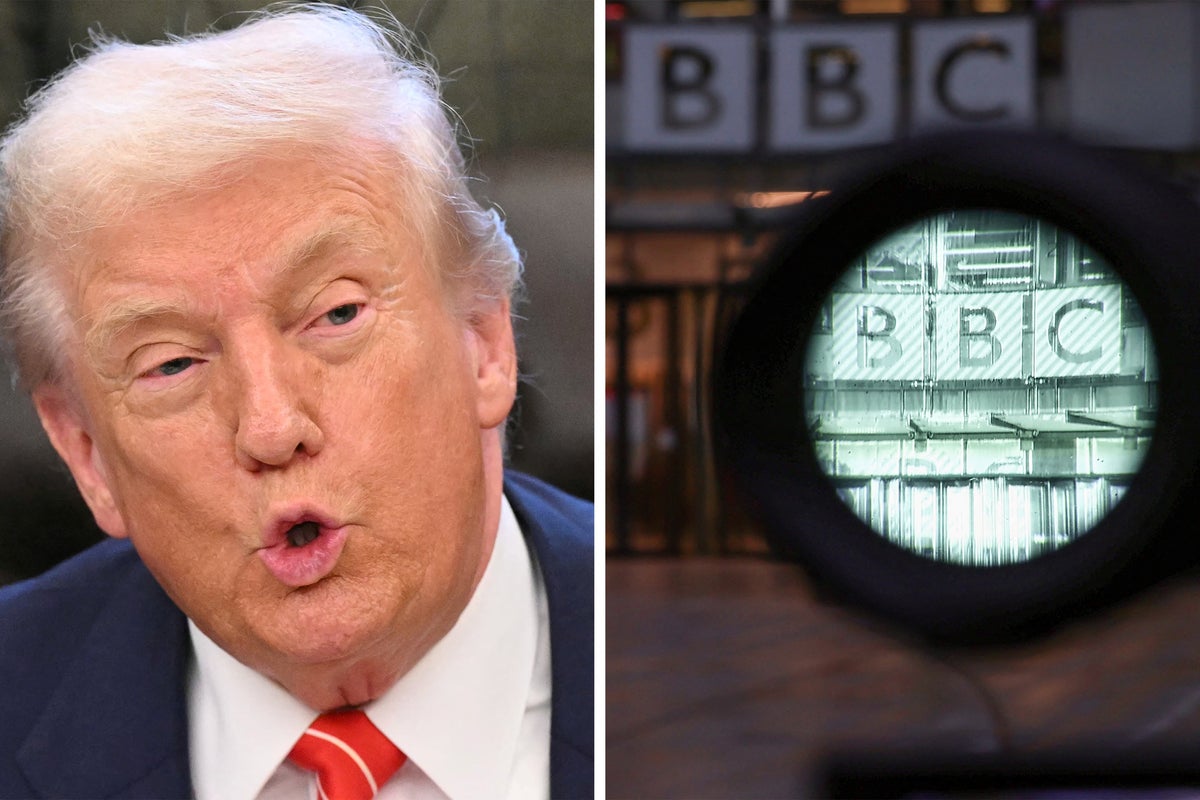
Litigation seeking ten billion dollars in commercial damages cannot survive on rhetorical assertions of brand erosion; it requires systematic financial disclosure. The ongoing defamation lawsuit filed in a Florida federal court by U.S. President Donald Trump against the British Broadcasting Corporation (BBC) over a controversial 2024 Panorama documentary edit has entered a structural bottleneck. While the legal debate initially centered on journalistic ethics and jurisdiction, the operational friction has shifted to the discovery phase. The plaintiff’s refusal to comply with subpoenas targeting the Donald J. Trump Revocable Trust exposes a fundamental paradox in high-stakes corporate defamation: one cannot claim catastrophic commercial loss while withholding the asset ledgers required to calculate it.
To understand why this multibillion-dollar claim is encountering severe procedural resistance, the dispute must be disassembled into its core economic and legal mechanics.
The Valuation Paradox of Corporate Brand Damage
The plaintiff’s complaint asserts two primary causes of action: common-law defamation and violations of the Florida Deceptive and Unfair Trade Practices Act (FDUTPA). Each count seeks $5 billion in compensatory and punitive damages, predicated on the claim that the BBC’s broadcast caused massive economic injury to the value of the plaintiff's brand, real estate holdings, and future commercial prospects.
In commercial litigation, calculating brand damage requires a precise accounting framework. Quantifying corporate injury relies on three distinct pillars:
- Impairment of Asset Value: A measurable reduction in the fair market value of physical or intellectual properties directly attributable to the negative publicity.
- Revenue Divergence: A statistically significant shortfall between projected cash flows and actual performance post-incident, isolating the defamatory event from broader market variables.
- Increased Cost of Capital: A heightened risk profile that causes lenders or investment partners to demand higher interest rates or unfavorable terms for future projects.
The legal mechanism of discovery allows a defendant to stress-test these claims. To evaluate whether the Panorama documentary structurally harmed the plaintiff's multi-layered commercial empire, the BBC issued subpoenas to the Donald J. Trump Revocable Trust. This entity holds and controls the president’s extensive business portfolio and is managed by his eldest son as sole trustee. The discovery requests target the financial records of approximately 400 distinct corporate entities, encompassing comprehensive tax returns, asset inventories, property valuations, and internal ledger entries.
The plaintiff's legal team has flatly refused to produce these documents, characterizing the requests as an overbroad "fishing expedition." This creates an immediate operational contradiction. Under federal civil procedure, a plaintiff who injects their financial health into a lawsuit by claiming specific, multi-billion-dollar commercial losses forfeits the right to shield those exact financial mechanics from scrutiny. By declaring that the brand suffered quantifiable economic harm, the plaintiff opens the underlying corporate entities to forensic accounting examination. Refusing to supply the data points necessary to establish a baseline valuation fundamentally stalls the progression of the damages claim.
Structural Impediments to Proving Economic Harm
Beyond the withholding of ledger data, the economic logic of the $10 billion claim faces profound evidentiary hurdles. In any complex commercial tort, the plaintiff bears the burden of establishing direct causation between the tortious act and the financial loss. This calculation is governed by a strict causal function:
$$L = f(D, M) - E$$
Where:
- $L$ represents the legally cognizable financial loss.
- $D$ represents the direct, quantifiable impact of the defamatory broadcast.
- $M$ represents independent macro-economic and political market variables.
- $E$ represents the baseline economic trajectory of the enterprise prior to the broadcast.
Isolating $D$ from $M$ in this equation is exceptionally difficult. The BBC has already articulated a highly potent structural defense in its preliminary filings: the plaintiff's subsequent political success. The documentary aired in late 2024, immediately preceding a presidential election cycle that culminated in the plaintiff winning the executive office.
From an economic valuation standpoint, an electoral victory of this magnitude strongly undermines claims of catastrophic reputational and commercial ruin. In the market for political and brand capital, securing the presidency represents the apex of brand validation and public leverage. The defense will argue that any parallel fluctuations in property values or licensing revenues were driven by standard market dynamics, macroeconomic interest rate shifts, or localized real estate trends—not the international broadcast of a documentary.
The Jurisdictional and Distributional Bottleneck
The second major structural flaw in the litigation strategy relates to the geographic distribution of the alleged injury. The lawsuit was filed in the Southern District of Florida, yet the offending Panorama episode was produced and primarily distributed by a publicly funded broadcaster within the United Kingdom.
For a Florida court to assert proper jurisdiction over an international media entity under a state trade practices act like FDUTPA, the plaintiff must demonstrate that the deceptive act or defamation directly targeted and harmed consumers within that specific jurisdiction. The BBC's defense relies heavily on technological and distribution boundaries:
- Geo-Blocking Compliance: The broadcast was not delivered via traditional television networks in the United States and was actively geo-blocked on the BBC’s domestic streaming infrastructure, iPlayer.
- Third-Party Syndication Boundaries: While the plaintiff argues the content was accessible via BritBox subscribers or accessible through Virtual Private Networks (VPNs), the scale of intentional domestic penetration remains unquantified.
If the domestic audience for the specific broadcast was statistically negligible, the argument for localized commercial devastation collapses. A Florida-based real estate asset cannot suffer billions of dollars in valuation compressed by a media product that the local consumer base could not readily view through standard domestic distribution channels.
Discovery Deadlocks as Tactical Maners
When high-profile defamation suits hit discovery walls, the gridlock is rarely an accident; it is a predictable feature of asymmetric litigation. In multi-billion-dollar claims brought by prominent public figures against media institutions, the primary strategic objective can bifurcate between public public relations leverage and actual courtroom adjudication.
If the objective is primarily reputational or political, a prolonged discovery dispute serves a useful tactical purpose. By resisting the exposure of tax returns and internal corporate ledgers, the plaintiff avoids the transparency that an asset-heavy corporate entity might find highly disadvantageous. Concurrently, the public narrative can focus entirely on the initial journalistic error—in this case, an acknowledged and apologized-for speech edit—rather than the granular, potentially volatile realities of the plaintiff's private corporate balance sheets.
The risk of this strategy is that federal judges possess broad discretionary powers to penalize non-compliance with discovery mandates. Persistent refusal to provide the necessary inputs for a damages calculation frequently results in judicial sanctions. These can range from the striking of specific damage claims entirely to the outright dismissal of the suit with prejudice for failure to prosecute the claim under the rules of civil discovery.
The progression of this litigation depends entirely on a singular tactical choice: the plaintiff must either subject the internal financial machinery of the Donald J. Trump Revocable Trust to hostile forensic analysis, or witness the systematic dismantling of the $10 billion damages claim by a court unwilling to accept valuation metrics built on unquantifiable assertions.