In the late autumn of 2008, a small group of engineers stood on a remote island in the Pacific, watching a slender white cylinder rise toward a blank blue sky. Three times before, their rockets had ended up as twisted metal at the bottom of the ocean or exploded into fireballs before reaching orbit. The company was entirely out of money. Employees had maxed out credit cards; the founder had scraped together his last remaining millions from the sale of an internet startup to fund one final, desperate attempt. Had that fourth rocket failed, the name SpaceX would today be a minor footnote in the history of venture capital failures.
Instead, the machine cleared the atmosphere. It stayed up there.
Flash forward to the present day. The numbers being whispered in the corridors of Wall Street no longer sound like financial metrics. They sound like science fiction. Bankers are preparing an initial public offering that targets a valuation between 1.75 and 2 trillion dollars.
To grasp that figure, ignore the spreadsheets for a moment. Think of it this way: if you earned one dollar every single second, it would take you more than thirty-one thousand years to reach one trillion. SpaceX is aiming for two. This is no longer just a company that builds machines. It has become a financial nation-state, an economic gravity well drawing the global market into its orbit.
But behind the staggering headlines lies a deeper, human tension. How did an enterprise built on the most volatile, dangerous, and historically unprofitable industry on Earth become more valuable than almost every legacy corporation on the planet?
The answer is not found in the cold mechanics of aerospace engineering. It is found in the psychological shift of how humanity prices the future.
The Weight of Two Trillion
Walk into any traditional brokerage firm, and the math is comforting in its predictability. You value a car company by how many sedans it rolls off the assembly line. You value a tech giant by its monthly active users and ad clicks. There are formulas, historical precedents, and neat rows of quarterly data to keep investors sleeping soundly at night.
SpaceX defies every established rule of this game.
If you view it strictly as a launch provider, the two-trillion-dollar valuation is absurd. The global market for putting satellites into orbit is large, but it is not that large. If tomorrow SpaceX captured every single commercial launch on Earth, the math still would not add up to two trillion dollars.
The secret lies in an invisible architecture. Investors are not buying a rocket company; they are buying the monopolistic highway of the next century.
Consider a hypothetical logistics manager at a legacy telecom firm—let’s call her Sarah. For two decades, Sarah’s job was to negotiate complex, multi-year contracts to launch single, school-bus-sized satellites that cost half a billion dollars to build and another hundred million to put into space. If a single component failed during launch, years of work vanished in a heartbeat.
Then, the rules changed.
By perfecting the art of landing a multi-story orbital rocket booster vertically on a drone ship in the middle of a choppy ocean, SpaceX turned space travel into a bus route. The Falcon 9 became the workhorse of modernity. Suddenly, Sarah wasn't buying a bespoke miracle; she was booking a freight service.
But even that infrastructure is just the foundation. The real engine driving this astronomical valuation is Starlink, the constellation of thousands of small satellites orbiting just a few hundred miles above our heads.
The Sky is No Longer Empty
We tend to think of the internet as something ethereal, a cloud that exists everywhere at once. In reality, it is deeply fragile. It relies on a sprawling, vulnerable network of underground copper wires and massive fiber-optic cables snaking across the dark abysses of the ocean floor. If an earthquake hits, or a submarine anchor drags in the wrong spot, entire regions go dark.
Starlink cuts the cord entirely.
Imagine a remote clinic in the mountains of Peru, or a research vessel navigating the freezing waters of the Arctic, or an ordinary family living in a rural stretch of the American Midwest where high-speed broadband was always a distant promise. For these people, the internet was a sluggish, frustrating luxury. Now, a small grey dish pointed at the sky unlocks the sum total of human knowledge in milliseconds.
This is where the financial calculus shifts dramatically. SpaceX has ceased to be a vendor for NASA and has transformed into a global utility provider.
Every single month, millions of subscribers—ranging from individual households to the United States military—pay their bills to Starlink. That is recurring revenue. It is predictable. It is scalable in a way that building metal tubes will never be. Wall Street loves predictability. When a company pairs the exponential growth of a software startup with the hard physical moat of a global rocket monopoly, traditional valuation models simply shatter.
The High-Stakes Gamble of Starship
Yet, the towering valuation carries a profound vulnerability. It assumes that the future will go perfectly. And in aerospace, perfection is a statistical anomaly.
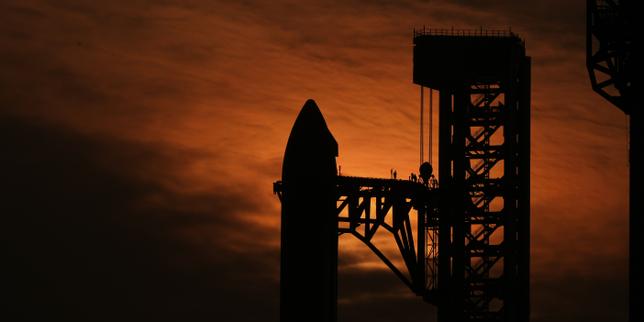
The true weight of the two-trillion-dollar expectation rests on the shoulders of a terrifyingly colossal machine currently undergoing testing in the salt marshes of South Texas. Starship.
It is the largest flying object humanity has ever constructed. Standing taller than the Statue of Liberty, it is designed to be fully and rapidly reusable, capable of carrying a hundred tons of cargo into deep space, landing, refueling, and doing it all over again the next day.
If Starship succeeds, the cost of accessing space drops by another order of magnitude. It makes the colonization of Mars an operational possibility rather than a theoretical dream. It allows for the construction of orbital factories, space-based solar power arrays, and asteroid mining initiatives.
But the technical hurdles are immense. The sheer energy required to control a vehicle of that scale during atmospheric re-entry is terrifying. A single catastrophic failure during a high-profile mission could send shockwaves through the financial markets, wiping out hundreds of billions of dollars in perceived value overnight.
This is the invisible tightrope that investors are choosing to walk. They are betting on an organization that moves fast and breaks things, in an industry where breaking things usually means massive explosions and national investigations. The emotional gravity of this IPO is intense because it asks conservative fund managers to adopt the risk appetite of an adrenaline junkie.
The Monopoly of the Horizon
There is a quiet discomfort growing within the halls of government and legacy aerospace competitors. For decades, companies like Boeing, Lockheed Martin, and Arianespace dominated the heavens. They operated with massive government subsidies, slow timelines, and cost-plus contracts that guaranteed profits regardless of delays.
SpaceX disrupted that cozy ecosystem completely. Today, the company launches more payload into orbit than the rest of the world combined.
This creates a strange, unprecedented geopolitical reality. A single private enterprise, controlled largely by one volatile individual, now holds the keys to low Earth orbit. When American astronauts need to get to the International Space Station, they ride on a SpaceX capsule. When the Pentagon needs to launch highly classified surveillance hardware, they rely on SpaceX hardware.
This total dominance is precisely what justifies the valuation in the eyes of the bulls. Monopolies are incredibly lucrative. If you want to go to space, you play by SpaceX’s rules, on SpaceX’s timeline, at SpaceX’s price point. There is no viable alternative on the horizon. Blue Origin is trying, Europe is struggling to modernize its Ariane fleet, and SLS remains far too expensive for commercial viability.
But for the broader world, this concentration of power invites legitimate anxiety. What happens when the infrastructure of global communication and exploration is entirely privatized? Who polices the entity that controls the highway to the stars?
The Valuation of Hope
Ultimately, the spreadsheets and the trillions are a proxy for something far more elemental.
We live in an era often defined by incremental progress. We optimize apps to keep people scrolling for four more seconds. We build slightly faster algorithms to trade stocks fractions of a millisecond quicker. Much of modern technology feels small, inward-facing, and exhausting.
SpaceX sells the opposite. It sells the grand, outward-facing ambition that defined the mid-twentieth century, wrapped in the sleek, aggressive packaging of modern capitalism.
When an investor buys into this historic public offering, they are not just looking for a return on investment. They are buying a piece of a grand narrative. They want to be part of the generation that built the city on Mars. They want to tell their grandchildren that they owned a fraction of the fleet that made humanity a multi-planetary species.
That psychological premium is the secret ingredient in the two-trillion-dollar calculation. It is the monetization of human awe.
The markets will fluctuate, the critics will point to the immense risks, and the regulatory battles will undoubtedly turn ugly. But tonight, somewhere out in the ocean, a robotic ship is riding the swells, waiting for a streak of fire to descend from the clouds and land precisely on its deck, proving once again that what was impossible yesterday is merely a line item on tomorrow's balance sheet.