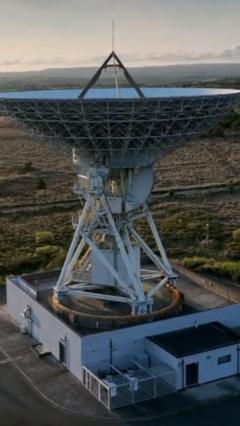
The press releases are out and the space industry is doing what it does best: self-congratulating over legacy infrastructure. If you’ve read the coverage regarding Goonhilly Earth Station tracking Artemis II, you’ve been sold a narrative of "seamless international cooperation" and "critical mission support." It sounds nice. It looks good on a LinkedIn carousel.
It is also a symptom of a deeper, systemic failure in how we manage deep space communications. For a different perspective, see: this related article.
The industry is currently obsessed with the idea that adding more ground stations—more "big iron" dishes in the Cornish countryside—is the solution to the looming bandwidth bottleneck of the lunar economy. It isn't. By treating Artemis II as a victory for traditional ground-based tracking, we are ignoring the fact that our current DSN (Deep Space Network) architecture is a crumbling relic that cannot scale.
The Myth of the "Vital" Ground Station
Goonhilly is an impressive site with a rich history. No one is disputing its ability to catch a signal. But the celebration of its role in Artemis II obscures a grim reality: NASA is outsourcing this labor because their own network is oversubscribed to the point of collapse. Further insight on this trend has been provided by Ars Technica.
We are currently operating on a "best effort" basis for scientific missions because the DSN is choked. When Artemis II launches, it won't just be "another mission." It will be a bandwidth vampire. The Orion capsule, with its high-definition video feeds and massive telemetry requirements, will effectively silence dozens of other scientific probes.
The industry calls this "collaboration." A more honest term would be "desperation."
I have spent years watching mission planners scramble for "passes"—designated windows where a ground station can talk to a satellite. We are currently playing a zero-sum game. Every hour Goonhilly spends tracking Artemis II is an hour it isn't tracking something else. The "consensus" says we just need more dishes. Logic says the dish model is dying.
The Inverse Square Law Does Not Care About Your Press Release
Here is the technical reality the trade rags won't explain: Deep space communication is governed by the Friis transmission equation.
$$P_r = P_t + G_t + G_r + 20\log_{10}\left(\frac{\lambda}{4\pi R}\right)$$
As $R$ (the distance) increases, the power received ($P_r$) drops off at a punishing rate. To compensate, we build bigger dishes ($G_r$) like those at Goonhilly. But there is a physical limit to how many 30-meter antennas we can build, maintain, and synchronize across the globe.
The competitor's narrative suggests that by integrating private stations like Goonhilly, we’ve solved the problem. We haven't. We've just distributed the inefficiency. The real bottleneck isn't the number of dishes; it's the medium itself. We are still relying on S-band and X-band frequencies that are as crowded as a London tube station at 5:00 PM.
If we were serious about Artemis being the "foundation" of a lunar presence, we would be pivoting entirely to optical (laser) communications. Laser comms offer 10 to 100 times the data rate of traditional RF. Yet, here we are, patting ourselves on the back for using 1970s-era radio technology to track a 21st-century moon mission.
Why the Commercial Ground Station Model is a Fragile Fix
The pivot to "Ground Station as a Service" (GSaaS) is the current darling of space tech investors. The idea is simple: Why own the dish when you can rent it?
This works for LEO (Low Earth Orbit) constellations like Starlink or Planet. It fails miserably for Deep Space.
- Geometry is a Cruel Mistress: In LEO, you have hundreds of opportunities to see a satellite. In Deep Space, you have one target and three primary windows (Goldstone, Madrid, Canberra). Adding Goonhilly adds a bit of redundancy, but it doesn't change the fundamental physics of the "Three Station" problem.
- The Latency Lie: People ask, "Can't we just use more stations to reduce latency?" No. The 1.3-second delay to the Moon is a constant of the universe. The delay in scheduling the data, however, is a human failure. The current bureaucracy of handoffs between NASA's Jet Propulsion Laboratory (JPL) and private entities like Goonhilly creates a layer of "management overhead" that is rarely discussed but frequently felt during mission anomalies.
- The Precision Gap: Tracking a crewed mission isn't like tracking a weather satellite. The Doppler shift calculations and the required pointing accuracy ($0.001$ degrees) demand a level of synchronization that private providers struggle to maintain over long durations without massive NASA intervention.
The Wrong Questions About Artemis II
If you look at "People Also Ask" or industry forums, everyone is asking: Is Goonhilly ready? That is the wrong question. Goonhilly is ready. The question you should be asking is: Why are we still tethered to the Earth at all?
A truly "forward-thinking" Artemis program would not be relying on Cornish hillsides. It would be deploying a dedicated lunar relay constellation—a GPS and comms network for the Moon. By keeping the "brains" of the tracking system on Earth, we are forcing ourselves to deal with atmospheric interference, weather outages, and the literal rotation of the planet.
Imagine a scenario where a solar storm disrupts ionospheric conditions over the North Atlantic. Suddenly, your "vital" ground station is screaming into a void of static. If your relay is in lunar orbit, that isn't your problem.
We are building a 21st-century highway but still using a paper map and a flashlight to find the entrance.
The High Cost of "Reliable" Legacy
The obsession with legacy ground stations is driven by risk aversion. NASA is terrified of losing a crew, as they should be. But there is a point where risk aversion becomes a risk in itself.
By pouring money into upgrading 50-year-old radio dishes instead of accelerating the deployment of space-to-space relay networks, we are ensuring that the lunar economy will be "bandwidth-poor." You cannot run a lunar base on X-band. You cannot have "persistent presence" if you have to wait for a 32-meter dish in England to rotate into the right position before you can send a 4K diagnostic video of a failing life support system.
The downside to my argument? Yes, building a space-based relay network is expensive. It’s hard. It requires launching more hardware. But the alternative is a "Moon mission" that is effectively a glorified 1960s rerun with better cameras.
Stop Celebrating Mid-Tier Success
We need to stop treating the integration of commercial ground stations as a "milestone." It’s a utility. It’s the space equivalent of NASA hiring a private security firm because they don't have enough guards for the gate. It’s necessary, but it’s not an achievement.
The real achievement will be the day we don't need Goonhilly to track Artemis. The day the communication happens peer-to-peer in the vacuum of space, bypasses the soup of the Earth's atmosphere, and delivers data directly to a global cloud without waiting for a specific dish to "see" the Moon.
Until then, we aren't "pioneering" the future. We are just renting the past.
The Artemis II mission will likely be a success. Goonhilly will likely do its job perfectly. But don't mistake a successful handoff for a functional system. We are running out of sky, we are running out of spectrum, and we are running out of time to build a network that actually scales.
Stop looking at the dishes. Start looking at the gap between them. That’s where the real mission fails.