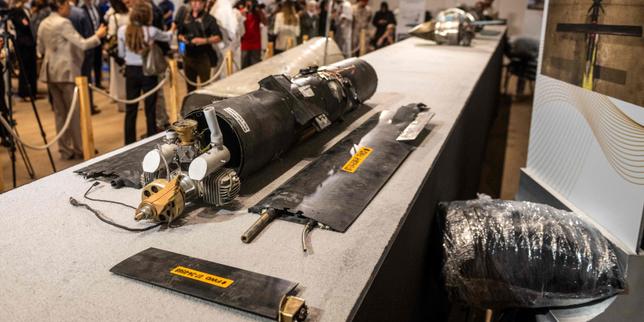
The proliferation of Iranian Unmanned Aerial Systems (UAS) has fundamentally inverted the cost-benefit calculus of sovereign airspace protection in the Middle East. Traditional air defense logic—built on the interception of high-value, manned kinetic platforms—is failing against a "saturation-attrition" model. This failure is not merely a matter of hardware deficiency but a mathematical inevitability where the cost of the interceptor exceeds the cost of the threat by orders of magnitude. For the neighboring states of Iran, the strategic challenge is no longer just "defense"; it is the management of a permanent state of low-intensity, high-cost aerial siege that threatens the economic viability of their most critical infrastructure.
The Structural Mechanics of Drone Proliferation
To analyze why Gulf monarchies and Levant states find themselves suddenly vulnerable, one must first categorize the Iranian UAS ecosystem into three functional tiers. Each tier demands a different defensive response, and the synergy between them creates the "defensive paradox" currently paralyzing regional security architectures. Recently making headlines in related news: The Polymer Entropy Crisis Systems Analysis of the Global Plastic Lifecycle.
- Tier 1: High-Persistence Surveillance and Loitering. These platforms (e.g., Mohajer series) force defenders to keep radar systems active and "lit," exposing sensor locations to electronic intelligence gathering.
- Tier 2: Tactical Kamikaze Munitions. Systems like the Ababil or Shahed-131/136 are designed for one-way missions. They are slow, low-flying, and possess a small Radar Cross-Section (RCS), allowing them to exploit the "clutter" of mountainous terrain or urban environments.
- Tier 3: Long-Range Strategic Strike. Heavy platforms (e.g., Shahed-129 or Shahed-149 'Gaza') provide the capability to deliver precision payloads across distances exceeding 2,000 kilometers, effectively putting every energy terminal and desalination plant in the region within range.
The primary driver of Iranian success is not technological "superiority" in the classical sense, but industrialized modularity. By utilizing off-the-shelf components—including Western-made engines and GPS modules diverted through complex procurement chains—Iran has decoupled the production of precision strike capability from the constraints of high-end aerospace manufacturing.
The Cost Function of Modern Air Defense
The crisis facing Iran’s neighbors is best understood through an economic lens: the Interceptor-to-Target Cost Ratio. When a Patriot MIM-104 battery fires an interceptor costing approximately $3 million to $4 million to neutralize a Shahed-136 drone costing roughly $20,000 to $30,000, the defender is losing the war of attrition regardless of whether the hit is successful. Further insights regarding the matter are covered by TechCrunch.
This economic imbalance creates a "Depletion Window." An aggressor can launch a swarm of 50 low-cost drones for roughly $1 million. To ensure a 90% intercept rate, the defender must expend $150 million to $200 million in interceptor stock. In a prolonged conflict, the defender runs out of high-end munitions or bankrupts their treasury long before the aggressor runs out of mass-produced plastic and fiberglass airframes.
The Three Pillars of Defensive Failure
- Sensor Blindness and Clutter: Most legacy radar systems are optimized for high-altitude, high-speed targets. Low-and-slow drones often fall below the "velocity gate" of radar filters, which are programmed to ignore birds or weather patterns. This creates a detection gap that can only be filled by a dense, interconnected mesh of short-range sensors—a system most regional states lack.
- Geographic Proximity and Reaction Time: The flight time from Iranian-aligned launch sites in Yemen, Iraq, or southern Lebanon to high-value targets is often measured in minutes. This compresses the OODA loop (Observe, Orient, Decide, Act) to a point where human intervention is a liability, yet automated engagement carries the risk of catastrophic "blue-on-blue" incidents involving civilian aviation.
- The Multi-Vector Threat: Iran’s doctrine emphasizes the "mixed salvo." By launching drones alongside cruise missiles and ballistic missiles, they force the defender to prioritize targets. If the air defense system focuses on the fast-moving missiles, the slow drones slip through. If they focus on the drones, they risk being hit by the more destructive missiles.
The Infrastructure Vulnerability Matrix
The economic model of the modern Gulf State is particularly susceptible to UAS threats due to the Concentration of Value. Unlike a decentralized industrial economy, a petro-state’s GDP often flows through a handful of geographic "choke points"—desalination plants, oil processing facilities (like Abqaiq), and gas liquefaction terminals.
A single $20,000 drone hitting a critical transformer or a high-pressure valve can cause hundreds of millions of dollars in downstream economic damage and weeks of downtime. This creates a "Strategic Lever" effect: the aggressor exerts massive geopolitical pressure with minimal investment. The 2019 attack on Saudi Aramco’s facilities served as the definitive proof of concept, demonstrating that even the most well-funded air defense network in the world could be circumvented by a coordinated low-altitude strike.
The Strategic Pivot: Electronic Warfare and Directed Energy
The realization that kinetic interception (hitting a drone with a missile) is a failing strategy has forced a shift toward non-kinetic solutions. However, these "soft-kill" methods have significant operational limitations that are often overlooked in strategic assessments.
- GPS Spoofing and Jamming: Effective against lower-tier drones, but modern Iranian systems increasingly utilize Inertial Navigation Systems (INS) or optical terrain mapping. Once a drone is within sight of its target, jamming the GPS signal is useless; the onboard computer simply "sees" the target and continues its terminal dive.
- Directed Energy Weapons (DEW): High-energy lasers offer the promise of "zero-cost" per shot. The limitation here is atmospheric interference—dust, humidity, and heat (all prevalent in the Middle East) dissipate laser energy, drastically reducing effective range.
- Electronic Attack (EA): Disrupting the command-and-control (C2) link between the operator and the drone. The counter-move has been the transition to fully autonomous, "fire-and-forget" flight paths, where no active link exists to be jammed.
The second-order effect of this technological arms race is the Regional Intelligence Gap. To defend effectively, neighbors must know not just where the drones are, but where they are being built and stored. This necessitates a transition from reactive defense to "Left of Launch" strategies—preemptive strikes or sabotage of the manufacturing and logistics chain. This, however, risks immediate escalation into a full-scale regional war.
The Bottleneck of Multilateral Integration
The most logical solution to the drone threat is the "Middle East Air Defense" (MEAD) alliance—a centralized data-sharing network where sensors from Israel, Jordan, Saudi Arabia, the UAE, and US naval assets are fused into a single Common Operational Picture (COP).
The bottleneck here is political, not technical. Integrated air defense requires a level of sovereign trust that does not yet exist. Sharing raw radar data means revealing the specific weaknesses and "dead zones" of one's own national sensors. Furthermore, the varying degrees of diplomatic engagement with Tehran—ranging from the UAE's de-escalation efforts to Israel's shadow war—mean that a unified response to a detected launch is rarely guaranteed.
Operational Shift Toward Passive Defense
Since the hardware-based "shield" is porous, we are seeing an uptick in Passive Defense and Resilience Engineering. This is a regression to mid-20th-century military logic:
- Physical Hardening: Enclosing critical infrastructure in reinforced concrete or steel mesh cages (anti-drone "copes") to detonate shaped charges before they hit the primary target.
- Redundancy and Distributed Assets: Moving away from massive, centralized processing hubs toward smaller, modular facilities that can be taken offline and repaired without crashing the entire national grid.
- Camouflage and Decoys: Deploying thermal and visual decoys to trick drone sensors into hitting low-value targets, thereby exhausting the attacker's inventory.
The move toward passive defense is an admission of vulnerability. It signals that the "neighboring states" no longer believe they can stop every drone; they are now simply trying to survive the impact.
The final strategic play for regional actors is the abandonment of the "Defense-Only" posture in favor of Competitive Proliferation. To re-establish deterrence, Gulf states are rapidly acquiring their own UAS strike capabilities—not to defend their skies, but to ensure that any drone launch from Iranian soil or its proxies results in a mathematically equivalent strike on Iranian industrial assets. This transition from "Air Defense" to "Mutual Drone Destruction" marks the end of the era of uncontested airspace and the beginning of a permanent, automated frontier of attrition. The focus must shift from purchasing more interceptors to building an indigenous, low-cost offensive drone capacity that can replicate the Iranian model of cost-asymmetric warfare. Any state that continues to rely solely on Western kinetic interceptors will eventually be outspent and overwhelmed.