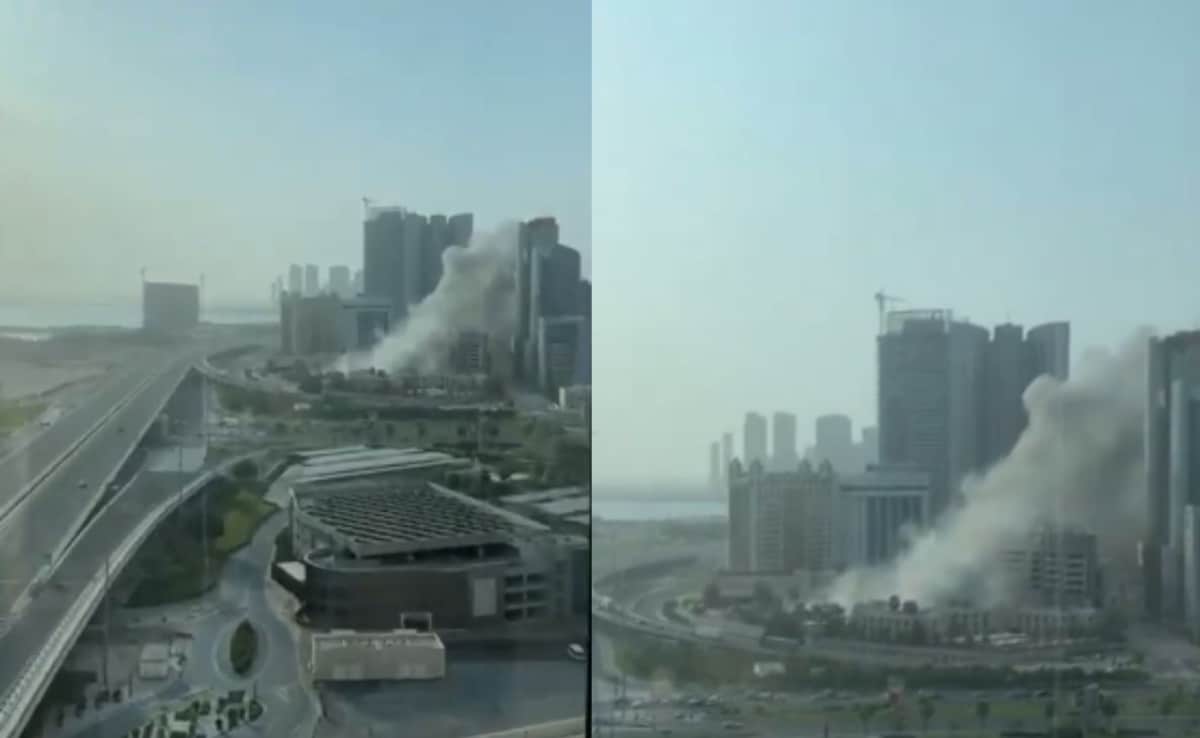
The convergence of regional kinetic conflict and high-value commercial real estate in Bahrain represents a fundamental shift in the risk profile of the Persian Gulf. When smoke obscures a 5-star hotel complex during a period of geopolitical retaliation, the impact extends beyond immediate physical damage. It signals a breakdown in the implicit security guarantee that has long underpinned the region’s economic diversification strategies. The viability of Bahrain’s luxury tourism and financial sectors depends on a perceived insulation from regional volatility; once that insulation is breached, the cost of capital, insurance premiums, and foreign direct investment (FDI) undergo a permanent structural repricing.
The Triad of Modern Siege: Physical, Psychological, and Economic Impact
The occurrence of smoke and fire at a luxury landmark during a state of high military tension must be analyzed through three distinct layers of impact. Competitor reporting often conflates these, but a rigorous assessment requires isolating the mechanisms of disruption.
- The Kinetic Layer: This involves the direct physical effects of debris, shrapnel, or incendiary materials. In the context of Bahrain’s compact geography, the proximity of civilian infrastructure to strategic assets—such as the U.S. Navy’s 5th Fleet headquarters—creates a high probability of collateral engagement.
- The Optical Layer: Luxury assets are selected as targets or inadvertently highlighted in conflict because they serve as high-contrast symbols of stability. Smoke rising from a 5-star facade acts as a potent visual shorthand for "instability," regardless of whether the building was the intended target or merely an incidental victim of interceptor fallout.
- The Actuarial Layer: This is the most durable impact. Underwriters evaluate the efficacy of integrated air defense systems (IADS) against saturation attacks. If a "shrouded" hotel indicates a failure to intercept incoming threats at a sufficient distance, the entire jurisdiction may be reclassified under "War Risk" clauses, drastically increasing the operational overhead for every business in the kingdom.
The Cost Function of Regional Volatility
The economic fallout of a security breach in the hospitality sector is not linear; it is exponential. Bahrain’s economy has leaned heavily into tourism as a pillar of its "Vision 2030" plan. The cost function of an event involving a 5-star complex is defined by three primary variables:
- Occupancy Elasticity: Luxury travelers and business executives possess the highest mobility. A single high-profile safety event triggers immediate cancellations, but more critically, it removes the destination from the "safe list" of corporate travel departments for a minimum of 24 to 36 months.
- Sovereign Risk Premium: Bahrain’s debt-to-GDP ratio necessitates constant access to international bond markets. Geopolitical friction that manifests as smoke over the capital city increases the yield investors demand, directly draining the national treasury through higher interest payments.
- The Insurance Spiral: Global insurers like Lloyd’s of London respond to kinetic events by shrinking capacity. When "hull and machinery" or "business interruption" insurance becomes prohibitively expensive, the profitability of 5-star assets—which already operate on thin margins due to high labor and utility costs—collapses.
Interception Dynamics and the "Debris Gap"
A critical technical misunderstanding in standard reporting is the assumption that smoke over a building implies a direct hit. In modern asymmetric warfare, the "Debris Gap" is a more frequent cause of civilian infrastructure damage.
When a Patriot (PAC-3) or similar interceptor engages an incoming projectile—whether a drone or a ballistic missile—the resulting mid-air neutralization does not vaporize the mass. Instead, it converts a single, guided threat into a dispersed field of high-velocity kinetic energy.
The physics of this engagement involve:
- Terminal Velocity of Fragments: Depending on the altitude of the intercept, debris can reach the ground with enough force to penetrate reinforced concrete or ignite flammable cladding.
- Chemical Combustion: Residual fuel from the intercepted threat or the interceptor itself often causes fires that are disproportionate to the size of the debris.
- Sensor Saturation: If the defense system is overwhelmed by a high volume of low-cost drones, the "leakage rate" increases. Even a 95% success rate is a failure in a dense urban environment where the remaining 5% can strike a landmark hotel.
Strategic Fragility in Diversified Economies
Bahrain’s vulnerability is a byproduct of its success in diversification. Unlike larger neighbors with vast hinterlands, Bahrain’s high-value assets are clustered. This density creates a target-rich environment where any regional "retaliation" has a high probability of impacting a global brand or a multi-national corporate headquarters.
This creates a paradox: the more a nation invests in "soft power" assets like luxury hotels and international sporting events, the more leverage it gives to adversaries seeking to inflict maximum psychological damage with minimum kinetic effort. The "smoke" isn't just an atmospheric condition; it is a tactical tool used to devalue the opponent's economic brand.
Institutional Response and the Crisis Management Protocol
When a 5-star complex is affected, the institutional response usually follows a flawed "denial and minimize" pattern. A more effective analytical framework for recovery involves:
- Transparency in Source Attribution: Clearly distinguishing between a direct strike, an interceptor failure, or an unrelated industrial accident is the only way to stabilize the insurance markets.
- Hardening of Soft Targets: This involves the retroactive installation of blast-resistant glazing and the integration of private security sensors with national air defense networks—a move that is technically difficult and aesthetically challenging for luxury brands.
- Recalibrating the Value Proposition: If the "safe haven" status is lost, the hospitality sector must pivot toward a high-security "fortress luxury" model, similar to high-end assets in other volatile regions (e.g., Kabul or Baghdad in previous decades), though this is antithetical to the open-tourism model.
The Structural Realignment of Gulf Risk
The current trajectory suggests that "retaliation" is no longer a localized military affair but a theater-wide economic disruption strategy. For Bahrain, the presence of smoke over its premier hospitality assets serves as a warning that the geography of conflict has expanded.
The strategic play for investors and operators is to move away from "blind" diversification and toward a "resilient" model. This requires:
- Diversifying physical asset locations to avoid cluster-risk.
- Self-insuring through captive insurance vehicles to bypass the volatility of the global War Risk market.
- Investing in localized, point-defense technologies that can provide a final layer of protection for specific high-value coordinates.
The era of assuming that a 5-star flag provides a "neutrality shield" is over. Future asset valuation in the Gulf will be dictated not by the quality of the amenities, but by the sophistication of the invisible dome protecting them. All future capital expenditure in the region must be filtered through a kinetic-threat lens before a single stone is laid.


