Stop looking at cornstarch and algae to solve the plastic crisis. They aren't strong enough. They melt when they get warm. They tear when you pull them. The real answer isn't growing in a field; it's spinning inside a laboratory bioreactor.
Researchers at Rice University and the University of Houston just bypassed the biggest limitation of bioplastics. They figured out how to force common bacteria to weave a supermaterial that matches the strength of steel and glass, yet remains flexible, transparent, and entirely biodegradable. This isn't just another green gimmick. It's a fundamental shift in bioengineering that addresses why previous biological materials failed to scale.
If you have ever wondered why your eco-friendly coffee lid cracks or why "compostable" forks snap under the slightest pressure, the reason comes down to structural alignment. This new research fixes that exact problem by turning chaotic microbes into disciplined microscopic weavers.
The Chaos Problem in Biological Materials
Plants and bacteria are excellent at producing cellulose. In fact, bacterial cellulose is one of the purest natural polymers on Earth. It requires no petrochemicals, leaves a fraction of the carbon footprint of traditional manufacturing, and decomposes safely without shedding microplastics or leaking bisphenol A (BPA).
But until now, it had a fatal flaw.
When bacteria produce cellulose in a standard environment, they move randomly. They dump the nanofibers in every direction, creating a tangled, unorganized microscopic mess. Think of it like a pile of loose threads. If you pull on that pile, it falls apart instantly. Because these fibers lack alignment, traditional bacterial cellulose sheets lack the structural integrity required to replace heavy-duty petroleum plastics. They tear easily under tension and fail to manage heat.
To replace industrial plastics in packaging or electronics, a material must withstand immense pulling forces, known as tensile strength. It also needs to dissipate heat so it doesn't degrade when components warm up. Unaligned microbial sheets simply couldn't do the job.
How a Spinning Reactor Changes Everything
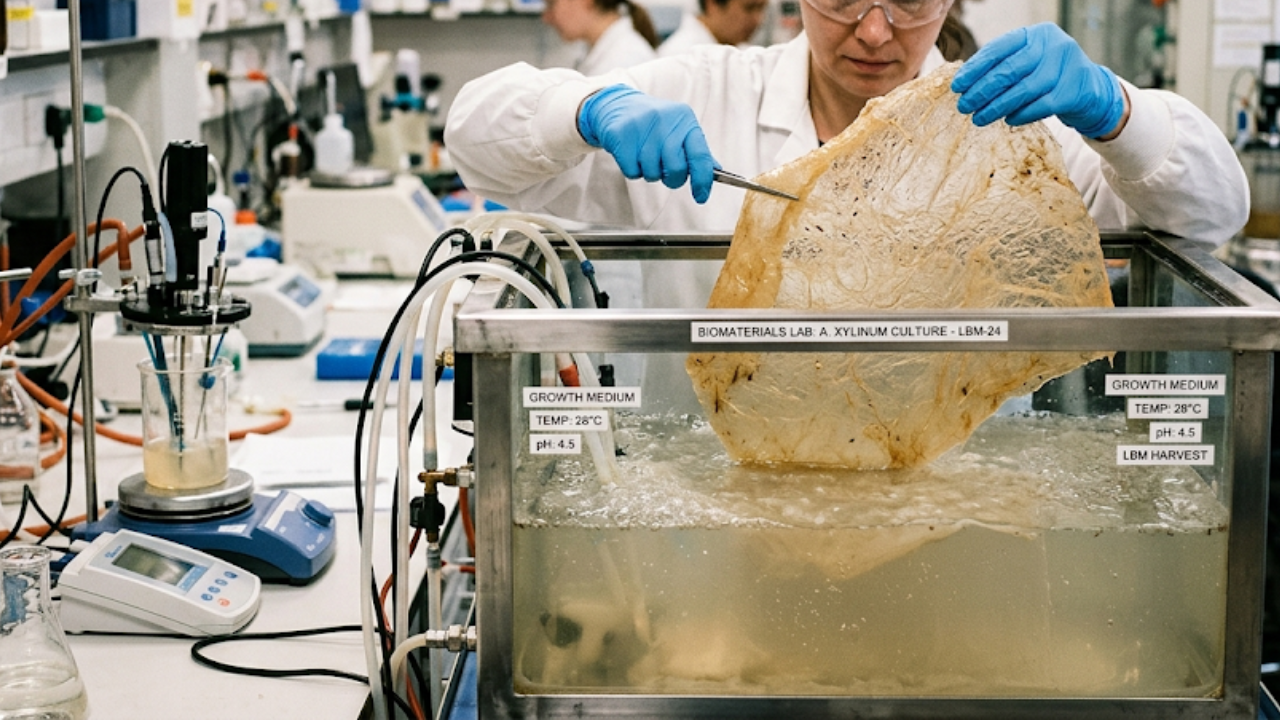
The breakthrough, published in Nature Communications, relies on a custom-built rotational bioreactor. The research team, led by Muhammad Maksud Rahman of the University of Houston and M.A.S.R. Saadi of Rice University, decided to stop letting the bacteria wander.
Instead of allowing the microbes to deposit cellulose randomly, the team introduced controlled fluid dynamics. They spun the growth medium. This rotation creates a gentle, consistent flow that forces the bacteria to move in a uniform path.
"The bacteria move in all directions; we tell them to move in a certain direction," Saadi explained. "Instead of having the bacteria move randomly, we instruct them to move in a specific direction, thus precisely aligning their cellulose production."
By forcing the microbes to line up like a disciplined cohort, the resulting cellulose nanofibrils grew perfectly parallel to one another. It transforms the loose pile of threads into a tightly woven, ultra-dense sheet.
The mechanical results are staggering. The aligned bacterial cellulose sheets achieved a tensile strength of up to 436 megapascals. To put that in perspective, common structural plastics like high-density polyethylene (HDPE) usually top out around 30 megapascals. This bio-grown sheet behaves more like industrial glass or structural metals, yet you can fold it, bend it, and look right through it.
Pushing past Nature with Nanomaterials
The researchers didn't stop at raw biology. Because the rotational synthesis happens in a single, fluid step, it allows scientists to introduce nanoscale additives directly into the material as the bacteria work.
The team introduced boron nitride nanosheets into the bioreactor during the growth phase. The bacteria wove these synthetic nanosheets directly into the parallel cellulose matrix.
This hybrid material pushed the tensile strength even higher, reaching roughly 553 megapascals.
- Tensile Strength: Over 15 times stronger than everyday structural plastics.
- Thermal Performance: The boron nitride integration allows the material to dissipate heat three times faster than standard, unmodified cellulose.
- Flexibility: Despite its metallic strength, the material remains entirely foldable and transparent.
This mix of thermal management and raw strength means the material can move far beyond simple grocery bags or takeout containers.
Where This Material Outperforms Petrochemicals
We don't need another alternative material that only works for shopping bags. We need materials that can survive harsh industrial environments. The unique combination of transparency, thermal conductivity, and tensile strength opens up applications where traditional bioplastics are completely useless.
Flexible Electronics and Green Circuit Boards
Modern smartphones and wearables rely on petroleum-based substrates that trap heat and resist recycling. This hybrid material can dissipate heat from processing chips while acting as a flexible, non-toxic substrate for circuit traces. When the device reaches the end of its life, the housing and substrate can degrade naturally instead of sitting in an electronic waste landfill.
Industrial Packaging and Barrier Films
Heavy machinery, shipping crates, and high-pressure food packaging require materials that won't tear under intense physical stress. The aligned nanofiber sheets provide the puncture resistance of heavy plastics without the chemical footprint.
Advanced Energy Storage
The structural stability and heat dissipation properties make these sheets viable candidates for battery separators and energy storage components. Batteries generate significant heat during rapid charge and discharge cycles. Managing that heat while keeping the components lightweight is a massive engineering hurdle that this living material helps solve.
The Real Scalability Hurdle
Many laboratory breakthroughs die in the petri dish because they require multi-step chemical extractions or toxic solvents that make commercial production impossible. The process developed by the Rice and Houston teams avoids this trap by utilizing a single-step, in-situ synthesis. The alignment and the additive integration happen simultaneously while the bacteria grow.
However, scaling up means moving from small rotational lab equipment to massive industrial fermentation vats that can maintain precise fluid dynamics across thousands of liters of growth medium. Controlling fluid flow at that scale without disrupting bacterial life cycles is a complex mechanical challenge.
Furthermore, industrial adoption requires cost parity with incredibly cheap petroleum. Fossil fuel plastics benefit from decades of infrastructure optimization. For bacterial supermaterials to truly become ubiquitous, synthetic biology companies must scale up feedstock fermentation—feeding the bacteria cheap agricultural byproducts or industrial sugar waste—to bring production costs down to a level where corporate supply chains will actually make the switch.
To track how close this technology is to your daily life, look out for corporate pilot partnerships in electronic manufacturing and high-end consumer goods. Watch the scaling metrics of bio-manufacturing firms like London-based Modern Synthesis, which secured millions in funding to scale up similar bacterial nanocellulose textiles for the fashion industry. The jump from luxury textiles to mass-market electronics packaging will depend entirely on how fast engineers can scale these specialized rotational bioreactors.