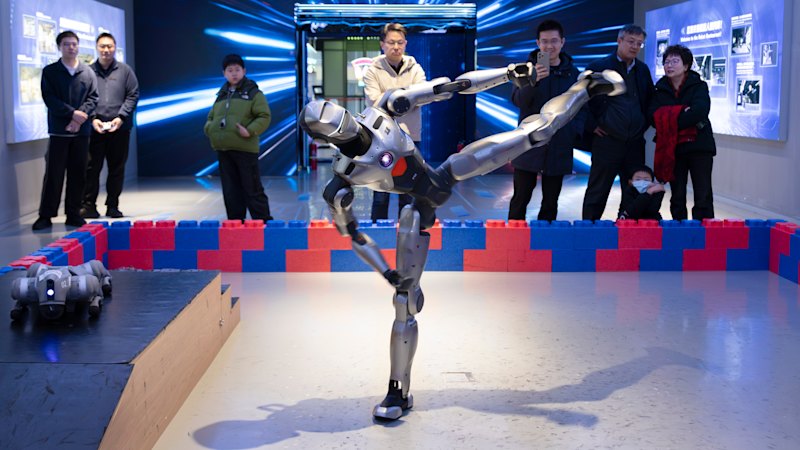
Beijing is not living in 2050. It is living in a very expensive, very shiny showroom for 20th-century hardware fantasies.
If you walk through the Zhongguancun tech hub or the corridors of the World Robot Conference, you’ll see the same tired tropes: a mechanical dog doing a backflip, a humanoid arm pouring a mediocre latte, and a bipedal hunk of plastic trying—and usually failing—to navigate a flight of stairs. The press calls it a glimpse into the future. I call it a failure of imagination.
The obsession with "humanoid" form factors is the single greatest distraction in modern engineering. We are burning billions of dollars trying to make machines mimic human inefficiency. While tourists gawk at a robot bartender in a Beijing mall, they are missing the fact that the most "advanced" thing in the room isn't the clunky metal arm; it’s the invisible software layer managing the supply chain that put the bean in the cup.
Hardware is a trap.
The Anthropomorphic Tax
Every time a company builds a robot with two legs and two arms, they pay what I call the Anthropomorphic Tax.
Nature didn't design the human body for efficiency; it designed it for survival across a million different edge cases. Our skeletal structure is a compromise. Why would we replicate that for a specialized task? If you want to move a box across a warehouse, a humanoid is the worst possible tool. A box-moving machine should be a series of conveyors, autonomous pallets, or perhaps a multi-limbed spider with suction-cup feet.
Beijing’s fascination with humanoid bartenders and receptionists is purely performative. It’s "Tech Theater." It exists to signal "progress" to investors and government officials who still equate "The Future" with The Jetsons.
I’ve sat in boardrooms where executives drool over the idea of a robot "walking" through their facility. I tell them the same thing every time: If you have to spend $200,000 on a bipedal robot to navigate your warehouse, your warehouse is designed poorly. You don't need better legs; you need a better floor.
The Latency of Reality
The "Future is Now" narrative ignores the brutal physics of power density.
A Boston Dynamics-style humanoid or its Chinese competitors from Unitree or Xiaomi require massive amounts of energy to simply stand still. The actuators, the cooling systems, and the real-time balance computations drain batteries in under two hours of "work."
Contrast this with the "invisible" automation that actually matters. In the Daxing district, there are automated warehouses where zero humans work. There are no robot dogs there. There are no "humanoid" assistants. There are only high-speed sorters, magnetic tracks, and optimization algorithms that operate with a spatial logic humans can't even perceive.
That is real technology. It’s boring. It doesn't look good on TikTok. And it’s exactly why it works.
When you see a robot dog in a Beijing park, you aren't seeing a breakthrough. You’re seeing a high-maintenance toy. The moment that dog encounters a loose pile of gravel or a curious toddler, its $30,000 price tag becomes a liability. The "intelligence" isn't in the legs; it's in the sensor fusion, which would be ten times more effective if it were mounted on a stable, four-wheeled chassis.
Solving the Wrong Problems
The industry is currently obsessed with "General Purpose Robots." The pitch is always the same: "One machine that can do everything a human can!"
This is a fundamental misunderstanding of how value is created. In the history of industrialization, we have never achieved scale through general-purpose tools. We achieved it through hyper-specialization.
- The Steam Engine didn't walk; it stayed still and turned a shaft.
- The Loom didn't have fingers; it had shuttles.
- The Computer didn't have a brain; it had a logic gate.
By trying to build a robot that can both pour a drink and climb a ladder, we ensure it does both things poorly and at an astronomical cost. Beijing's robot bars are a gimmick because a $500 soda fountain is faster, cleaner, and more reliable than a $100,000 humanoid arm.
The question isn't "Can a robot do this?" The question is "Why would you want it to?"
If the answer involves the word "experience" or "innovation," you’re usually looking at a marketing budget disguised as a R&D project. True innovation is invisible. If you notice the technology, it has failed to integrate.
The Labor Fallacy
A common defense of Beijing’s robotic push is the demographic crisis. "We need these robots because the workforce is shrinking," the experts claim.
They’re half right. They just have the wrong solution.
You don't solve a labor shortage by replacing a barista with a mechanical barista. You solve it by redesigning the process so the barista isn't necessary. This is the difference between Automating a Task and Automating a Result.
- Task Automation: Building a robot arm to flip a burger. (Expensive, slow, prone to breaking).
- Result Automation: Designing a vertical oven that flash-cooks meat as it moves down a belt. (Cheap, fast, scalable).
Beijing is doubling down on Task Automation because it looks impressive in a press release. But the companies that will actually win the next decade are the ones stripping away the human-centric design of our world entirely.
The Fragility of the "Cool" Factor
I have watched three "robot revolutions" fail in the last fifteen years.
The first was the "Social Robot" wave (think Pepper or Jibo). They were supposed to be our companions. They ended up as expensive dust collectors because humans realized very quickly that a screen on wheels isn't a friend; it's a nuisance.
The second was the "Delivery Drone" hype. It turns out that gravity is a very expensive enemy, and the "last mile" is better served by a guy on an e-bike or a simple autonomous locker.
Now, we are in the "Humanoid and Quadruped" wave.
The common thread? All of these technologies prioritize the form over the function. They try to fit into our world instead of reshaping the world to be more efficient.
We don't need robots that can walk through doors. We need a world that doesn't require doors. We don't need robots that can drive cars. We need cities that don't require cars.
High-Friction Innovation
The "Future is Now" crowd loves to talk about how Beijing is "frictionless." You pay with your face, you order with a QR code, and a robot brings your food.
But look closer at the friction.
Maintenance on these robots is a nightmare. The specialized sensors—LiDAR, depth cameras, torque actuators—are sensitive to heat, dust, and vibration. For every "autonomous" robot you see in a Beijing mall, there is a team of three engineers in a back room somewhere struggling with a firmware update or a mechanical failure.
It is a facade of autonomy powered by a hidden army of high-paid technicians. This isn't efficiency; it's a redistribution of labor from the service sector to the engineering sector, with a massive net loss in capital.
The Real Future is Boring
If you want to see the real future of China, don't go to the tech fairs. Go to the dark factories in Shenzhen.
There, you won't find anything that looks like a dog or a human. You will find massive, terrifyingly fast machines that look like nothing in nature. They don't have eyes; they have sensors that see in spectrums we can't imagine. They don't have hands; they have specialized end-effectors that move with sub-millimeter precision.
These machines are making the world cheaper, faster, and better. But they aren't "cool." They don't make for good b-roll on the evening news.
Beijing is currently leading the world in "Novelty Tech." But novelty has a very short shelf life. While we are distracted by humanoid bartenders, the real disruption is happening in the logic of the network, the efficiency of the battery, and the optimization of the algorithm.
Stop looking at the robot dog. Look at the code that’s telling the dog where to go, and then ask yourself why the dog needs to exist at all.
Build the result, not the replica.


.png?auto_optimize=medium)