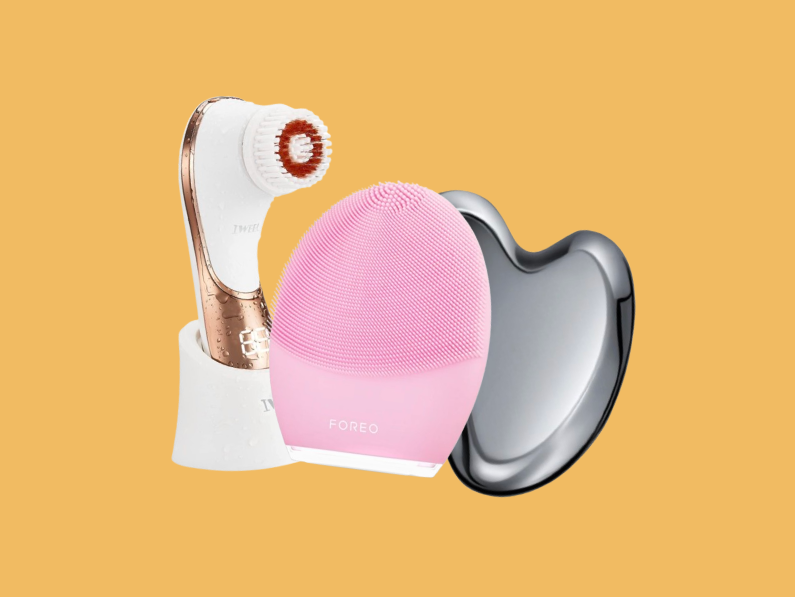
Spring skin transitions are typically framed as aesthetic "upgrades," but a more accurate model views this period as a physiological recalibration. As ambient humidity increases and UV exposure intensifies, the skin’s lipid barrier requirements shift from occlusive protection to accelerated cell turnover and regulated sebum management. Most consumer-facing beauty guides treat tools as luxury accessories; however, an analytical approach categorizes them as mechanical catalysts for three specific biological outcomes: forced desquamation, lymphatic drainage, and transdermal delivery enhancement.
The Tri-Pillar Framework of Mechanical Skincare
To evaluate the utility of any beauty tool, one must measure it against its impact on the skin’s structural integrity. Most tools fall into one of three functional categories, each solving a distinct seasonal bottleneck. For an alternative view, check out: this related article.
1. Controlled Desquamation via Micro-Vibration
During winter, the rate of natural exfoliation—desquamation—often slows due to decreased surface hydration, leading to a buildup of corneocytes. This accumulation creates a dull appearance and blocks the absorption of spring-specific serums. Ultrasonic spatulas and sonic cleansing brushes operate by disrupting the ionic bonds holding dead cells to the stratum corneum.
High-frequency vibrations (typically 24,000 to 30,000 Hz) create a process known as cavitation in the fluid on the skin’s surface. This mechanical energy effectively "blasts" away cellular debris without the erratic abrasiveness of chemical peels or physical scrubs. The primary benefit here is the reduction of surface impedance, allowing the skin to interact more efficiently with the environment. Further insight on the subject has been provided by WebMD.
2. Thermal Modulation and Pore Dynamics
The transition to warmer weather necessitates a focus on pore patency. Cold-press tools and heated massagers are not merely "relaxing"; they are tools for thermal vasodilation and vasoconstriction.
- Heat (Vasodilation): Increases blood flow to the surface, temporarily softening sebum within the follicle. This is the optimal state for extraction or the application of fat-soluble vitamins.
- Cold (Vasoconstriction): Reduces interstitial fluid buildup and constricts the superficial vasculature. This is critical in spring when seasonal allergies often trigger histamine responses, leading to periorbital edema (puffiness).
3. Microcurrent and Muscle Tonality
While topicals address the epidermis and dermis, microcurrent devices target the underlying musculature and cellular energy. These tools deliver low-level electrical currents that mimic the body’s natural bioelectrical signals. The core mechanism is the stimulation of Adenosine Triphosphate (ATP) production. ATP serves as the "energy currency" for cellular repair and collagen synthesis. By increasing ATP levels, microcurrent tools provide a non-invasive method for maintaining structural tension as the skin adjusts to the stress of increased UV exposure.
Quantifying the ROI of Skincare Hardware
A rigorous skincare strategy treats tools as a capital investment. The value of a tool is defined by its ability to increase the efficacy of existing topicals (The Multiplier Effect) versus its cost and the risk of barrier disruption.
The Absorption Multiplier
The bottleneck in any skincare routine is the skin’s natural defense mechanism: the barrier. Most high-molecular-weight ingredients, like hyaluronic acid or certain peptides, struggle to penetrate the lipid bilayer. Tools that utilize iontophoresis (using a voltage gradient to push ionic molecules into the skin) or phonophoresis (using ultrasound to increase permeability) fundamentally change the ROI of expensive serums. Without these tools, a consumer might only see a 10% to 20% utilization rate of active ingredients; with them, the penetration depth and volume increase significantly.
The Cost of Over-Manipulation
A common failure in tool-heavy routines is the "aggression bias." There is a misconception that more mechanical force equals better results. In reality, the skin operates on a U-shaped utility curve.
- Under-stimulation: Leads to congestion and sluggish turnover.
- Optimal stimulation: Triggers the wound-healing response, stimulating collagen without permanent damage.
- Over-stimulation: Causes micro-tears, chronic inflammation, and Post-Inflammatory Hyperpigmentation (PIH).
Spring is a high-risk period for over-stimulation because the skin is already adapting to increased UV. If a mechanical exfoliator is used in tandem with increased sun exposure, the risk of UV-induced damage scales exponentially because the protective "dead" layer has been thinned.
Structural Breakdown of Essential Spring Hardware
LED Photobiomodulation
LED therapy should be viewed through the lens of wavelength-specific biological signaling.
- Red Light (630-700nm): Targets mitochondrial chromophores. This is essential for spring to preemptively strengthen the skin against photo-aging. It signals the fibroblasts to produce collagen, creating a denser dermal matrix.
- Blue Light (405-470nm): Induces singlet oxygen production within P. acnes bacteria. As humidity rises and sebum production increases, blue light acts as a non-chemical antimicrobial stabilizer, preventing the seasonal breakouts associated with heavier perspiration.
The limitation of at-home LED devices is irradiance. Most consumer masks lack the power density (measured in $mW/cm^2$) of clinical panels. To compensate, the duration of use must be strictly managed to reach the "Minimal Effective Dose" required for cellular signaling.
Micro-Needling vs. Nano-Needling
For those seeking deep textural remodeling, the distinction between these two is vital. Micro-needling (0.5mm and above) creates controlled micro-injuries that trigger the Collagen Induction Therapy (CIT) cascade. Nano-needling, conversely, uses silicone tips to create microscopic channels in the stratum corneum without drawing blood.
In a spring context, nano-needling is the superior tactical choice. It provides the "absorption multiplier" for brightening agents (like Vitamin C or Niacinamide) without the long downtime and sun sensitivity associated with deeper needle depths.
The Lymphatic Drainage Mechanism
The "puffiness" associated with seasonal changes is often a result of a sluggish lymphatic system. Unlike the circulatory system, the lymphatic system lacks a central pump. It relies on muscle movement and external pressure.
Manual tools like Gua Sha or specialized facial rollers function as external pumps. The physics of this is simple: by applying directional pressure toward the lymph nodes (located near the ears and clavicle), one facilitates the movement of interstitial fluid. This is not a permanent structural change, but a fluid-dynamic optimization. For the most effective results, these tools should be used at a 15-degree angle to maximize the "stretch" on the skin surface, which opens the initial lymphatic valves.
Logical Integration into a Seasonal Protocol
To transition a skincare routine from winter to spring using tools, one must follow a sequential logic gate:
- Phase One: Reset (Weeks 1-2). Focus on ultrasonic cleansing to remove the "winter coat" of dead cells. This prepares the canvas.
- Phase Two: Stimulate (Weeks 3-4). Introduce microcurrent and LED therapy. This builds the internal cellular energy required for the higher metabolic demands of the skin in warmer weather.
- Phase Three: Protect and Maintain (Ongoing). Shift toward cryo-tools (cold rollers) to manage inflammation from heat and allergens, while using nano-needling once every two weeks to drive antioxidants deep into the dermis.
Identification of Tool Obsolescence
Not all tools provide a measurable benefit. Devices that rely on "suction" for pore cleaning often provide a net negative ROI. The vacuum pressure required to remove a sebaceous filament often exceeds the tensile strength of the local capillaries, leading to telangiectasia (broken capillaries) and bruising. Similarly, tools that do not disclose their specific wavelength (for LED) or frequency (for sonic) should be treated as placeholders rather than functional hardware.
The market is saturated with "vibrating rollers" that provide no more benefit than a manual massage but at a 400% price premium. The analytical consumer must distinguish between haptic feedback (the tool feels like it is working) and biological signaling (the tool is actually changing cellular behavior).
Strategic Implementation
The most effective spring skincare strategy ignores the trend of "maximalism" in favor of "precision intervention."
The first priority is the procurement of a high-quality LED device with a documented irradiance of at least $40mW/cm^2$ to fortify the dermal layers against the impending UV surge of summer. Second, replace aggressive physical scrubs with an ultrasonic spatula to manage the increase in sebum without compromising the lipid barrier. Finally, implement a cold-therapy tool specifically for the morning routine to counteract the vasodilation caused by rising overnight indoor temperatures. This targeted approach treats the skin as a dynamic system that requires mechanical assistance to maintain equilibrium during environmental shifts.