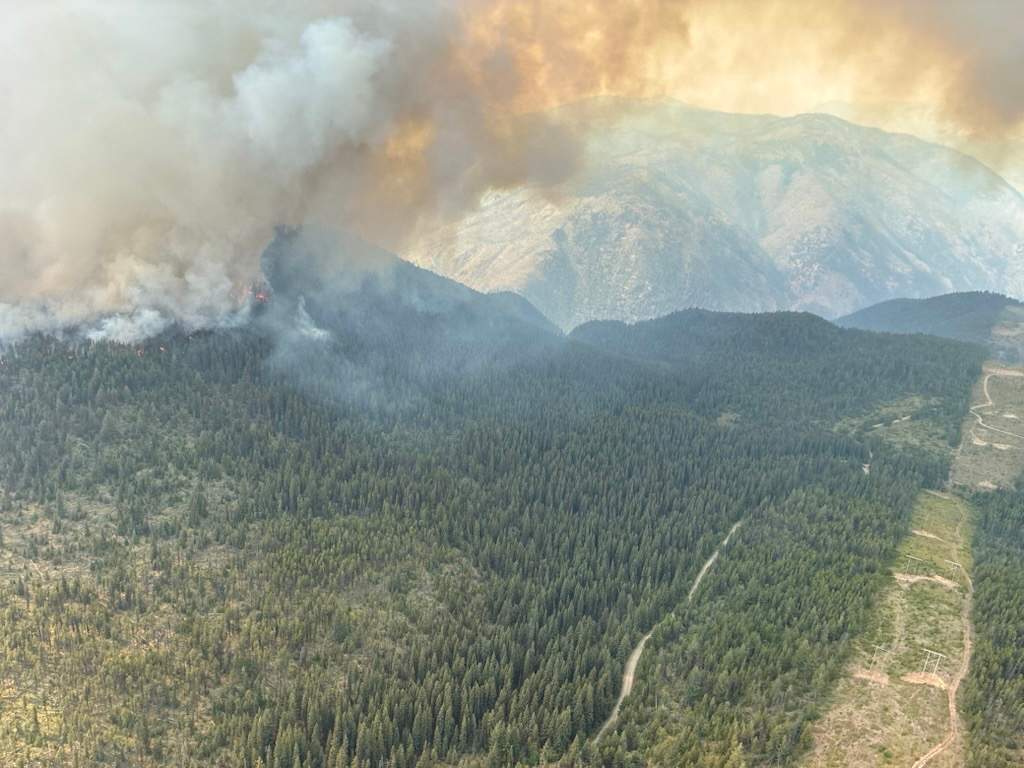
Every summer, the narrative repeats like clockwork. Flames tear through the timber, smoke blankets the valleys, and utility spokespeople line up to point fingers at airborne ash. When the lights flicker across British Columbia, the official line from BC Hydro is simple: microscopic soot particles and smoke create temporary electrical faults on transmission corridors, tripping automated protection relays.
It is a convenient, comforting story. It treats the symptoms of an overstressed macro-system as mere acts of meteorological God.
Blaming wildfire smoke for voltage dips is lazy consensus reporting. It lets infrastructure planners off the hook for decades of deferred hardening, soaring residential demand curves, and an aging high-voltage architecture that was never engineered for continuous climate volatility.
The Smoke Screen Physics
Let us look at the mechanical reality. High-voltage alternating current lines rely on air insulation. When dense plumes of ionized smoke, carbon ash, and particulate matter coat porcelain or composite insulators, the dielectric strength of the air drops. Conductivity spikes. An electric arc forms, causing a temporary phase-to-ground fault.
The utility response is automated. Circuit breakers open to clear the arc, reclose milliseconds later, and restore power. That is what causes your kitchen lights to stutter.
Technically, the utility is correct. Smoke causes the fault. But stopping the analysis there is like blaming gravity for a plane crash because the aircraft hit the ground too fast.
The real question nobody is asking: why are transmission lines across major interior corridors still completely exposed to ambient atmospheric contamination in an era of predictable, multi-month mega-fire seasons?
The Demand Mirage
Utilities are quick to separate smoke-induced flicker from grid capacity constraints. They tell you that peak summer air conditioning loads—which shattered records across the province—have nothing to do with your blinking kitchen bulbs.
That defense collapses under basic systems logic.
Imagine a scenario where a transmission highway is already operating near its thermal and magnetic threshold due to massive regional cooling loads. When smoke introduces micro-faults, the system does not just shrug and reset. It absorbs successive shockwaves of transient current spikes.
An aging transformer or a saturated substation under heavy load handles thermal stress poorly. The cumulative degradation of constant micro-arcs accelerates equipment fatigue exponentially.
When BC Hydro insists that generation capacity remains high thanks to flexible hydro assets, they are talking about total volumetric energy, not localized line stability. Megawatts in a dam a thousand kilometers away do nothing for a sagging 500-kilovolt transmission line choked by particulate matter and carrying maximum current loads to urban heat islands.
The Cost Of Reactive Infrastructure
We have built a grid that waits for failure to justify its engineering. Reclosers and breakers are designed to save equipment from blowing up, not to guarantee continuous operational quality for modern digital economies.
When power dips for three cycles, industrial machinery trips, sensitive server racks take a hit, and home automation systems reboot. Multiply that across tens of thousands of households during a two-month fire season, and the economic friction is massive.
Yet, capital expenditure programs continue to favor sprawling overhead expansions over localized grid autonomy, underground cabling in high-risk zones, and aggressive microgrid decoupling.
What Actually Needs To Happen
If you want to survive the summer energy stutter, stop waiting for the utility PR machine to fix the sky.
First, audit your home power architecture. If your electronics are handling voltage fluctuations with cheap consumer power strips, you are rolling the dice. Invest in double-conversion online Uninterruptible Power Supply units for critical infrastructure. These units isolate your gear entirely from the dirty, flickering reality of the transmission line by rectifying AC to DC and back to clean AC continuously.
Second, reframe how you view grid reliability. The centralized utility model is hitting its biological limit against modern environmental extremes.
Stop accepting that ash in the air gives a multi-billion-dollar Crown corporation a free pass for systemic vulnerability. The flickering lights are not just a minor environmental inconvenience. They are the visible pulse of a grid running on borrowed time.