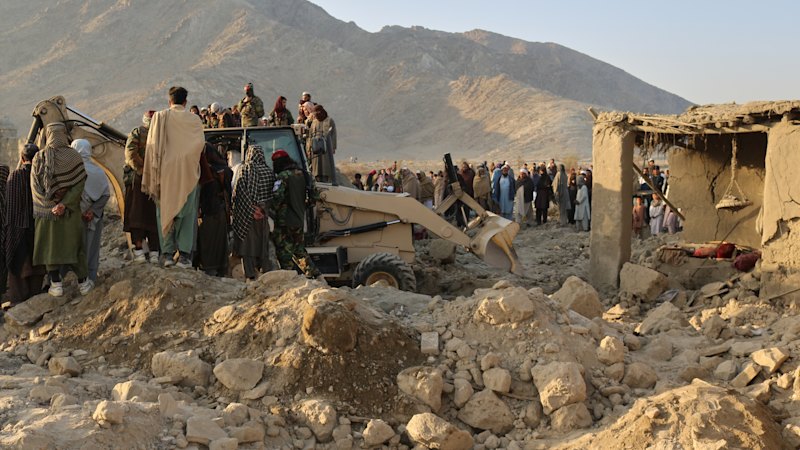
The dust in the Torkham Pass doesn't just settle on your clothes. It gets into your teeth, your lungs, and the very way you perceive the world. For decades, this jagged line through the Hindu Kush was a porous thing—a suggestion rather than a barrier. Families crossed it for weddings. Traders crossed it with rugs and pomegranates. It was a chaotic, breathing artery of the Silk Road.
Now, that artery is being cauterized.
When the Pakistani government recently declared an "open war" against the threats emanating from Afghan soil, the words felt heavy, like stones dropped into a well. But for those living on the jagged edge of the Durand Line, the war hasn't just started. It has been a slow-motion car crash involving two neighbors who can’t stop reaching for each other’s throats even as their houses burn.
The Ghost in the Mountains
To understand why a state would use such scorched-earth language, you have to look at the Tehrik-i-Taliban Pakistan (TTP). They are often called the "Pakistani Taliban," but that title simplifies a terrifyingly complex reality.
Consider a hypothetical shopkeeper in Dera Ismail Khan named Bashir. For Bashir, the "open war" isn't a headline. It is the sound of a motorcycle idling too long outside his storefront. It is the letter delivered at night demanding "protection money" in the name of a holy war. The TTP has spent the last few years migrating from the fringes back into the heart of Pakistan’s northwestern valleys. They didn’t come alone. They brought a renewed sense of audacity, bolstered by the fact that their ideological cousins now sit on the throne in Kabul.
When the Afghan Taliban took power in August 2021, Islamabad cheered. They thought they had finally secured "strategic depth." They believed a friendly government in Kabul would stop the cross-border raids and finally recognize the border.
They were wrong.
Instead of a buffer, Pakistan found a mirror. The Afghan Taliban, despite their historical ties to Pakistani intelligence, have proven to be fiercely nationalistic. They don't recognize the British-drawn Durand Line. More importantly, they have been unwilling—or perhaps unable—to rein in the TTP fighters using their soil as a launchpad.
The Cost of a Broken Handshake
The statistics are sobering, but the stories are worse. In 2023 and 2024, terror attacks in Pakistan spiked to levels not seen in a decade. We are talking about suicide bombings in mosques and sophisticated ambushes on police stations.
The "open war" is Pakistan's admission that diplomacy has failed.
The strategy has shifted from quiet pressure to loud, kinetic action. This includes air strikes inside Afghan territory—a move that would have been unthinkable a few years ago. Imagine the tension of a border guard in the Khyber Pass. He is looking at a man across the fence who speaks his language, shares his faith, and perhaps even shares his lineage. Yet, they are now instructed to see each other as existential threats.
This isn't just about soldiers. It’s about the million-plus Afghan refugees who have lived in Pakistan for generations. In the eyes of a frustrated state, these people have transformed from "brothers in faith" into "security risks." The mass deportations we’ve seen over the last year are the human debris of this falling out.
Imagine being ten years old, born in a dusty suburb of Peshawar. You have never seen Kabul. You don’t know the mountains of Helmand. But suddenly, you are packed into a truck with a few rolled carpets and a cooking pot, sent toward a "home" that is currently enduring a famine and a fundamentalist crackdown. That is the "open war" in its most intimate form.
The Great Betrayal
There is a specific kind of bitterness that only comes from a betrayed friendship. Pakistan spent twenty years navigating a double game, trying to manage the Americans while keeping the Taliban relevant. They gambled that a Taliban victory would bring stability to the border.
The current fighting is the sound of that gamble hitting the floor.
The Afghan Taliban are facing their own internal pressures. They cannot be seen as puppets of the Pakistani state. They are also dealing with their own splinter groups—like IS-K (Islamic State Khorasan)—who look at any cooperation with Pakistan as a sign of weakness. It’s a hall of mirrors, each one reflecting a more radical version of the last.
The "war" is also economic. When Pakistan shuts down the Torkham or Chaman border crossings, it is more than a blockade. It’s a strangulation. Truck drivers who have spent their lives on the Karakoram Highway find themselves stranded for weeks. Their fruit rots in the sun. They are the collateral damage of a high-stakes chess match played by men in climate-controlled rooms in Islamabad and Kabul.
For a driver like our hypothetical friend, Aziz, the border is a living thing. He has seen it change from a handshake to a fence, then from a fence to a wall, and now from a wall to a front line. He doesn’t care about the geopolitics of "strategic depth." He cares about the radiator of his truck and whether he can afford the bribe to get his onions across the line before they turn to mush.
The Invisible Stakes
Why does this matter beyond the Hindu Kush? Because a destabilized Pakistan—a nuclear-armed state—cannot afford a forever war on its western flank. The more the Pakistani military is drawn into these border skirmishes, the more oxygen the TTP gets. The more they fight, the more they find common ground with the very people they are trying to suppress.
This isn't a simple case of "good guys" versus "bad guys." It is a tragedy of proximity.
The history of this region is a cycle of interference. We are watching the latest turn of that wheel. Each time it spins, it grinds down the people underneath. The "open war" is a declaration of desperation, a sign that the old ways of managing the frontier are dead.
When the sun sets over the Torkham Pass, the mountains turn a deep, bruised purple. It is beautiful, until you remember what is buried in those slopes. It is a place where every rock has a memory and every valley has a grudge.
The dust never truly settles.
Instead, it hangs in the air, waiting for the next wind to kick it up again, stinging the eyes of the millions caught in between a border that shouldn't be there and a war that refuses to end.